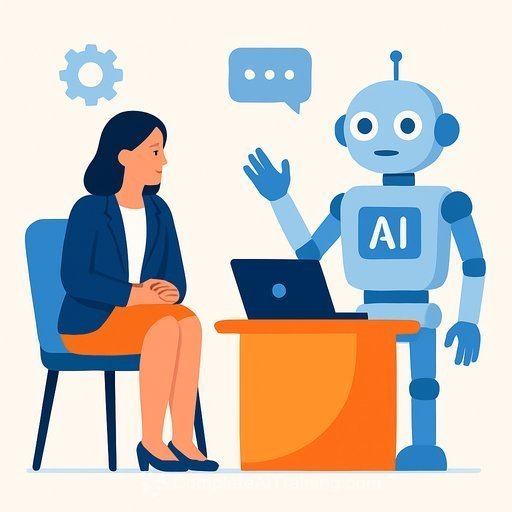
HR's AI Crossroads: From Process Custodian to Business Catalyst
The function most grounded in human judgment is also the most hesitant about AI. That's HR. The concern isn't tech-it's identity. When your value feels tied to process, documents, and gatekeeping, automation hits close to home.
This is the moment to decide what HR becomes next. Not later. Now.
Why HR resists AI
There are three core reasons, and they're uncomfortable to face.
1) AI exposes a capability gap
Many HR leaders were trained for policy and compliance, not for how value is created, how decisions compound, or how systems scale. In executive meetings, AI strategy gets airtime with product, finance, and operations. HR sits quiet. Not excluded-silent.
Silence is expensive. Boards aren't asking if AI will be embedded in work, but how fast. If HR isn't shaping that conversation, it becomes the downstream implementer of decisions it should influence.
2) HR fears replacement, not irrelevance
AI can draft policies, analyze compensation data, answer routine questions, and build presentations in seconds. If that threatens the role, it's worth asking why those tasks defined the role in the first place.
What AI can't do: coach through a moral dilemma, design incentives that change behavior, or sense when a culture is quietly breaking. The point isn't efficiency. It's influence.
3) Companies underestimate real innovation
Some of the most meaningful operational shifts come from HR leaders who understand human systems and redesign how work gets done. Used well, AI increases decision speed, reduces bias, improves accountability, and builds organizations that learn faster.
That's not a "people initiative." That's strategy.
What HR must do right now
Treat AI as a human-systems shift
AI changes how people think, collaborate, and decide. That means trust, transparency, and frequent communication-not a tool rollout. No function is better positioned than HR to lead this transition.
Remove sentimentality from work assessment
Stop protecting tasks with no strategic value: hand-writing policies, manual spreadsheets, staffing inboxes for basic inquiries, hours spent polishing decks. Automate to the edge of safety and quality. The human work starts where automation ends.
Accept HR's leadership future: uncomfortable and essential
This job now demands comfort with ambiguity, the willingness to challenge legacy thinking, and the skill to redesign systems without losing empathy. Psychology drives behavior more than policy. Trade familiar tasks for real influence-or risk becoming irrelevant.
A practical 90-day plan
- Weeks 1-2: Inventory and intent. List major HR workflows. Tag each as Automate, Augment, or Retain. Map the high-impact decisions (hiring, compensation, performance, org design) and who owns them.
- Weeks 3-4: Policy and trust. Draft a simple AI use policy with Legal and Security. Include human-in-the-loop rules, data handling, audit logs, and escalation paths. Communicate it company-wide, then repeat. Consider aligning with EEOC guidance on AI and employment.
- Weeks 5-8: Pilot 3 use cases.
- Talent: AI-assisted screening triage with structured rubrics and human review.
- Compensation: scenario modeling and pay equity scans with analyst validation.
- Employee service: knowledge-base chat for FAQs, with complex cases routed to humans.
- Weeks 9-12: Scale what works. Train managers on decision quality with AI (prompts, verification, bias checks). Shift HRBP time toward coaching, org design, and leadership development. Sunset low-value work.
Metrics that matter
- Decision cycle time for hiring, pay changes, and org moves
- Quality: error rates in offers/payroll; decision reversals
- Fairness: hiring and promotion differentials across groups
- Adoption: % of teams using approved AI workflows
- Time allocation: % of HR time on coaching/strategy vs. admin
- Manager confidence using AI in decisions (pulse surveys)
Guardrails you actually need
- Human review for high-stakes or irreversible calls
- Data governance: minimize PII, strict access controls, retention limits
- Vendor diligence: model provenance, bias testing, audit logs, IP terms-partner with IT leadership (AI Learning Path for CIOs)
- Transparency: tell employees what's automated and why
- Legal alignment with evolving standards; see the NIST AI Risk Management Framework
For CEOs and CFOs
Pull HR into AI strategy as a core owner of decision quality. Fund outcomes, not pilots. Tie budget to the metrics above and review them monthly. For guidance on leadership alignment and board-level strategy, see AI for Executives & Strategy.
For CHROs
Your value isn't templates or decks. It's judgment at scale. Use AI to clear the noise so you can lead the work only humans can do-coaching, culture, incentives, and system design.
Where to upskill fast
If your team needs a structured path to practical AI skills by role, explore Courses by Job. HRBPs and people managers should consider the AI Learning Path for Business Unit Managers. For hands-on credibility, consider an AI Automation certification and build internal playbooks your leaders will actually use.
The bottom line
AI won't erase HR. It will erase HR tasks that never delivered real value. The work that remains is harder, more human, and far more strategic-if you choose it.
Your membership also unlocks: