
AI news ·
From Pilots to Production: Humanoid Robots Go to Work
Microsoft and Hexagon plan to deploy AEON humanoids in real sites, with cloud training and fleet learning. Start small: narrow tasks, clean OT/IT integration, human oversight.
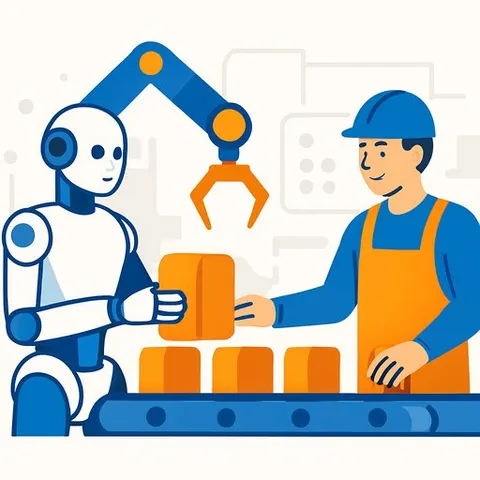
Humanoid AI robots are entering operations
A new partnership between Microsoft and Hexagon Robotics is a signal, not a stunt. Hexagon brings robotics, sensing, and spatial data. Microsoft brings cloud and AI. The goal: deploy AEON, an industrial humanoid robot, at scale in real facilities, not just in demos.
AEON targets factories, logistics hubs, utilities, and inspection-heavy sites where fixed automation hits limits. The work centers on multimodal training, imitation learning, fleet data management, and clean integration with OT and enterprise systems. Sectors under pressure-manufacturing, automotive, aerospace, logistics-stand to benefit first.
Why this matters for Operations
- Retrofit-friendly: Humanoid form factors operate in spaces built for people, avoiding major facility redesigns.
- Coverage for labor gaps: Consistent output in night shifts, peak periods, or repetitive and high-risk tasks.
- Faster iteration: Connected fleets learn from each other; updates push through the cloud instead of on-device rework.
- Safety and compliance: Repeatable inspection, data trails, and controlled autonomy reduce variability.
From demos to disciplined deployments
For years, humanoids lived in research labs. That's changed. Better perception, reinforcement and imitation learning, plus elastic cloud capacity, have moved them into controlled, real-world use.
Agility Robotics' Digit is already trialed in logistics for material handling and short-range transport-often augmenting people rather than replacing them. See more on Digit here: Agility Robotics. Tesla's Optimus is being tested on structured tasks inside its plants, following the same logic: use a human-shaped platform to fit existing workflows and safety rules.
Inspection, maintenance, and high-risk tasks
Early wins are showing up in inspection and maintenance. Boston Dynamics' Atlas has been trialed for industrial inspection and disaster response, handling stairs, uneven ground, and tool use. Toyota Research Institute has explored remote inspection and manipulation with a human-in-the-loop for oversight.
AEON fits this lane. Sensor fusion and spatial intelligence matter more than chat ability when the job is quality checks, utilities maintenance, or tight-tolerance inspection where repeatability and environment awareness are non-negotiable.
Cloud is the backbone, not an accessory
Training, monitoring, and updating humanoids creates a flood of video, force data, maps, and telemetry. Handling that locally is hard to scale. Cloud platforms turn robots into connected endpoints managed like software.
With services such as Azure IoT Operations, you get fleet visibility, shared learning, and consistent behavior across sites. For Ops leaders, treat these systems as enterprise platforms with physical execution, not standalone machines.
Where humanoids fit in your plan
Start with a focused playbook
- Identify 2-3 task families: repetitive material moves, visual inspections, gauge reads, or tool-based checks.
- Score each for risk, variability, takt time, and incident history. Prioritize where human availability is unstable or risk is high.
- Select one site and one process owner. Define success metrics upfront: safety incidents, throughput, first-pass yield, and downtime.
Design for integration from day one
- Design the OT/IT integration: CMMS, MES, WMS, and quality systems need a clean interface. Plan data schemas and event models early.
- Data governance: Set rules for video retention, telemetry ownership, audit trails, and vendor access.
- Cybersecurity: Treat robots as privileged endpoints. Segment networks, enforce zero trust, and test incident response.
Run a 90-day proof of value
- Kickoff: Map the task, hazards, and handoffs. Capture a baseline week of metrics.
- Configure and train: Use imitation learning informed by Research on real workflows. Keep humans in the loop for exceptions.
- Pilot and tune: Weekly reviews with line leaders. Lock in stable routines before adding scope.
- Decision gate: Continue, pause, or scale based on agreed KPIs and operator feedback.
What early deployments are teaching us
- Narrow scope wins. Constrain tasks and environments. Add complexity only after stability.
- People make or break adoption. Give operators clear authority, simple controls, and visible safety boundaries.
- Cloud-first matters. Centralized learning and updates compound value faster than isolated deployments.
- Oversight is required. Keep human supervision for safety, accountability, and regulatory comfort-especially in the first year.
Common pitfalls to avoid
- Chasing general-purpose autonomy before proving a single task with clear ROI.
- Underinvesting in data pipelines, labeling, and MLOps-then wondering why behavior is inconsistent.
- Ignoring cybersecurity and vendor lock-in until after rollout.
- Skipping change management. If line leaders and EHS aren't bought in, the project stalls.
Budget and rollout signals
Start small. One line, one use case, one to two units. Integrate with existing systems, prove the metrics, then scale horizontally to similar sites and processes.
Expect costs to map more to software and services than traditional automation. You'll pay for integration, training data, and cloud operations. That also means faster iteration cycles and fewer sunk costs when you pivot.
The takeaway for Operations
Humanoid robots won't replace your workforce wholesale. But they are already doing real work in logistics, inspection, and structured plant tasks. The question is timing: where can a disciplined deployment stabilize output, reduce incidents, and protect margins this year-not someday.
If you're preparing teams for AI-enabled operations and want a practical curriculum, see our role-based training hub: Complete AI Training - Courses by Job.