Fujitsu's AI Pivot: An HR Playbook for Building a Job-Based, Skills-First Company
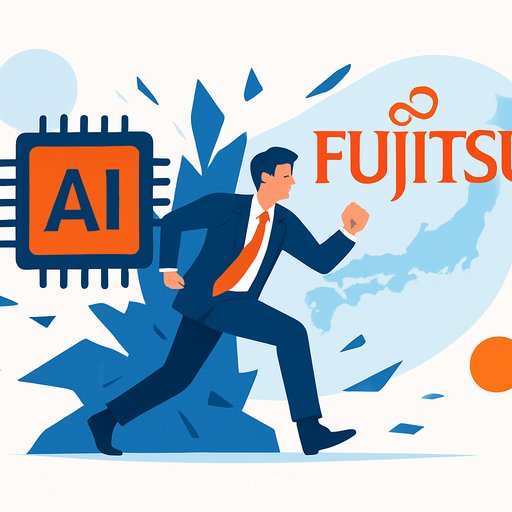
"We have taken the first step toward a society driven by artificial intelligence (AI) under a vision shared with NVIDIA," said Fujitsu CEO Tokita Takahito, standing next to NVIDIA CEO Jensen Huang. That step includes co-developing AI semiconductors that don't just live in data centers - they run "physical AI" in robots, vehicles, drones, and industrial equipment.
Behind the tech is a people strategy. Fujitsu is shifting from custom system integration to standardized AI solutions and platforms. That shift forced a reset of pay, roles, promotions, and how managers work with talent.
From SI to scalable AI solutions
Fujitsu built "Uvance" to move away from labor-based projects and toward repeatable solutions. Instead of billing man-months, they sell verified AI models and platforms aligned to industry challenges and global issues.
The result: Uvance sales hit 482.8 billion yen in FY2025 (April 2024-March 2025), up 31% year over year, and its share of total service solution sales rose from 17% to 21%. The NVIDIA alliance is central here - Fujitsu integrated its Japanese-language LLM "Takane" with NVIDIA's agent development tools to support "physical AI."
Comp and careers without seniority
Fujitsu replaced seniority-based pay with a job-based system. It started with 15,000 managers in 2020 and expanded to all 45,000 employees in 2022. Compensation and rank now depend on the job and market value, not age or tenure.
An internal posting system lets employees apply for roles instead of waiting for assignment. In 2024, about 7,000 people applied and 2,800 moved. There are even cases where second-year employees became managers. The old "what year did you join?" status marker faded fast.
Managers hold monthly one-on-ones focused on performance and career paths; employees averaged 11.7 such meetings in 2023. AI and cybersecurity specialists get market-based premiums tied to objective benchmarks. From 2026, the uniform starting salary for new grads will end, replaced by job-competency pay from day one. To support this, Fujitsu is refining roughly 650 roles.
What HR should copy now
- Build a job architecture that maps to products and platforms. Move from "project roles" to durable roles (platform engineering, model ops, safety, data products, agent QA).
- Adopt skill- and market-based pay. Price critical skills (AI, cybersecurity, data) with premiums and transparent bands. Review quarterly.
- Stand up an internal talent marketplace. Let employees self-apply. Track mobility rate and time-to-fill internal roles.
- Make one-on-ones non-negotiable. Standardize monthly career and performance conversations, not just status updates.
- Codify "career ownership." Promotions and high-impact work go to those who apply and ship outcomes - write it, teach it, repeat it.
- De-risk role changes. Offer short trials, micro-internships, and mentor-backed transitions so junior talent can stretch safely.
- Guardrails for fairness. Audit pay equity, promotion velocity, and internal selection bias by gender, age, and location.
Metrics that matter
- Internal mobility: application rate, move rate, and time-to-productivity post-move.
- Manager quality: cadence and quality of one-on-ones; career-path clarity scores.
- Market alignment: comp-to-market ratio for AI/cyber roles; specialist retention and offer win rate.
- Business shift: revenue share from standardized offerings vs. custom projects; gross margin improvement.
- Global footprint: domestic vs. overseas growth and talent mix by region.
Where the cracks show-and what HR can do
Results aren't instant. Fujitsu's total sales have held around 3.5 trillion yen over five years, with profits moving without a clear uptrend. Domestic service solution revenue grew 8%, but overseas fell 2%. Analysts still question brand clarity and structure.
For HR, the priority is global capability. Build cross-border leadership pipelines, standardize role definitions across regions, and make internal mobility cross-country. Strengthen the employer brand where you're weak, and ensure skills are portable between businesses.
Prepare talent for "physical AI" roles
Physical AI demands hybrid skills: robotics, safety, real-time systems, agent testing, data ops, and field support. Partner with engineering to define role standards and certification paths.
If you need a primer on where the tech is heading, see NVIDIA's robotics platform overview: NVIDIA Isaac. Use it to align job families and training roadmaps.
Upskilling: make it systematic, not optional
- Baseline AI literacy for all managers; deeper tracks for product, data, and security roles.
- Practical training for talent partners on pricing hot skills and structuring premiums.
- Manager playbooks for one-on-ones, internal postings, and skill assessments.
If you're building structured paths, these resources can help: AI courses by job. For practical productivity techniques tailored to AI teams and managers, consider AI Productivity Courses.
Why this matters
Fujitsu shows the real work behind an AI-first strategy: change the business model and refactor the people system to match. The tech story is loud; the HR story decides if it sticks.
Move pay to skills. Open internal mobility. Train managers to coach. Then measure it like a product. That's how a legacy company becomes an AI company without losing itself.
Your membership also unlocks: