
AI news ·
GCC and North Africa take distinct paths to AI adoption in healthcare
MENA healthcare providers are adopting AI on separate tracks: GCC countries building integrated, policy-backed systems while Egypt focuses on high-volume operational tools. Trust and unclear use cases remain the biggest barriers in both regions.
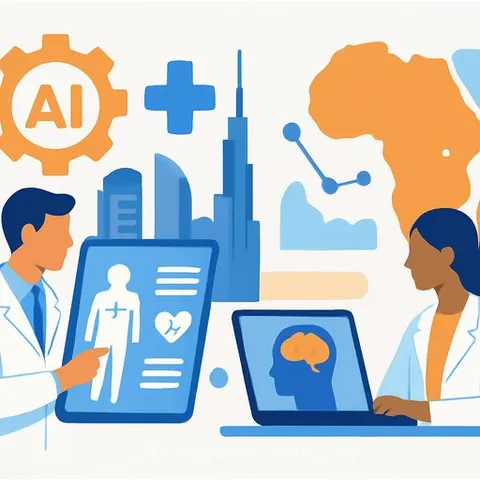
MENA Healthcare Systems Pursue Distinct AI Paths, Shaped by Infrastructure and Scale
Healthcare providers across the Middle East and North Africa are adopting artificial intelligence at different speeds and through different approaches, driven by variations in digital infrastructure, patient populations and operational priorities.
The Gulf Cooperation Council countries-the UAE, Saudi Arabia and Qatar among them-are building integrated AI-enabled healthcare systems supported by digital infrastructure and interoperability frameworks. North African organisations are focusing on practical deployments that address patient volume, workforce constraints and access to care.
GCC: Building Integrated Ecosystems
In the GCC, healthcare providers are experimenting broadly with AI applications. Ahmad Awada, innovations and digital health director at Mediclinic Middle East, said adoption remains in early stages despite widespread piloting.
Ambient AI-systems that support clinicians through real-time documentation and clinical decision support during consultations-is gaining traction. These tools can prompt doctors when something is missed and help standardise clinical decision-making across systems.
Primary care represents a significant opportunity. "If you are able to empower primary care and really scale it up, the benefit is huge," Awada said.
AI is also expanding in radiology and pathology, with systems now capable of analysing scans for multiple conditions simultaneously and identifying patterns associated with future deterioration risk.
The UAE government announced in April a national framework to deploy agentic AI across 50% of government sectors and services within two years, signalling strong policy support.
Health information exchange platforms such as Malaffi and NABIDH are aggregating structured health data at scale, creating opportunities for AI data analysis and predictive modelling. Awada said the region's structured, diverse health data makes it attractive for developing and testing AI solutions.
North Africa: Prioritising Operational Efficiency
In Egypt, healthcare organisations are pursuing a more operationally focused model. Amr Alashkar, chief information officer at Cleopatra Hospitals Group, said his organisation began digital transformation in 2017, creating infrastructure that later enabled targeted AI deployment.
The group has integrated clinical decision support tools for imaging analysis, structured recommendations and faster access to patient histories across connected hospitals. Patient engagement chatbots now account for 5-6% of outpatient bookings, up from 1% when first launched.
North African healthcare organisations continue relying more heavily on their own electronic medical records while broader digital health infrastructure evolves. Yet Egypt's scale creates distinct AI opportunities, particularly in high-volume environments and underserved areas.
Alashkar said AI-supported systems can extend access to higher-quality care in rural areas lacking specialist expertise. "There is the need for a structured approach in diagnosing and treating patients," he said.
Building Capability, Addressing Trust
Both regions are investing in broader innovation ecosystems. The GCC is establishing regulatory sandboxes and interoperability initiatives to attract AI developers, while North Africa is building a startup ecosystem and expanding university programmes in AI, data science and healthcare informatics.
Trust remains a major barrier to wider adoption. "People still trust people more than computers and technology," Alashkar said.
Clinician adoption also presents challenges, particularly when new technologies are perceived as adding complexity rather than reducing workload. Healthcare organisations are still determining how to translate AI-enabled efficiency gains into measurable operational value.
Organisational readiness, cost, infrastructure, data privacy and localisation requirements present ongoing barriers. Defining clear use cases is critical. "AI is a very nice word," Alashkar said. "But how to define the use case … this is very important."
Both experts will present further on MENA's AI for healthcare ecosystem at HIMSS Europe 26, scheduled for 19-21 May 2026 in Copenhagen.