
AI news ·
Healthcare companies need HIPAA-ready architecture before building AI-driven mobile clinical apps
Healthcare mobile apps must treat HIPAA compliance as a foundation, not a last-minute checklist. AI workflows, data access rules, and audit trails need to be built in from the first architecture decision.
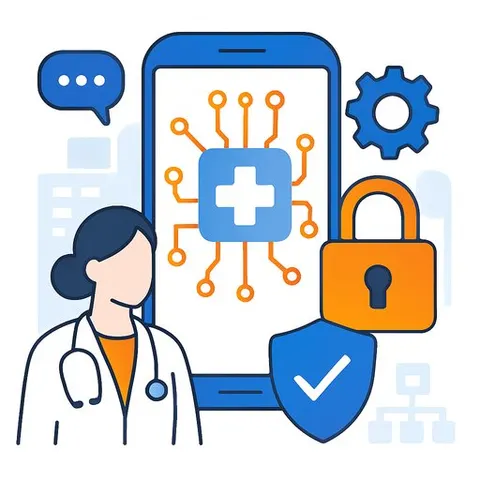
Healthcare Apps Need HIPAA-Ready Architecture From Day One
Healthcare companies building mobile apps now face a harder problem than before. They must improve clinical speed, reduce operational load, and protect sensitive health data across every workflow - all at once.
AI has raised the stakes. A mobile app can no longer be a thin interface over patient data. It must support care teams, automate routine steps, and meet privacy expectations from the first architecture decision.
Engineering and digital platform leaders should treat HIPAA readiness as a product foundation, not a compliance task near launch. That shift changes how teams design data flows, AI workflows, access rules, and release governance.
AI Pilots Are Moving Into Live Clinical Operations
Healthcare organizations have tested AI across intake, documentation, scheduling, triage, claims support, and patient engagement. Many pilots prove value in controlled environments. The real challenge starts when those pilots need to work inside live clinical operations.
A clinical workflow app must handle context. A patient message, provider note, lab update, or care plan task can trigger different actions for different users. AI can support those actions, but it cannot sit outside the system as an isolated feature.
The mobile product must define what the AI can read, what it can suggest, and when a human must approve the next step. It must also record why the system made a recommendation and who acted on it.
Healthcare teams cannot afford unclear ownership. When an AI tool drafts discharge instructions, flags a care gap, or summarizes a visit, the app needs review controls, role-based access, and audit trails.
Custom AI development should start with workflow design before model selection. Healthcare companies need AI that fits care operations, not an AI feature that creates new review burdens.
Architecture Decisions Determine HIPAA Readiness
HIPAA-ready mobile apps need more than encrypted screens and secure login. They need architecture that limits the exposure of electronic protected health information at every layer.
Engineering teams should map data movement first. They need to know where patient data enters the app, where it gets stored, which services process it, which users can access it, and how long the system retains it.
This mapping should guide identity, access control, logging, monitoring, and incident response design. A care coordinator, physician, patient, and billing associate should not have the same visibility or permissions.
Mobile apps also need strict device-level controls: session timeouts, secure token storage, biometric authentication support, encrypted local storage, jailbreak and root detection, and remote logout flows.
AI adds another layer of risk. If a workflow sends patient information to an AI service, the system needs clear controls around input data, output review, retention, logging, and vendor agreements.
The strongest teams design AI Agents & Automation workflows with the minimum necessary data access. They reduce raw data exposure, use approved retrieval sources, and create escalation paths when the AI output lacks confidence.
The Operating Model Matters More Than the App Screen
The main challenge for enterprise healthcare teams is not the app screen. It is the operating model behind the product.
A mobile healthcare app must connect patient experience, clinician experience, compliance, cloud infrastructure, cybersecurity, data engineering, and product delivery. Each team owns a piece of the outcome, but the user sees one product.
This creates delivery friction. Security teams want controls. Product teams want speed. Clinical teams want fewer clicks. Platform teams want reliable integrations. Customer experience teams want higher adoption.
The answer is a shared architecture and governance model. Teams should define core workflows, data classifications, AI permissions, integration patterns, audit events, and release gates before the first major build cycle.
They should also test AI output like product behavior, not research output. That means testing for accuracy, privacy leakage, bias, failure modes, edge cases, and workflow impact.
When leaders align these decisions early, the app becomes easier to scale. Teams reduce rework, shorten security reviews, and avoid redesigning the product after compliance gaps appear.
Five Engineering Partners for HIPAA-Ready Healthcare Apps
GeekyAnts
GeekyAnts provides mobile app development, AI for Healthcare workflow engineering, backend systems, product design, and cloud-aligned delivery. Clutch rating: 4.8 with 113 verified reviews. Address: 315 Montgomery Street, 9th and 10th floors, San Francisco, CA 94104. Phone: +1 845 534 6825. Email: info@geekyants.com. Website: www.geekyants.com/en-us
Vention
Vention works with enterprise teams across mobile products, custom software, AI development, cloud infrastructure, and DevOps. Suits healthcare companies moving from AI pilots into production-grade workflows. Clutch rating: 4.8 with 100 verified reviews. Address: 575 Lexington Avenue, 14th Floor, New York, NY 10022. Phone: +1 718 374 5043
Simform
Simform supports custom software development, mobile app engineering, cloud services, quality engineering, and AI development. Fits healthcare organizations needing co-engineering support for large product roadmaps. Clutch rating: 4.8 with 84 verified reviews. Address: 111 North Orange Avenue, Suite 800, Orlando, FL 32801. Phone: +1 321 237 2727
BlueLabel
BlueLabel focuses on digital product strategy, mobile app development, AI development, product design, and application delivery. Suits healthcare organizations that need early product clarity before full-scale engineering begins. Clutch rating: 4.7 with 69 verified reviews. Address: 18 West 18th Street, New York, NY 10011. Phone: +1 206 651 4244
Zco Corporation
Zco Corporation brings experience across mobile app development, custom software, web development, UX and UI design, and application support. Suits teams that need structured mobile delivery with design and development under one program. Clutch rating: 4.8 with 58 verified reviews. Address: 58 Technology Way, Suite 2W10, Nashua, NH 03060. Phone: +1 603 881 9200
Build for Trust and Speed Together
Healthcare companies will not create HIPAA-ready AI mobile apps through isolated experiments. They need product architecture that connects privacy, security, clinical workflow design, AI governance, and mobile engineering from the start.
The next wave of digital health products will reward teams that build for trust and speed together. Leaders should evaluate each workflow through one lens: whether the app helps users act faster without exposing data, increasing risk, or adding operational noise.
A strong consultation should clarify the workflow, identify compliance gaps, define the AI guardrails, and show the path from product idea to secure production release.