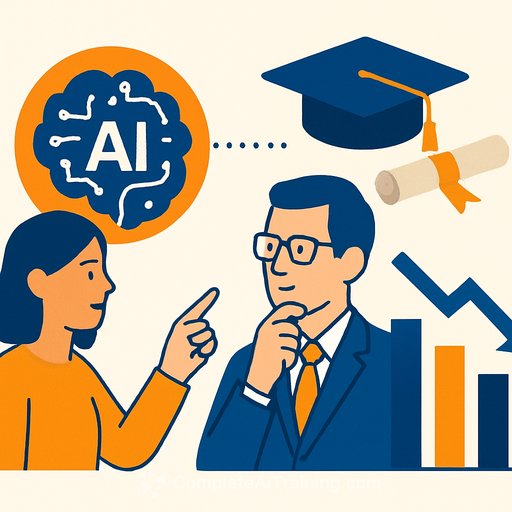
Six Questions on Employment, College Value, and Generative AI
Generative AI is colliding with the job market just as older Gen Z workers are entering their careers. The big questions are simple: What happens to employment, productivity and the payoff of a college degree? Here's a clear read on the signals-and how HR, IT and developers can respond.
1) Will unemployment keep rising?
The pressure looks structural, not just cyclical. Unemployment increases are concentrated among recent graduates and in roles exposed to generative AI, which points to deeper shifts in how work gets done. Monetary policy could ease some strain, but the technology trend will keep pushing on younger and AI-adjacent workers.
2) What did the pandemic change?
Early in the pandemic, demand for digital services surged and tech hiring ran hot. What we're seeing now is part normalization back to historical patterns after an exceptional run. Some of the cooling isn't collapse-it's reversion.
3) Is a college degree losing its near-term employment edge?
Historically, the unemployment gap between college and noncollege workers widens in downturns. This time, despite higher overall unemployment since mid-2023, that gap has stayed closer to zero. Translation: the near-term employment security premium of a degree has thinned.
4) What's driving the decline in the college premium?
Two forces stand out. First, the strong post-pandemic recovery helped narrow the gap. Second, AI and large language models let more people perform research, analysis and creative tasks that used to favor degree holders, which compresses the advantage at the point of hire.
Context matters: college grads still have lower absolute unemployment. But value depends more on field. Roles that lean on interpersonal skill, complex judgment or specialized technical depth hold their ground better than routine cognitive work.
- More resilient: client-facing project management, enterprise sales, compliance, security, data engineering, ML operations, product leadership.
- More exposed: routine analysis, basic copy and asset production, templated reporting, standard research synthesis.
5) Will gen AI boost productivity like past tech waves?
Expect a lag. General-purpose technologies often show up in daily life before they show up in productivity stats. In the computer era, the payoff came after firms rewired processes and workers built complementary skills. Gen AI looks similar: visible benefits now, broad productivity lift later-once workflows and talent catch up.
For context, track official metrics over time: U.S. unemployment rate (BLS) and labor productivity data (BLS).
6) What does history suggest about jobs?
Past technology shifts created new roles even as they disrupted old ones. The computer age birthed entire job families no one anticipated a decade earlier. Gen AI will do the same, but the transition phase can hit unevenly-especially recent grads who invested in skills AI can now perform.
Net: long-run opportunity with near-term friction. The winners will be teams and individuals who adapt faster than their peers.
Practical playbook for HR, IT and development leaders
Leaders can follow an AI Learning Path for Business Unit Managers to structure governance, pilots, and skill programs.
- Audit work at the task level: identify tasks that are routine, repeatable and language-based. Those are first in line for AI assistance or redesign.
- Redesign workflows around AI copilots: move from "doer" to "designer-reviewer." Standardize prompts, checkpoints and review criteria. Consider targeted training such as AI Productivity Courses to scale new practices.
- Update hiring signals: prioritize proof-of-work, speed to learn and AI fluency over pure credential weight. Portfolios beat resumes for exposed roles.
- Run structured pilots: pick 2-3 high-volume processes, baseline metrics, and test AI augmentation with tight feedback loops.
- Measure what matters: cycle time, quality/defect rates, rework, customer NPS, and cost per unit of output-not just hours saved.
- Support early-career talent: build apprenticeships, rotational programs and mentorship to replace the "learning by doing" that AI compresses.
- Governance, not guesswork: set policies on data privacy, model choice, human-in-the-loop review and incident response.
Skill map for workers (especially Gen Z)
- Human advantage: problem framing, stakeholder communication, negotiation, ethics, and domain judgment.
- AI fluency: prompt writing, critique and refinement, retrieval-augmented workflows, and tool chaining.
- Data + automation: SQL, Python basics, spreadsheets-to-API thinking, and workflow automation.
- Proof-of-work: ship demos, repos and case studies that show impact, not intent.
- Career hedges: choose niches with human contact, accountability or safety constraints (e.g., enterprise sales, compliance, security, clinical support).
If you're planning upskilling
Pick learning that ties directly to workflows and business metrics. Focus on AI-assisted research, reporting automation, coding copilots, and data analysis with strong review practices.
- AI Data Analysis Courses to build analytical automation and review skills.
- Map training to specific roles and measurable outcomes-pilot courses on a few teams before scaling.
Bottom line
Generative AI is pressuring entry-level and routine cognitive work, compressing the immediate edge of a degree while raising the bar for complementary skills. Productivity gains will come, but only after process rewiring and skill upgrades. Start small, measure well, and build a culture that learns faster than the change curve.
Your membership also unlocks: