
AI news ·
Global pet insurance market projected to reach $107 billion by 2035 as AI speeds up claims processing
The global pet insurance market will reach $107.1 billion by 2035, up from $25.2 billion today. AI claims processing is a key driver, cutting approval times by 70% and reducing fraud by over 35%.
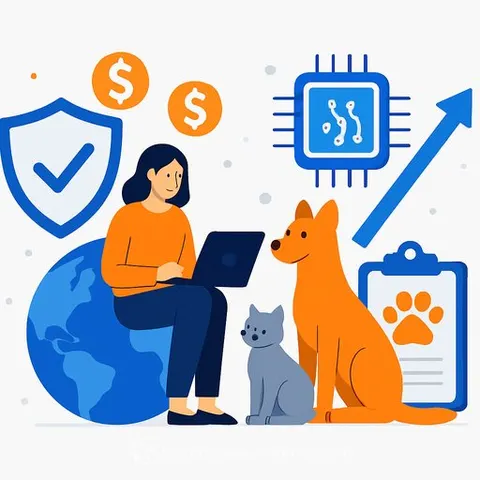
Pet Insurance Market to Hit $107 Billion by 2035 as AI Speeds Up Claims
The global pet insurance market will grow to $107.1 billion by 2035, expanding at 17.4% annually from its current $25.2 billion, according to market research from Dimension Market Research. The surge is being driven by artificial intelligence systems that process claims in days instead of weeks.
Machine learning algorithms now scan veterinary records, flag billing errors, and approve legitimate claims with minimal human review. Insurers using AI-powered claims platforms have cut processing times by up to 70% while reducing fraudulent claims by over 35%.
Where the Market is Concentrated
North America controls 40.9% of the global market, with the U.S. alone valued at $8.7 billion in 2026. The region's dominance stems from higher pet healthcare spending, mature digital infrastructure, and established veterinary networks.
Asia-Pacific is growing fastest. China, India, and Japan are investing in digital insurance infrastructure and automated claims analysis. Japan's market alone is projected to reach $860.2 million in 2026.
Europe represents a mature market valued at $7.6 billion in 2026, growing at 15.8% annually. Germany, France, and the UK are leading adoption of digital pet health initiatives.
What Pet Owners Are Buying
- Accident and Illness coverage dominates with 62.3% market share, covering emergencies, surgeries, and chronic conditions
- Wellness add-ons are the fastest-growing segment as owners prioritize preventive care
- Dogs account for 73.2% of insured pets, driven by higher veterinary costs and owner preference
How Pet Insurance is Being Sold
Direct-to-consumer channels lead with 41.7% share, powered by online comparison tools and mobile apps. Insurance agents remain the second-largest channel, while bancassurance-banks adding pet insurance to existing products-is growing fastest.
Private insurers control 78.4% of the market. They offer more flexible policies, faster claims processing, and broader veterinary networks than public providers.
The Shift From Reactive to Predictive
Pet insurance is moving beyond simple reimbursement. Insurers now use predictive analytics to identify health risks before they become expensive problems, monitor chronic conditions in real time, and validate treatments before services are rendered.
This creates a competitive divide. AI-native insurers are pulling ahead of traditional providers still relying on manual claims review.
What's Holding Growth Back
System integration costs remain high. Deploying new platforms requires significant investment in testing, compliance with data privacy laws like GDPR, and alignment with veterinary workflows. This limits adoption among smaller insurers and new entrants.
Fragmentation across veterinary and insurance systems persists. Many insurers still use hybrid digital and manual processes, creating inefficiencies in claims processing and limiting interoperability between providers and insurers.
Where Opportunities Exist
Emerging markets in Brazil, Indonesia, Nigeria, the UAE, and Vietnam have few legacy insurance systems. New technology-driven platforms can scale quickly in these regions without competing against established players.
Cloud-based infrastructure is in demand. Remote veterinary care, distributed pet health networks, and real-time claims processing are driving adoption of cloud systems that centralize data access and speed policy administration.
Major Players and Recent Moves
Trupanion, Nationwide, Lemonade, MetLife, Progressive, and Chubb dominate the market. Recent developments include Nationwide launching customizable chronic and hereditary condition coverage in January 2026 and MetLife expanding into employer supplemental benefits through a partnership with Combined Insurance.
What This Means for Insurance Professionals
Pet owners now expect real-time claims, transparent pricing, and seamless integration between veterinary clinics and insurers. Providers without AI for Insurance capabilities, cloud-based policy management, or AI Agents & Automation will lose market share to more agile competitors.
The next three years will determine which insurers capture leadership in the $107 billion market. Early adopters of automated claims validation, predictive health analytics, and direct-to-consumer platforms have a significant first-mover advantage across North America, Europe, and Asia-Pacific.