Google, Microsoft and xAI agree to U.S. government review of advanced AI systems
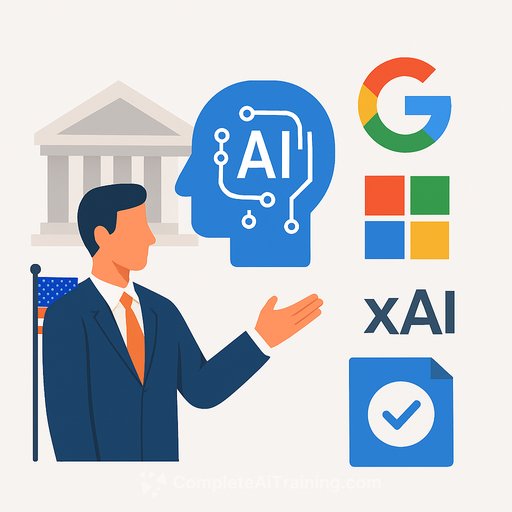
Google, Microsoft and Elon Musk's xAI have agreed to allow the U.S. government early access to review advanced AI systems before public release. The arrangement marks a significant shift in how governments interact with private AI developers and has triggered debate over safety, innovation and national security.
Under the agreement, federal authorities can assess AI models for potential threats including misinformation, cyberattacks, deepfakes and autonomous weapons risks. The government gains visibility into highly advanced systems without taking direct control of company products.
Why this matters for your work
AI is no longer treated as a commercial sector. Policymakers now view it as strategic infrastructure comparable to nuclear technology or aerospace systems. That classification changes how development, deployment and infrastructure decisions get made.
For IT and development teams, this means:
- Safety testing and security audits will become standard requirements before model deployment
- Licensing or certification frameworks may eventually govern advanced AI system development
- Transparency documentation about model capabilities and limitations will likely increase
- Compliance overhead could slow feature releases, particularly for startups
The companies involved face pressure to demonstrate responsibility. Microsoft's partnership with OpenAI makes its involvement especially significant, given ChatGPT's role in triggering the recent AI boom.
The competing concerns
Supporters of government oversight argue that AI systems are becoming too powerful to deploy without safeguards. Safety researchers compare current development to building aircraft while flying them, warning that companies are moving faster than they understand the consequences.
Critics worry that government involvement could slow innovation, increase censorship risks and hand regulatory advantages to large corporations over smaller competitors. They also question whether governments themselves can be trusted with access to advanced AI systems.
What comes next
The U.S. arrangement may become a template for other countries. The European Union is already implementing strict AI rules through its AI Act. The United Kingdom, Canada and several Asian nations are developing their own governance frameworks.
International cooperation remains uncertain. The U.S., China and EU are competing for AI dominance, and different regulatory models could fragment the global AI ecosystem. Some experts believe future international treaties-similar to nuclear non-proliferation agreements-may eventually be necessary.
Possible developments include mandatory safety testing, government licensing systems, emergency shutdown procedures and cross-border data standards.
Privacy and surveillance questions
Government oversight creates new privacy concerns. AI systems require enormous amounts of training data, and expanded government access raises questions about surveillance scope and data protection.
Who controls training data, which conversations get monitored and whether personal information faces deeper analysis remain unresolved. Technology companies insist they prioritize privacy, but skepticism about future oversight systems persists.
The infrastructure angle
For development teams, understand that AI infrastructure-cloud computing, semiconductors, data centers-is becoming as strategically important as the models themselves. Companies building or managing this infrastructure will face increased scrutiny.
Regulatory frameworks will likely require stronger cybersecurity standards, transparency reports and monitoring systems. Smaller teams may struggle with compliance costs that larger organizations absorb more easily.
The agreement signals that AI development is entering a new phase. Decisions made in the next few years about oversight, regulation and deployment will affect not just technology companies but geopolitical power distribution and how digital infrastructure operates globally.
For professionals in IT and development, staying informed about emerging governance frameworks-and how they affect infrastructure, security and deployment timelines-is now essential.
Learn more about how these systems work with Generative AI and LLM Courses and explore AI for IT & Development to understand implementation patterns in regulated environments.
Your membership also unlocks: