
AI news ·
Graduates boo AI optimism at commencements as blue-collar trades jobs go unfilled
Construction trades face a shortage of 350,000+ workers this year as AI data centers and new factories drive demand. While college grads fear job losses, skilled tradespeople are building the infrastructure that makes AI possible.
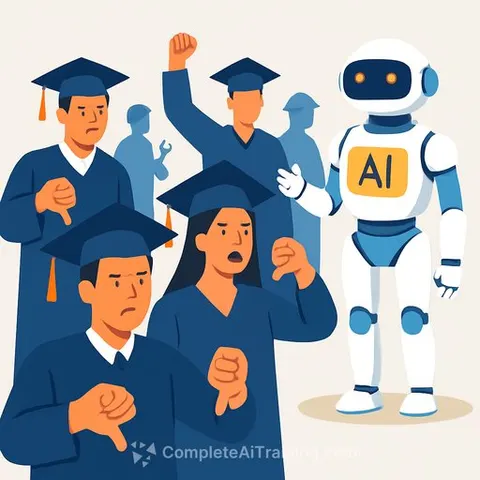
College Grads Fear AI Job Losses. Blue-Collar Trades Tell a Different Story.
Students at major universities booed commencement speakers last month over warnings about artificial intelligence. At the University of Arizona, former Google CEO Eric Schmidt faced disapproval when he told graduates that AI would shape the world. The same reaction greeted a real estate executive at the University of Central Florida, where students booed mentions of AI capabilities and the coming industrial revolution.
The backlash reflects genuine anxiety. College graduates worry about mass job displacement from AI. But the construction and trades sectors are experiencing the opposite trend: labor shortages and expanding opportunity.
New Jobs Built on AI Infrastructure
AI data centers are massive physical structures that power the technology. These facilities are emerging across the country, and construction workers are building them. This is not theoretical work - it's happening now and scaling rapidly.
Beyond data centers, the technology requires entirely new manufacturing bases to produce specialized hardware. That means new factories, new supply chains, and new demand for skilled trades workers. Companies like Home Depot and BlackRock have invested hundreds of millions in training plumbers, carpenters, and electricians, signaling confidence in this sector.
Labor estimates show the construction industry needs over 350,000 new workers this year alone, with hundreds of thousands more required by decade's end.
Modernization, Not Elimination
AI doesn't automatically eliminate jobs. When the technology handles one aspect of a job more efficiently, the entire job often becomes more productive rather than obsolete.
Construction and manufacturing are seeing concrete benefits. AI-driven data analysis identifies safety risks and sends real-time alerts to workers, reducing injuries. Automated compliance tools reduce paperwork burden - a significant cost in construction - allowing companies to work faster and pass savings to clients.
Safety improvements also matter for recruitment. Safer job sites attract new workers, including women and other underrepresented groups in the trades.
Training Is the Missing Piece
The gap between AI opportunity and worker readiness is real. Affordable education and training for blue-collar workers is as critical as the technology itself.
Major employers are already moving. They recognize that AI is here to stay and that skilled trades workers are essential to building the infrastructure that makes AI possible.
For construction and real estate professionals, the message is clear: the sector is growing, not shrinking. The question is whether workers will develop the skills to meet the demand.
Learn more about AI for Real Estate & Construction, or explore how AI Agents & Automation are changing construction workflows.