
AI news ·
Health insurers deploy AI to detect synthetic fraud
AI is accelerating health insurance fraud via fake records and synthetic voices. A federal takedown charged 324 defendants tied to $14.6 billion in intended losses.
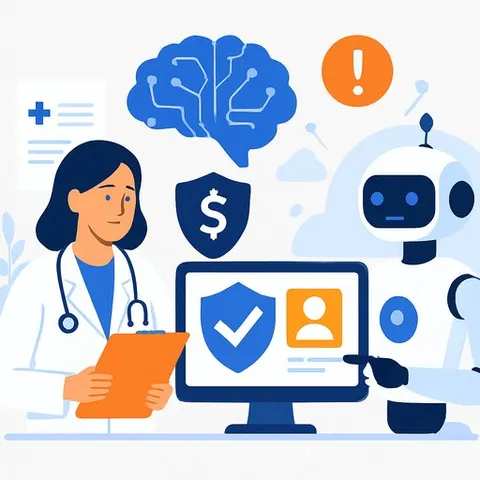
Artificial intelligence is making health insurance fraud faster, cheaper and markedly harder to detect, enabling criminals to fabricate medical records, impersonate patients and physicians, and flood call centers with synthetic voices at a scale that was impossible a few years ago. The June 2025 National Health Care Fraud Takedown, the largest in U.S. history, charged 324 defendants across 50 federal districts for schemes involving more than $14.6 billion in intended losses - and AI-generated evidence had already surfaced in the indictments.
Two executives of Pakistani marketing companies were charged with using AI to generate fake recordings of Medicare beneficiaries consenting to receive products, which they sold alongside stolen patient data to support approximately $703 million in fraudulent Medicare claims. The case signals how quickly AI has moved from theoretical threat to active weapon.
Up to $480 billion is lost each year to healthcare fraud, according to the National Health Care Anti-Fraud Association. The Coalition Against Insurance Fraud places annual healthcare fraud losses at roughly $105 billion. Recovering those funds is rare - criminal investigations remain the primary route, and returns are often cents on the dollar.
What AI-enabled fraud looks like
The National Health Care Anti-Fraud Association outlines multiple attack vectors: falsified medical records, synthetic patient identities, physician impersonation, and automated scanning of coverage policies for exploitable gaps. The scale is what makes this generation of fraud uniquely dangerous. "We believed AI was something that was going to be leveraged against us as an insurance industry for fraud, and now we're starting to see that," said Kurt Spear, vice president of financial investigation and provider review at Highmark.
At the call center, the volume of automated fraud attempts is climbing sharply. Jason Barr, vice president of healthcare for voice authentication firm Pindrop, said some insurers have seen 15,000 bot calls in just a couple of months. Pindrop's system analyzes voice, cadence, and device signals to determine whether the caller is human. The synthetic voices have improved so much that they now change accents mid-call or mimic the agent's voice - behavior that was obviously artificial two years ago.
Deepfake medical imaging is an emerging front. Highmark is deploying a tool that detects anomalies in medical images at the pixel level, acknowledging that the human eye is no longer sufficient. A 2026 study in Radiology found radiologists could correctly distinguish real X-rays from deepfakes only 75% of the time. Written documentation is also under attack. Researchers at the University at Buffalo have built a detector for AI-generated radiology reports, noting that large language models tend toward polished, elaborate phrasing while clinicians write in concise clinical shorthand.
The government response
Federal agencies are shifting from "pay and chase" to a detect and deploy strategy, using AI to flag suspicious billing before payments go out. The DOJ's Health Care Fraud Data Fusion Center, announced as part of the 2025 takedown, brings together the Health Care Fraud Unit, FBI, HHS-OIG, and others to apply cloud computing and advanced analytics against evolving schemes. False Claims Act recoveries hit a record $6.8 billion in 2025, with healthcare accounting for 84% of that total. The DOJ has also made clear that AI-enabled provider documentation - including AI-driven chart reviews and retrospective coding - will face increasing scrutiny and could create False Claims Act liability.
What this means for insurers
An 87% jump in insurance AI deployments in 2025 has not reduced fraud losses, suggesting that detection investments are still trailing the sophistication of attacks. Carriers with advanced detection systems report measurably better outcomes, but the gap between leaders and laggards is widening.
For carriers that are behind, the immediate priorities are clear. Voice authentication at the call center is the most urgent gap to close given the documented bot call activity. Imaging verification tools and AI-generated documentation detection need to be built into claims workflows, not applied after the fact. And the DOJ's focus on AI-assisted clinical records means carriers must reassess how they handle those records on intake - not just as a fraud detection problem, but as a potential liability exposure if controls are later found inadequate in a False Claims Act investigation.
The policyholder remains a critical defense. "Some of the best referrals come from members," Spear said. When a patient receives a statement for care they never received, that is often the earliest signal that something is wrong.
Why this matters for insurance professionals
AI is lowering the barriers to large-scale fraud at the same time that regulators are raising the stakes for detection and documentation practices. Insurers that do not integrate voice authentication, imaging verification, and AI-generated content detection into real-time claims processing will find themselves not only absorbing higher losses but also facing greater legal exposure. The front-line claim and call center teams, along with investigative units, need to adapt workflows now, because the fraudsters are already using AI to automate their side of the equation.