
AI news ·
Health systems focus AI investments on administrative tasks while virtual care usage rises amid financial losses
Health systems spend 2x to 3x more on AI than other sectors, mostly funding admin tasks over patient care. Rising virtual visits also fail to break even for many providers.
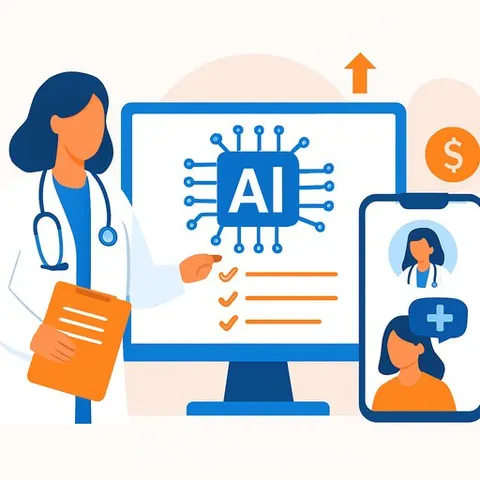
Healthcare organizations are spending two to three times more on AI than other industries, but the investment is largely channeled into administrative workflows rather than direct patient care improvement. Meanwhile, virtual care utilization continues to rise even as many health systems lose money on digital service lines, creating a financial squeeze that technology alone has not resolved.
Reporting from the HIMSS AI in Healthcare Forum in Boston, described by Healthcare IT News, highlighted the disconnect between spending and results. Leaders from UMass Memorial Health and Stanford Healthcare said most providers are pointing AI at scheduling, prior authorization, clinical documentation, and other back-office functions. Those areas deliver efficiency gains, yet they fall short of the technology's potential to change patient outcomes.
The automation trap
Distinguishing between automating a task and redesigning a care process matters more than it might appear. Automating prior authorization saves staff time. Rebuilding a care pathway with AI-assisted decision support can alter whether a patient deteriorates before a clinician intervenes. Experts at the HIMSS forum argued health systems need to pursue the second category with the same urgency they have brought to the first.
Clinical AI demands clinician buy-in, and trust remains a steep barrier. Jay Anders of Medicomp Systems addressed the skepticism in a separate Healthcare IT News interview. "The concern is not simply that AI might be wrong," Anders said. "It is that clinicians often cannot see why AI reached a particular conclusion, making it difficult to know when to trust the output and when to override it." That opacity has turned transparency in AI reasoning from a philosophical preference into a practical deployment requirement as health systems push AI closer to the point of care.
Pilots that don't scale
A related pattern is surfacing globally. Eric Wong, chief digital health officer at NHG Health in Singapore, told Healthcare IT News that organizations frequently launch AI pilots without first identifying the specific problems those pilots are meant to solve. The result is a graveyard of proofs of concept that show technical feasibility but never reach production.
Wong's observation points to a discipline problem as much as a technology gap. Health systems that make AI work at scale tend to start with the clinical or operational question and work backward to the tool, rather than chasing a new technology and hunting for a use case to justify it. As health systems pour resources into AI for Healthcare, the gap between spending and clinical returns is widening for those that skip this discipline.
Virtual care's financial gap
Virtual care utilization is rising in 2026, but many health systems are bleeding money on digital services. More patients use telehealth and remote monitoring. Fewer health systems break even on those services. The gap between utilization growth and financial sustainability reflects structural problems that technology alone cannot fix.
Reimbursement rates for virtual services in many markets still do not cover the real cost of running a digital care operation. Infrastructure, platform licensing, care coordination, and clinician time add up faster than fee schedules have adjusted. For health system executives, virtual care strategy in 2026 is as much a financial engineering challenge as a technology deployment one. Systems that have found a path to profitability typically integrate virtual care tightly with in-person workflows, using digital touchpoints to reduce avoidable high-cost encounters rather than treating telehealth as a standalone revenue line.
Revenue cycle management shows near-term wins
One area where AI is delivering concrete financial results is revenue cycle management. At First Choice Neurology, Dr. Ernesto Alonso described AI reducing cognitive burden for clinical staff while accelerating collections. The direct link between documentation quality, coding accuracy, and revenue capture means AI improvements show up in financial performance relatively quickly.
That makes revenue cycle among the more mature AI use cases in healthcare, even if it falls squarely in the automation category that experts say should not be the final goal. For many organizations, it serves as the entry point that builds internal confidence and technical infrastructure for more ambitious clinical applications. This impact on financial outcomes highlights the value of targeted skill-building, such as an AI Learning Path for Medical Billers that helps revenue teams stay current with evolving tools.
What comes next
The HIMSS forum conversations and virtual care financial data together signal a consolidation phase in healthcare's digital transformation. Organizations that deployed broadly over the past several years are under pressure to show their investments produce outcomes, not just activity metrics. On the AI side, that pressure is steering the discussion toward governance, clinician adoption, and measurable clinical impact. On the virtual care side, it is pushing toward integration and reimbursement strategy.
The CDC is also moving in parallel. Matthew Ritchey of its Office of Public Health Data, Surveillance and Technology outlined plans for a secure public health data ecosystem designed to give clinicians and local agencies more timely, actionable information. That infrastructure, if it develops as described, would give health system AI tools better data to work with at the population level.
Why this matters for healthcare professionals
Healthcare executives and clinical leaders face a clear fork: continue channeling AI investment into administrative automation that cuts costs but does not reposition care delivery, or redirect resources toward clinical AI that requires building trust, infrastructure, and outcome measurement from the ground up. Virtual care's growing usage without financial stability forces teams to redesign workflows and reimbursement models rather than simply scale digital visits. For clinicians, the transparency of AI reasoning will determine whether these tools become trusted partners or just another screen to ignore. The organizations that connect AI to specific clinical problems and integrate virtual care into core operations will be the ones that exit this consolidation phase with durable results.