
AI news ·
Health systems stall on AI scaling as workforce readiness lags behind deployment
Most health systems have AI tools running but remain stuck in pilots. The bottleneck isn't budget or vendors-it's staff who aren't prepared to use the tools safely and consistently.
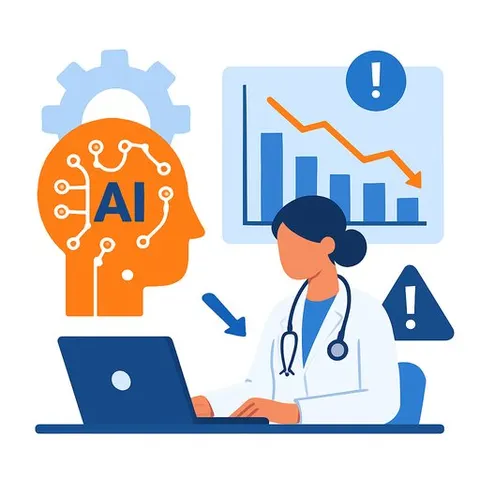
Health Systems Can't Scale AI Without Prepared Staff
Health systems are no longer debating whether to adopt AI. At HIMSS26, the conversation shifted to a harder question: why isn't it scaling?
Ambient documentation tools are live. Revenue cycle automation is running. Clinical decision support is deployed. Yet many organizations remain stuck in pilot phases, unable to move from controlled experiments into operational infrastructure.
The usual suspects-vendor immaturity, interoperability gaps, budget constraints-don't fully explain it. Some of the best-resourced systems in the country are stuck alongside community hospitals with a fraction of the budget. The real bottleneck is people.
The Training Checkbox Problem
Most health systems deployed AI as a technology initiative and treated workforce readiness as a training checkbox. They bought a tool, built a training module, tracked completions, and reported the number to leadership.
For AI, that model breaks down. Capabilities change too quickly for point-in-time training to keep up. A module built in January can be outdated by March-not because the content was wrong, but because the tool has new capabilities, new risks, and new workflow implications.
Completion rates don't measure readiness. They measure who sat through content. They don't tell you whether a radiologist is verifying AI-flagged findings before acting, whether a revenue cycle analyst is catching AI-generated coding errors, or whether a clinician is using an approved tool instead of bypassing it for an unapproved consumer app.
That last scenario-shadow AI-is where the readiness gap becomes most dangerous. When staff don't feel confident using approved tools, they find workarounds. In healthcare, those workarounds can involve patient data, and organizations often discover them only after something goes wrong.
What Readiness as Infrastructure Looks Like
Organizations moving past pilots share four traits.
- Readiness is continuous, not episodic. When a tool changes, staff get guidance in the flow of work-not months later in an annual refresher.
- Readiness is role-specific, not generic. A nurse using ambient documentation faces different decisions than a coder using AI-assisted charge capture. Generic AI awareness training serves neither well.
- Readiness is measurable at the behavior level. Completion rates are input metrics. The better question is whether staff are using approved tools, following verification protocols, and escalating when outputs look wrong.
- Readiness is auditable. Under regulatory scrutiny, organizations may need to show that workforce preparation translated into practice and was maintained over time. That requires evidence.
The Challenge for Smaller Systems
This issue hits community hospitals especially hard. A 200-bed hospital may not have a dedicated AI governance team or a chief AI officer. It depends on an EHR vendor's roadmap and whatever training materials ship with the product.
But that hospital still deploys AI into workflows that carry real regulatory and operational exposure. The compliance standard doesn't shrink just because the org chart does.
For smaller systems, readiness infrastructure has to be low-overhead and scalable. It has to adapt as tools change, reach people where they already work, and produce the behavioral evidence governance requires. Otherwise, organizations are left hoping a one-time training session was enough-and finding out only after a failure.
The Test That Matters
If you want to know whether your organization is ready to move AI out of pilot, ask one question: Can you produce evidence right now that the people using AI in clinical and administrative workflows are demonstrably prepared, and that their preparation is being maintained as the technology changes?
If the answer is a training completion report, you haven't moved past the checkbox. You've checked it. Health systems scaling AI built a system instead.
AI will continue to get faster and more embedded in care delivery and operations. The workforce readiness gap won't close on its own. It closes when organizations decide that preparing people is as important as deploying the technology-and build the infrastructure to prove it.
For healthcare professionals looking to stay current with AI tools in your role, AI for Healthcare and AI Productivity Courses offer structured approaches to continuous skill development.