
AI news ·
NC Republicans push bill to stop AI from being sole decision-maker on health insurance claims
North Carolina Republicans are pushing a bill to ban AI from being the sole basis for denying health insurance claims or inflating hospital billing codes. House Bill 565 would require a human review before any such AI-driven decision takes effect.
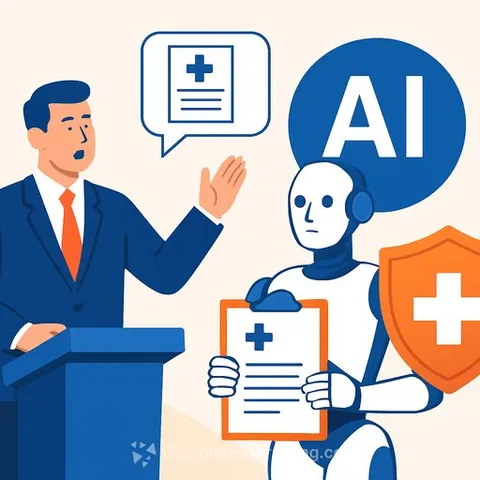
North Carolina Lawmakers Propose Limits on AI in Insurance Claims and Hospital Billing
North Carolina Republicans are advancing legislation that would restrict how artificial intelligence can be used to deny health insurance claims and prior authorization requests. House Bill 565 would require human review before insurers or hospitals use AI to make those decisions.
"We do not want robots or computers to deny care to sick people," said state Sen. Amy Galey, R-Alamance, during a committee meeting.
The bill targets two specific problems. First, it blocks insurers from using AI as the sole basis for claim denials. Second, it prevents hospitals from using AI to inflate billing through a practice called upcoding - assigning higher-severity diagnosis codes to justify bigger payments.
How AI Can Accidentally Drive Up Costs
Healthcare providers use thousands of specific billing codes to describe treatments and diagnoses. Higher codes generate higher reimbursements from insurers and government programs. When done intentionally, upcoding is fraud. But AI systems can unintentionally push toward more expensive codes if no one reviews their recommendations.
Alessandra Bazzano, a professor at UNC Gillings School of Public Health, said the problem is structural. "If there's a reimbursement algorithm that rewards severity or intensity, those AI tools might accelerate pressure toward doing that kind of higher coding," she said.
Under House Bill 565, providers cannot use AI to generate billing codes without a treating provider reviewing the documentation first to confirm it matches the patient's medical record.
The Equity Problem
A 2019 study in the journal Science revealed how AI algorithms can embed historical inequities. A widely used healthcare algorithm treated Black patients as healthier than equally sick white patients.
The algorithm didn't predict who was actually sickest - it predicted who would generate the highest future healthcare costs. Because the healthcare system historically spends less on Black patients, the algorithm learned to associate lower spending with lower medical need.
When researchers changed the algorithm to measure actual health conditions instead of spending patterns, racial bias largely disappeared and more Black patients qualified for additional care.
Broader National Trend
Most health insurers already use AI for claim authorization and fraud detection, according to the National Association of Insurance Commissioners. Academic researchers generally recommend that insurers require human review of AI-assisted decisions, maintain transparency about how algorithms work, and keep audit trails of what AI recommended and who approved it.
Kandyce Brennan, co-chair of the AI task force at the UNC School of Nursing, said transparency is essential. "Without that transparency, it's hard to know whether AI is supporting better decision-making or simply automating denials, increasing costs, or reinforcing existing inequities," she said.
Healthcare Industry Pushback
The North Carolina Healthcare Association, which represents hospitals, expressed concern that the bill could limit beneficial uses of AI. "We are concerned the bill could limit healthcare providers' ability to use this technology in ways that support patient care and workforce needs," the association said.
Some Democratic lawmakers also raised practical questions. Sen. Gale Adcock, a nurse practitioner, noted that upcoding is already prohibited under existing law and said the proposal needs revisions. "I think this bill needs a great deal of work on it to achieve the balance we're looking for, and also the ability to enforce it," Adcock said.
The legislation reflects a national push to ensure humans stay involved in insurance and billing decisions as AI expands through healthcare systems. America's Health Insurance Plans, a trade group representing insurers, has said AI tools should augment human work rather than replace it entirely.
The Broader Context
North Carolina is simultaneously investing heavily in AI research tied to healthcare. NCInnovation, a public-private partnership focused on commercializing university research, has committed more than $19 million toward AI and healthcare projects, including AI-assisted maternal ultrasounds at UNC-Chapel Hill and virtual reality nurse training at Winston-Salem State University.
Republican lawmakers have said North Carolina has among the highest healthcare costs in the nation. This bill is one of several proposals aimed at controlling those costs, though previous efforts to repeal certificate-of-need laws and increase billing transparency have failed against industry lobbying.
For healthcare professionals, the debate underscores a core tension: AI can improve efficiency and catch fraud, but without guardrails and human oversight, it can also automate bias and drive up costs. The question lawmakers are wrestling with is how to preserve the benefits while preventing the harms.