
AI news ·
Healthcare technology spending fails to deliver returns as AI adoption doubles
Healthcare AI adoption doubled to 66% in one year, yet 57% of tech leaders say investments are just breaking even. Forty percent of organizations spend $50-100M annually on technology.
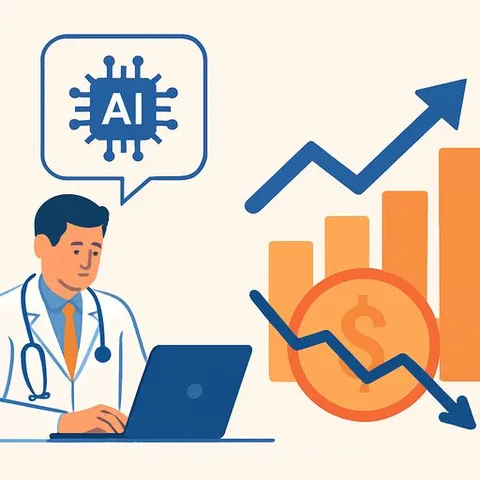
Healthcare providers doubled their deployment of artificial intelligence over the past year, but most organizations are still failing to convert that spending into measurable financial returns. KPMG's Global Tech Report 2026: Healthcare, released in May, found that 57% of healthcare technology leaders said their investments were only breaking even, while just 30% reported returns above their original outlay.
The study, based on a survey of 128 healthcare technology leaders worldwide, showed that 40% of organizations spend between $50 million and $100 million a year on technology. Most of that money flows into electronic health records, cloud platforms, and enterprise systems.
AI adoption climbs but spending outpaces returns
AI deployment has grown sharply. KPMG found that 66% of healthcare organizations now use AI applications, up from 32% a year earlier. Another 76% expect to expand AI over the next 12 months, and 86% are integrating it into clinical or operational work.
The findings align with separate reports from PricewaterhouseCoopers and the Healthcare Information and Management Systems Society, which identified similar obstacles for organizations pursuing AI for Healthcare. Both reports found providers are focusing on cybersecurity, data quality, and information sharing as they expand digital services.
Despite the appetite for AI, adoption alone has not closed the gap between spending and returns. More than half of respondents are treading water financially on their technology bets.
The barriers slowing down healthcare technology
KPMG identified cybersecurity, poor quality data, and regulatory compliance as the biggest obstacles to wider technology adoption. Weak governance and limited in-house expertise were cited by 42% of respondents as their single largest challenge.
"Cybersecurity, poor quality data, and regulatory compliance remain the biggest barriers to wider tech adoption," the report said. These three issues routinely force organizations into reactive spending that undercuts long-term planning.
Poor data quality creates a particular drag. Without clean, structured information, AI tools produce unreliable outputs, and clinical teams lose confidence in the systems. The result is technology that gets deployed but never fully embedded in daily work.
Where providers are putting their money next
Organizations are betting on several emerging areas. KPMG reported growing interest in remote patient monitoring, robotic surgery, digital twins, predictive analytics, and patient support networks. Nearly one-third of organizations plan to hire more local technology professionals to reduce reliance on offshore workers.
These investments signal a shift toward technologies that touch patients directly rather than back-office systems alone. The challenge, however, remains the same: turning deployment into returns requires data that is clean, governed, and secure before the algorithms go live.
Why this matters for healthcare professionals
Technology leaders inside hospitals and health systems face a clear tension. AI adoption is accelerating, but the foundational work - fixing data quality, closing cybersecurity gaps, and building in-house expertise - has not kept pace. Organizations that invest in those foundations before layering on more AI tools are more likely to move from breaking even to seeing actual returns. The data from KPMG suggests that skipping those steps leaves money on the table, no matter how fast AI deployment grows.