
AI news ·
Hollywood writers take AI training gigs to survive as the industry contracts
Hollywood screenwriters are taking AI training jobs to pay rent, then getting fired without warning-repeatedly. One writer was terminated seven times in three months as hourly rates dropped from $150 to $16.
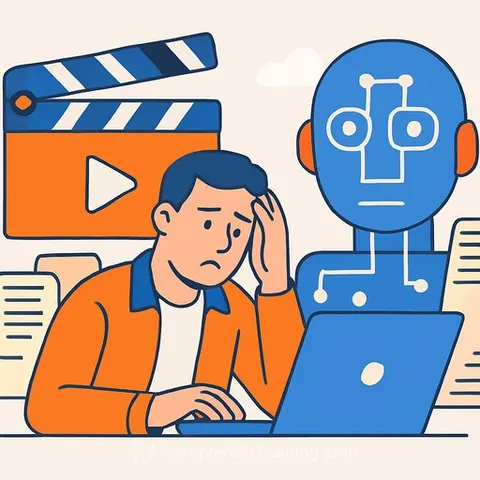
Hollywood Writers Are Now Training the AI That Could Replace Them
A Hollywood screenwriter and showrunner has spent eight months working as an AI trainer across five different platforms, completing 20 contracts for companies like Mercor, Outlier, and Turing. The work pays between $16 and $150 per hour, depending on skill level and project type. It is, by her account, brutal.
The jobs involve assessing whether chatbot responses sound natural, annotating videos frame-by-frame, identifying objects in images, and red-teaming AI systems to find safety vulnerabilities. The work itself is straightforward. The employment structure is not.
The Waiting Game
Contractors are classified as independent workers, not employees. They receive no benefits, no predictable hours, and no job security. Projects appear with urgent deadlines, then vanish without warning. One project she joined in November promised work starting within a week. Phase 2 never launched until late December-four weeks later. By then, the finite tasks had already been claimed by faster workers.
She earned $180 from that project by December 1.
The pattern repeated across multiple gigs. Projects start abruptly at odd hours-sometimes 9 p.m. on a Monday-with messages flooding Slack demanding immediate completion. Technical glitches lock workers out. Tasks run out within hours. Then silence. No explanation. No next steps.
Wage Collapse
When AI training jobs first appeared in early 2025, expert-level contractors earned $150 per hour. Entry-level workers made $35 to $75. By early 2026, those rates had dropped sharply. Experts were offered $50 per hour. Entry-level positions paid as little as $16-below California's minimum wage.
In November 2025, Mercor fired thousands of workers from Project Musen, then immediately rehired them on an identical project called Nova at $16 instead of $21 per hour. Workers who had built community and friendships lost $5 per hour right before Thanksgiving.
Several lawsuits allege that contractors should be classified as employees. The demands suggest employment: frequent onboarding, mandatory retraining, constant email and Slack monitoring, short-notice work sprints, and minimum weekly hour requirements. But classified as independent contractors, workers have almost no legal protections against unpredictable scheduling, excessive hours, or retaliation.
Management From Gen Z
Project managers are typically in their early twenties, fresh out of college. Many have no prior work experience. One manager, a recent economics graduate, had never held another job. Another, a stay-at-home mother in her twenties, oversaw hundreds of experienced professionals in their thirties and forties.
These managers send messages at 3 a.m. urging workers to "lock in" and "go team go." They post icebreaker questions on Slack: "If you were a pizza, what kind would you be?" This happens during unpaid waiting periods when no work is available.
When workers complain, managers dismiss concerns and ask them to "be positive." One manager told a contractor not to rely on this work, not to expect anything from it. "These are not jobs, these are tasks," she typed. "Think of tasking as a bonus."
The Grading Trap
On one video-annotation project, managers introduced performance scores visible to all workers. Reviewers graded annotators on a scale of 1 to 5. Most workers scored around 2. Those consistently scoring below a certain threshold faced termination.
Then managers announced a "golden batch" of premium tasks reserved for workers with perfect 5s and fast completion times. The competition intensified. Workers discovered the scoring rubric was vague and inconsistent. Feedback came as absurdly granular corrections: "Replace 't-shirt' with 'a t-shirt.'" "Change 'grunt' to 'grunting.'"
Workers who scored high enough to be promoted to reviewer positions received no additional pay. One colleague demoted back to annotating confirmed it: "No one gets more money for being promoted. That's all a lie."
The Scale of the Operation
Mercor employs about 300 full-time staff members. Each week, the company keeps approximately 30,000 independent contractors in active rotation across projects. These contractors are kept in what one worker described as "a fever dream of aimless, directionless urgency."
The work is often trivial. One project paid workers to write shopping prompts for automated lawnmowers. Another involved removing people from photographs and placing them on the moon. The stated purpose: to make AI systems more human by making workers more like machines.
Why Writers Take These Jobs
In 2023, Hollywood writers struck partly to prevent studios from replacing them with AI. When the strike ended after nearly five months, the entertainment industry's momentum never recovered. By early 2025, producers were defaulting on six-figure checks owed to writers.
Desperate for income, writers discovered AI training gigs advertised in unofficial Writers Guild of America Facebook groups. Posts described $150-per-hour work as "easy money." Writers needed cash for rent, food, and basic expenses.
They discovered the work was neither easy nor stable. But by then, they were already committed.
The Cost
The emotional toll is significant. Workers describe paranoia in Reddit forums dedicated to AI contractor platforms. Fear of sudden termination keeps people checking Slack at all hours. One worker with COVID was fired for missing the minimum weekly hours, then forced to rejoin the application process.
The competitive structure-badges for top performers, golden tasks for the fastest workers-creates tension among colleagues. Burnout is widespread. One worker noted that 95 percent of annotators in her project were experienced professionals in their thirties and forties with "a seething, deep-rooted hatred" of their Gen Z managers.
She was fired seven times between February and April 2026. Each dismissal came without warning. One moment a project existed. The next, the interface vanished. Slack channels disappeared. Google documents locked. No explanation. No severance. No next steps.
The only constant was the urgency. The only guarantee was its end.
Learn more about how AI affects writers and how ChatGPT is being used in content creation and training.