
AI news ·
Honeywell sees AI-empowered workers, not dark factories, as the near-term future of mining automation
Mining companies must embed AI into core operations across the full production chain, not treat it as isolated projects. Bottleneck analysis comes first-software cannot fix a physical constraint.
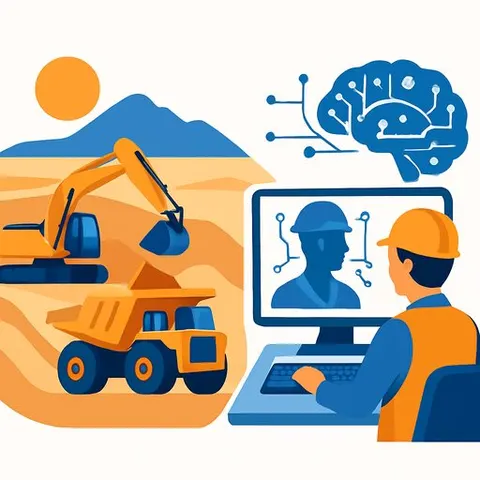
Mining Operators Must Embed AI Into Core Processes, Not Treat It as Separate Projects
Mining companies that treat artificial intelligence as an isolated automation tool will fail to capture its full value. Instead, operations leaders need to integrate AI and traditional automation into a single orchestrated system that manages the entire production chain-from extraction through processing to transport-according to Fernando Romero, director of Honeywell's Global Center of Excellence in Mining Automation.
The distinction matters because mining follows a strictly linear value chain unlike manufacturing. A single bottleneck anywhere in that chain can undermine efficiency gains elsewhere. Romero said the industry's carbon footprint stems largely from moving concentrates and refined metals globally, not just from production itself.
Three Pillars Required for Successful Implementation
Operations teams attempting digital transformation should focus on three synchronized elements: people, processes, and technology. Automation cannot fix a poorly designed process. If a crushing plant lacks sufficient capacity or conveyor throughput, software will not solve that physical constraint.
Romero emphasized bottleneck analysis comes first. Only after verifying the underlying process is sound should teams move toward automation and AI deployment.
The human element becomes critical during this transition. Automation shifts roles and responsibilities, requiring comprehensive change management. Each mining operation defines its own strategy for how deeply to integrate technology and what balance of human and machine capabilities it needs.
Machine Learning and Generative AI Solve Different Problems
Honeywell combines two distinct branches of AI to address mining's inherent complexity. Machine learning identifies patterns as sensors collect data from the operating environment. Generative AI supplements human analytical capacity by processing billions of data points simultaneously.
Advanced Process Control demonstrates the practical application. Traditional control solutions use linear programming. By integrating machine learning, Honeywell elevated these systems to manage non-linear process behaviors-a capability that has been standard in its industrial offerings for over five years.
These tools address mining's extreme energy loads and, in regions like Chile, scarce water resources. The industry cannot avoid deploying them.
Bridging the Talent Gap Through AI Agents
Mining faces a dual talent crisis. Fewer young professionals will relocate to remote sites, and the industry is losing expertise as senior operators retire. AI offers a solution by embedding veteran operator knowledge into intelligent systems.
Honeywell is developing what it calls AI agents-not physical robots but AI elements embedded directly in control systems. These agents act as virtual collaborators that anticipate problems. A system can warn an operator of a potential alarm five minutes before it occurs, allowing preemptive action. The agents learn from top performers, effectively distributing expertise across the workforce.
This approach aligns with what industry analysts call Industry 5.0, where humans remain central and technology augments rather than replaces judgment. AI still lacks the philosophical ability to decide between complex options based on a vision of the future.
The Autonomous Plant: A Longer Timeline Than Expected
Mining companies frequently discuss autonomous plants-facilities that operate with minimal human intervention. Honeywell defines autonomy as a system that constantly measures and adapts to environmental variables: metal prices, financing costs, safety regulations, mineralogy changes, and ore grade fluctuations.
Autonomous truck fleets already demonstrate this concept. At shift start, a fleet receives a mission: move a specific tonnage from certain sectors. The operator provides the instruction, and the fleet coordinates itself to complete the task, adjusting routes and speeds without human intervention.
Applying this logic to mineral processing plants means ore enters and finished metal exits with no one inside-a dark factory. But this vision has a practical constraint: autonomy lasts only as long as physical assets remain functional. If a grinding mill fails, robots cannot yet autonomously replace heavy industrial equipment.
Honeywell manages autonomy within specific time horizons. A plant might operate automatically for two months, knowing human maintenance will be required afterward. The goal is extending that window over the decade ahead, with AI managing unpredictable disturbances.
Strategic Partnerships Replace Project-Based Contracts
Operations leaders should expect technology vendors to shift from transactional contracts toward long-term collaboration. Honeywell's 20-year joint venture with Codelco, the world's largest copper producer, demonstrates this model. The partnership has survived radical technological shifts that were unimaginable when it began two decades ago.
Long-term partnerships allow vendors and operators to share risks and rewards while supporting digital transformation roadmaps that evolve with the business. Instead of solving isolated problems through competitive bidding, teams work in unison toward shared goals.
Vendors Must Speak the Language of Business Value
Mining remains perceived as conservative because entry barriers and required investments are massive. Board-level decision-makers face immense pressure. The industry functioned for centuries without automation, so technology companies must connect directly to core business value: return on capital, asset profitability, or mineral deposit yield.
Approximately 95% of the technology needed for any project already exists. The real challenge is ensuring operators understand how that technology generates specific value.
Implementation is only the beginning. No problem is solved entirely during initial technology introduction. Operations teams should expect continuous improvement processes that extend across the asset lifecycle. Software evolves much faster than hardware, so ongoing support and maintenance are essential to sustaining the original investment's value.
For operations managers, the takeaway is clear: understanding how AI and automation integrate into your operational strategy is no longer optional. The question is not whether to adopt these tools, but how to orchestrate them across your entire value chain while maintaining human judgment at the center.