
AI news ·
Hospitality leaders weigh workforce impact and industry readiness as AI and robotics adoption grows
Hotels face a structural staffing crisis-70% of restaurant operators can't fill open roles, and accommodation quit rates hit 4.8% in early 2026. Operators who skip automation now risk falling irreversibly behind by 2030.
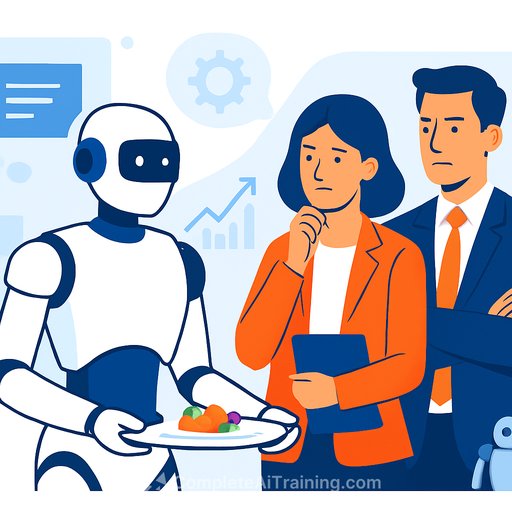
The Hospitality Industry Faces a Choice: Automate Wisely or Lose Competitive Ground
Hospitality faces a critical inflection point. AI and robotics are moving from pilot projects to mainstream operations, but the industry remains divided on how to deploy them-and what happens to the workforce in the process.
A new analysis from industry leaders across operations, technology, revenue strategy, and robotics reveals a consensus on one point: the conversation about job displacement is fundamentally backwards. The real risk isn't automation eliminating jobs. It's operators who do nothing while staffing crises worsen and guest satisfaction erodes.
The Labor Crisis Is Structural, Not Cyclical
The National Restaurant Association reported in December 2025 that 70% of restaurant operators have job openings they struggle to fill. Forty-five percent say they lack enough staff to meet current demand. TD Bank research found 54% of operators cite a shrinking labor pool as their biggest concern for the year ahead.
Automation is filling gaps the workforce has already abandoned. The fry station is the hardest kitchen position to fill not because machines are taking it-it's because no one wants to do it.
Hospitality hotels report 65% facing staffing shortages, with a gap exceeding 200,000 workers. The accommodation and food services quit rate sat at 4.8% in January 2026, the highest of any major sector.
What people get wrong: assuming hospitality has surplus labor waiting to be replaced. What they get right: technology will change what kinds of work exist.
Job Transformation, Not Elimination
The more honest conversation is about what kinds of jobs the industry wants to create.
Repetitive, physically demanding, and highly transactional tasks will be handled differently. Back-office work-accounting, analytics, payroll-will shift toward validation and strategic analysis rather than manual data entry. Administrative and clerical roles face the most immediate pressure.
Front-of-house roles remain largely protected. Guest-facing hospitality still depends on human interaction and contextual judgment that automation currently handles poorly.
When automation removes the worst work, operators can redeploy teams toward higher-value roles. That benefits everyone. The question is whether leadership uses efficiency gains to cut costs or to reduce burnout, improve service quality, and attract better talent.
The Real Problem: Disconnected Systems and Weak Data Foundations
The industry is underestimating how much clean data matters. Only 24% of hotels have full integration across property management systems, revenue management, point-of-sale, booking engines, and distribution channels.
AI is only as good as the data it processes. Most properties operate with fragmented ecosystems where systems don't communicate. Deploying AI on top of that architecture produces inconsistent results and erodes trust in the technology quickly.
The conversation about AI readiness must start with data readiness. Without unified, accurate data, even sophisticated models fail to deliver value.
Real returns are coming from scheduling engines, waste tracking, dynamic pricing, and behind-the-scenes automation-not from visible robots in lobbies. One robot in a guest area generates headlines. Fifty invisible algorithms running continuously drive measurable improvements in profitability and guest experience.
Technology Amplifies What's Already There
A critical mistake: assuming technology can fix weak operations. It cannot.
If communication is poor, standards are inconsistent, leadership is absent, or accountability is unclear, technology will expose those problems faster but won't solve them. Technology amplifies the discipline-or dysfunction-already present.
The most valuable tools in hospitality may not be the most visible. Bigger wins often come from systems that make daily operations stronger, more organized, and more accountable.
A tool may be exciting, but the real question is whether it helps the hotel execute better. Does it improve communication? Does it remove unnecessary obstacles? Does it help managers see problems earlier? Does it support the team?
What Professionals Need to Do Right Now
Hospitality professionals should build a daily AI habit. Fifteen minutes every morning running prompts against a real business problem compounds into genuine fluency within six months.
Develop cross-functional commercial literacy. Revenue, sales, marketing, and operations have operated in silos too long. Professionals who bridge those disciplines will command disproportionate value. These are people who understand how group business affects transient displacement, how channel mix drives profitability, and how labor costs interact with total revenue strategy.
Learn to read and challenge data, not just act on it. The professionals who will command the most value are those who can interpret AI-generated insights, identify when a model is missing context, and communicate the implications to ownership and teams.
Double down on human skills that machines cannot replicate: relationship management, change leadership, storytelling with data, and the ability to build trust with owners and guests. The market is currently undervaluing these skills relative to technical competencies.
Get comfortable with technology without becoming dependent on it. Understanding how AI pricing models work, what assumptions they make, and where they have blind spots is increasingly a baseline professional competency.
For executives specifically: do not outsource AI literacy to the IT team. CEOs whose companies are moving fast are personally fluent in the technology. Those who delegate it lose years they don't get back.
The 2030 Divide: Two Camps Will Emerge
By 2030, hospitality will bifurcate into two unmistakable groups: operators who treated AI as core architecture, and operators who treated it as an IT project or outsourced it to vendors and brands.
The first camp will run hotels with materially less labor, materially better guest scores, and materially higher profit margins. The second camp will be acquisition targets, exit candidates, or simply gone. The gap will not be a five-percent difference. It will be the difference between thriving and disappearing.
Properties that thrive will combine smart tools with strong leadership, dependable teams, clear standards, and genuine service. Hospitality still runs on trust, execution, and people.
The winning hotels will feel effortlessly personal to guests, ruthlessly efficient to owners, and surprisingly attractive to employees. AI and robotics will handle repetitive work. Humans will handle the moments that matter.
By 2030, the competitive advantage won't be whether you have AI-it will be how well your commercial teams use it to make better decisions faster than competitors. The conversation shifts from RevPAR to total profitability per available square foot.
The Real Tension
Technology alone will not determine the future of hospitality. Leadership will.
Used wisely, AI and robotics ease operational pressure, support teams, improve decision-making, and allow people to focus on work where human judgment, care, and presence matter most. Used carelessly, they risk creating hospitality that is faster but thinner, colder, and less human.
The window to choose which path your operation takes has already narrowed. The operators making that choice now will define the industry's future. The ones waiting will be defined by it.
For hospitality professionals looking to stay relevant, the path is clear: build AI literacy alongside human excellence, own one experiment per quarter, read outside your industry, and never outsource your thinking to vendors or technology teams. The future belongs to those who use better tools without losing sight of why guests chose them in the first place.
Learn more about AI for Hospitality & Events and AI Data Analysis to build skills that matter for this transition.