
AI news ·
Hospitals and pharmacies around the world deploy AI to ease clinician workload and expand patient access
Hospitals from Munich to Kenya are using AI to cut paperwork, speed diagnosis, and handle routine calls-freeing clinicians for direct patient care. A UK hospital estimates the shift could add 250,000 patient visits per year.
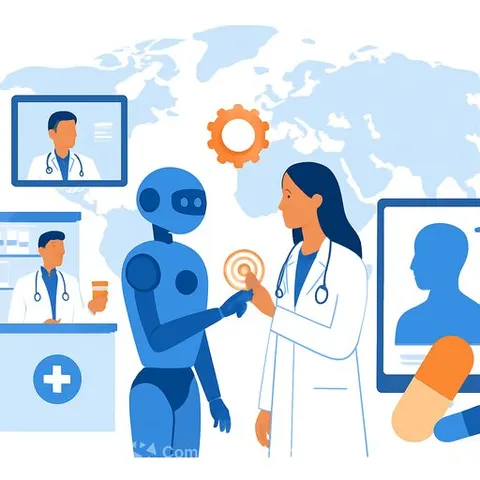
Healthcare systems deploy AI to reduce clinician paperwork and improve patient access
Hospitals and clinics worldwide are using AI tools to free up clinician time by automating documentation, handling routine administrative tasks, and improving access to patient care. Budget constraints and rising demand are pushing healthcare providers to adopt these systems, which keep doctors and nurses in control of clinical decisions.
Munich Fire Department handles routine calls with AI operator
An AI operator at Munich's Fire Department now manages non-emergency patient transport calls, allowing dispatchers to focus on life-threatening emergencies. The system uses natural language processing across multiple languages to arrange transports and verify critical details before handing calls to human staff when needed.
Florian Dax, one of the system's creators, said the technology was designed by firefighters, paramedics, and dispatchers working with AI experts. "For all the support tasks and low-priority calls, AI can really help," Dax said. The system is currently in beta testing at Munich's largest hospital.
UK hospital cuts paperwork with ambient AI note-taking
Doctors at Manchester University NHS Foundation Trust are using an ambient AI tool that listens to clinical conversations and automatically generates medical notes. Instead of typing during appointments, clinicians focus entirely on patients while the system transcribes visits and organizes information in the background.
Cardiologist Dr. Charles Pearman said he saves several minutes per patient with the system. Over time, those minutes add up-he estimates he could see one additional patient per day. The hospital's chief executive said early results suggest the technology could help treat up to 250,000 additional patients annually.
Kenyan pharmacies improve profitability with inventory AI
Small, independent pharmacies in Kenya serve communities within walking distance but struggle with profitability. An AI app called Zendawa helps pharmacies track inventory, cut waste, and forecast their needs.
The app collects sales data that feeds into a credit score, allowing pharmacies to apply for loans to expand. Zendawa's creator, Wilfred Chege, built the app to help pharmacies transition from pen-and-paper operations to digital systems.
Spain's rare disease diagnosis tool cuts wait time from 10 months to minutes
When Julián Isla's infant son Sergio suffered seizures, his family waited 10 months for a diagnosis of Dravet syndrome, a rare neurological condition. The experience prompted Isla, a Microsoft software engineer, to co-found Foundation 29 in 2017 to apply AI to rare disease diagnosis.
The organization built DxGPT, an AI diagnostic support tool that analyzes symptom data to help doctors and patients reach answers faster. The tool is now used by hundreds of thousands worldwide and is integrated into Madrid's public health system, with plans to expand to two additional Spanish regions.
Large US health system reduces clinician burnout with integrated AI
Intermountain Health, a major nonprofit health system in the Western US, deployed an AI clinical workflow assistant directly into its electronic health record system. The tool captures patient-clinician conversations and automatically generates clinical notes, reducing time spent charting.
The organization scaled the system to more than 2,500 clinicians and reported faster documentation, reduced cognitive load, and improved clinician satisfaction. By embedding the technology into existing workflows, Intermountain prioritized caregiver wellbeing alongside patient care.
Japanese hospital strengthens security after ransomware attack
When ransomware crippled Osaka General Medical Center in 2022, servers became inaccessible and patient data was locked. The hospital restored operations within two months but recognized its cybersecurity measures were insufficient.
Hospital president Dr. Takeshi Shimazu said the organization deployed AI-powered security and cloud technologies to mount stronger defenses. The hospital now uses machine learning-based threat detection and AI-driven risk analysis to control network access. It also rolled out collaboration tools for its 2,000 employees to improve workflows and communication.
European hospital network uses AI to predict patient risks
Ribera, which operates 16 hospitals and 74 medical centers across Spain, Portugal, and Central Europe, uses AI to identify patients at risk of complications before problems become crises. The organization developed a model to predict which patients are likely to develop pressure ulcers and another to assess fall risk.
Ribera is testing generative AI to draft discharge letters for routine procedures, freeing doctors to redirect their time to patient care. The organization also uses an in-house app to monitor patients with chronic conditions.
Learn more: Explore AI for Healthcare or discover how AI Agents & Automation are reshaping operational efficiency.