
AI news ·
Hotel staff share sensitive guest data through unauthorised AI tools as governance policies lag behind adoption
Hotel staff are pasting guest medical details, incident reports, and personnel records into public chatbots without approval. No policy, no data controls, and no oversight is turning routine AI use into a serious liability.
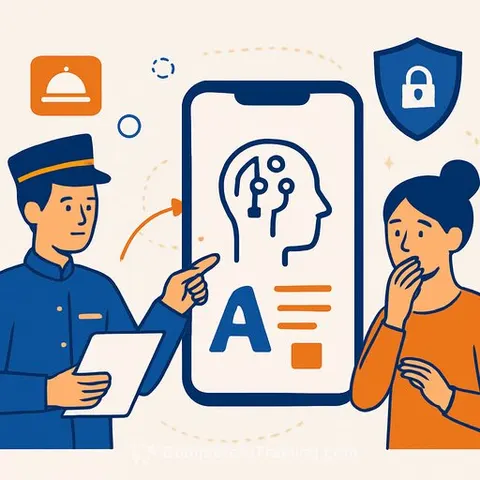
Your Staff Are Already Using AI - And You Probably Don't Know It
Hotel employees are pasting sensitive guest data into public chatbots without approval or oversight. This is happening now, not in some distant future scenario, and the information being shared is far more sensitive than most hotel leaders realize.
The problem has a name in technology circles: Shadow AI. It describes staff using tools like ChatGPT, writing assistants, and summarizers without permission, without policy, and without the data controls a responsible organization would require.
What Data Is Actually Being Shared
The commonly cited example - a front desk agent drafting a guest apology email in a public chatbot - understates the actual risk. In practice, hotel staff are pasting into public AI tools:
- VIP preference profiles containing named medical and dietary requirements
- Incident reports detailing complaints, injuries, or security events involving identifiable guests
- Ownership correspondence and asset management documents
- Confidential personnel records and disciplinary notes
- Investigative summaries relating to theft, harassment, or staff misconduct
These are not hypothetical. They are exactly the categories of information hotel professionals reach for when drafting sensitive communications or summarizing complex situations - the precise moments when the instinct to open a free AI tool is strongest.
The Real Governance Problem
The risk is not that staff use AI. The risk is that the most sensitive operational data in your hotel is the most likely to be shared with a tool that has no data residency controls, no enterprise agreement, and no deletion guarantee.
None of this is malicious. Staff are trying to do their jobs better with the tools available to them. The failure is institutional, not individual.
How This Breaks Operations: A Real Example
A guest at an upper-upscale city hotel submitted a formal complaint about noise and slow housekeeping service. During a busy checkout period, the front office team leader pasted the guest's complaint into a public chatbot and asked it to draft a recovery letter.
The tool returned a polished apology - including a reference to "a complimentary room credit of £75 applied to your account" that had never been discussed or approved.
The team leader sent the letter without reading it carefully. The guest attempted to redeem the credit at checkout. When it could not be found, the guest escalated to the general manager, citing the hotel's own letter as evidence of a broken commitment. A recoverable service failure became a reputational and commercial liability.
Two governance failures compounded each other. A public AI tool was used with no data controls. And there was no approval workflow requiring a manager to review AI-drafted guest communications before sending. Either control alone would have prevented the outcome.
The Response: Policy, Not Punishment
Hotels that respond with blanket bans typically make the problem worse. Staff continue using tools informally and hide the practice. The response that works has three parts:
Publish an Acceptable Use Policy. Create a clear, accessible document that defines what AI tools staff may use, what data must never leave the hotel's system boundary, and what happens when the rules are broken.
Provide approved alternatives. If staff are using a public chatbot to draft communications, give them an enterprise-grade tool that meets the same need without exposing data.
Train staff on the why. Employees need to understand why certain data cannot be shared with public tools, not just that it cannot.
The Escalating Risk: Shadow Agents
Shadow AI has a more dangerous cousin: the shadow agent. Where shadow AI generates text for a human to review, a shadow agent can take action - sending emails, creating tickets, modifying records - without management visibility. As AI tools become more capable, the risk of unofficial adoption rises sharply.
Where to Start
Before your next leadership meeting on AI, ask one question: Do we have an Acceptable Use Policy that staff have read and acknowledged?
If the answer is no, that is where the conversation begins.
Learn more about AI governance for hospitality and events operations.