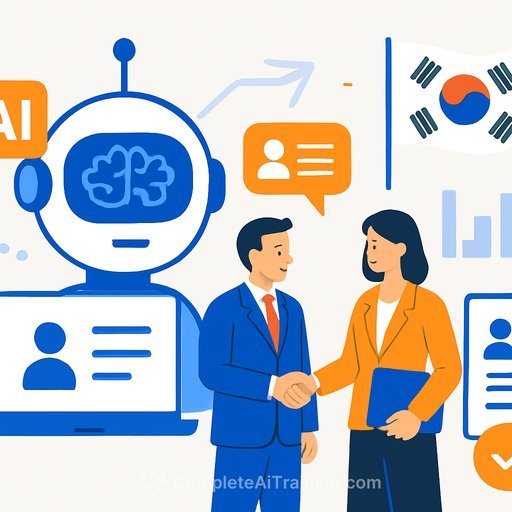
HR and the C-suite are split on AI in hiring. Here's how to close the gap
An AMS report released Jan. 29 shows a simple truth: most leaders think AI is needed, but few are using it where it counts. That disconnect is showing up hardest in hiring.
Key findings signal urgency and misalignment across leadership teams. The risk isn't theoretical - it's speed, visibility into skills, and fair decision-making falling behind competitors.
What the data says
- 64% say their talent pool won't stay competitive without AI.
- 89% aren't using AI across all major recruiting functions.
- Nearly half say HR and the C-suite aren't aligned on AI use in hiring.
- CHROs are the most pro-AI group for strengthening the talent pool - yet also the most concerned about job security as TA tasks get automated.
- More than half expect to hire "more AI-savvy HR leaders" within two years to guide the shift.
As AMS CEO Gordon Stuart put it, "Without a coordinated approach between HR and the C-suite, organizations risk falling behind in a competitive talent market where speed, skill visibility, and ethical decision-making will increasingly be shaped by AI."
The reality on the ground
Recruiters are already leaning on AI for sourcing and evaluation as candidate volume grows, according to LinkedIn. But many HR teams still don't trust AI to make workforce decisions, and reports note HR often reworks generative outputs before anything goes live.
Translation: leaders want the benefits, teams don't trust the process, and adoption stalls in the messy middle. That's fixable with clear use cases, guardrails, and shared metrics.
What HR leaders can do next
- Align on purpose. Define where AI should help first: sourcing, screening, scheduling, talent intelligence, or internal mobility. Avoid vague mandates.
- Set standards up front. Document data sources, validation steps, bias checks, human-in-the-loop review, and audit logs. Bring Legal, DEI, and Security in early.
- Pilot, don't boil the ocean. Run 60-90 day pilots with a clear owner, baseline metrics (time-to-shortlist, candidate response rate, quality-of-hire proxy), and a go/no-go call.
- Pick AI where the risk is low and the lift is high. Examples: resume-to-shortlist suggestions, outreach personalization, interview scheduling, JD drafts with skills tagging, and candidate FAQ assistants.
- Keep a human at key decision points. AI can recommend; humans decide. Require reviewer sign-off for screening thresholds and offers.
- Measure equity continuously. Track adverse impact and rejection patterns by stage. Recalibrate models and prompts when drift appears.
- Upskill the team and evolve roles. Define what "AI-savvy HR leader" means - prompting, evaluation, data fluency, vendor due diligence, and change management. Build a repeatable training path.
- Communicate job impact honestly. Show which tasks will be automated and which skills matter more. Offer reskilling options before fear turns into resistance.
Where AI fits in hiring right now
- Sourcing: talent discovery, skills matching, rediscovery of silver-medalist candidates.
- Screening support: structured resume parsing, skill extraction, and ranked shortlists (with human review).
- Ops efficiency: interview scheduling, candidate comms, and recruiter workflows.
- Content aids: job description drafts with inclusive language checks and calibrated skill levels.
- Candidate experience: 24/7 Q&A and status updates, with clear escalation to humans.
Compliance and trust
Treat AI like any other employment decision tool: validate, document, and test. Keep line-of-sight on explainability, accessibility, and reasonable accommodations.
For useful context on fair use of AI in employment decisions, see guidance from the EEOC. For adoption trends and use cases in recruiting, LinkedIn's research is a helpful reference; for deeper studies and related resources, see Research.
If you need to upskill your team
If your plan includes hiring or developing AI-savvy HR leaders, structured training speeds this up. Explore practical learning paths and certifications built around role-specific skills, for example the AI Learning Path for Training & Development Managers.
Bottom line: agree on where AI helps, prove it in small wins, protect decision quality, and train your people. Do that, and the HR-C-suite split closes fast - and hiring gets stronger.
Your membership also unlocks: