
AI news ·
Human resistance to AI tools costs companies more than the technology itself
A $176M analytics dashboard went ignored by floor managers who trusted gut instinct over algorithms. The real AI problem isn't the tech-it's the people refusing to use it.
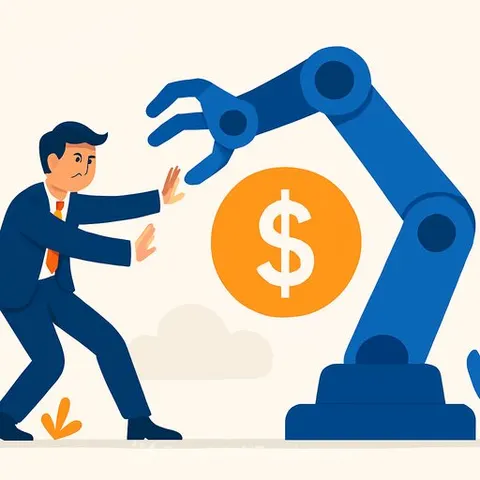
The $176 Million Problem Nobody Used
A predictive analytics dashboard identified $176 million in annualized savings. The math was flawless. Floor managers ignored it anyway, overriding algorithms with gut feelings and sticky notes. The technical solution worked. The people didn't.
This isn't a rare failure. Across enterprises, companies are spending billions on AI infrastructure while their employees actively sabotage the ROI by refusing to trust the systems they've been given.
The gap between what AI can deliver and what organizations actually realize has a name: the aversion tax. An algorithm that's 99% accurate but only 10% adopted isn't a breakthrough. It's a $200 million paperweight.
Why Adoption Fails
Technical debt is visible. Psychological resistance isn't. Executives treat digital transformation as a technical milestone to check off, when the real work happens in human behavior.
Three psychological barriers consistently block AI adoption:
- The black box paradox. People don't trust what they can't explain. If an AI recommends a decision without showing its reasoning, senior leaders will ignore it to protect their P&L. Explainable AI (XAI) has lost priority to black box efficiency, and it costs millions in trust.
- Identity threat. Organizations have spent years rewarding employees for intuition and autonomy. When a machine automates that work, it feels like a threat. Employees see the tool as replacing them, not assisting them. They revert to manual processes they controlled for a decade.
- The perfection trap. Humans forgive a 20% error from a peer but punish a 5% error from a machine. One AI mistake becomes the excuse to shut down an entire project. We hold algorithms to standards of infallibility we'd never apply to people.
The Math of Friction
If adoption hits 10%, your aversion tax is 90% of your investment. Finding the algorithmic defect is straightforward. Closing the last mile of adoption-the gap between potential and realized ROI-requires treating people as seriously as infrastructure.
A senior analyst who doesn't trust the recommendation will return to tribal knowledge. At that moment, your multi-million-dollar system becomes shelfware.
What Changes the Outcome
A cloud migration at a major data services company faced a January 2027 deadline. Technical hurdles were significant, but the real problem was a global team terrified of losing control and transparency in a cloud environment.
Instead of pushing harder on the technology, leadership applied behavioral architecture. They reframed data governance-which feels like restriction-as data democratization, which feels like power. They gave stakeholders ownership through automated quality tools and intuitive interfaces.
The project moved from January 2027 to May 2026. Migration velocity increased 367%. The organization realized $400,000 in immediate cost avoidance by deprecating legacy systems early. Success came from solving for the person, not just the partition.
The Executive Decision
The next wave of competitive advantage won't go to the CEO with the biggest data lake or the most advanced language model. It goes to the leader who understands the people using them.
CIOs and COOs should stop hiring AI experts in isolation. Start building an AI-ready culture. Apply the same engineering rigor to people integration that you apply to your data warehouse migration or automation rollout.
You cannot code your way out of a culture problem. The dashboard doesn't matter if the driver won't turn the key.
Every dollar spent on AI is currently subject to an aversion tax. The math is simple: ignoring the human side of adoption is a multi-million-dollar mistake you can no longer afford.
Learn more about AI for Executives & Strategy and AI for Management to understand how organizational culture shapes AI success.