Insights from the most AI-mature companies
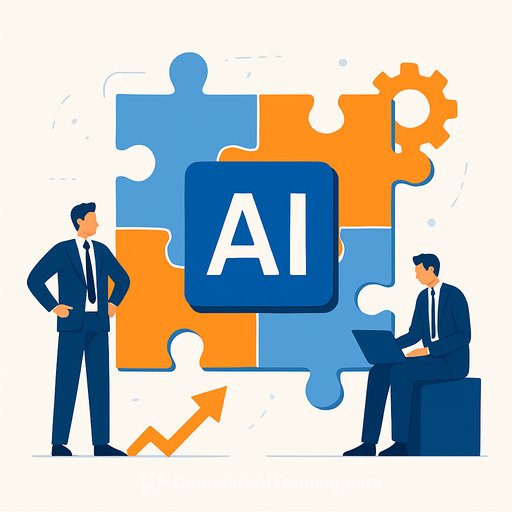
The highest performers share a simple pattern: leadership sets clear outcomes, people have the skills and incentives to deliver, and technology removes friction instead of adding it. When those three move in sync, AI stops being a cost center and starts driving revenue, margin, and speed.
Here's a practical playbook for executives and HR leaders to move from pilots to profit, without bloated roadmaps or vague promises.
What AI maturity looks like
- Outcomes first: Every AI effort ties to a P&L goal with a metric, a baseline, and a time-bound target.
- Fewer, bigger bets: A focused portfolio of high-value use cases, not a scatter of proofs-of-concept.
- Data with guardrails: Reliable data pipelines, access controls, and model oversight baked in.
- Product operating model: Cross-functional squads ship, learn, and iterate on a cadence.
- Trust and risk by design: Clear standards for privacy, fairness, security, and human oversight.
The core alignment: leadership, people, technology
Leadership sets direction, funds what works, and stops what doesn't. That means a one-page AI thesis, a quarterly portfolio review, and named owners on each use case.
- Define 3-5 business outcomes (e.g., reduce cost-to-serve by 8%, lift conversion by 3 pts).
- Stand up an AI council that includes Finance, Legal, Risk, HR, and the business.
- Adopt stage gates: problem fit, data fit, model fit, value proof, scale.
People drive adoption. Skills, roles, incentives, and communication matter more than model accuracy.
- Run a skills inventory across data, engineering, product, and business. Close gaps with targeted learning paths.
- Update job architecture: AI product owner, analytics translator, prompt specialist, MLOps engineer.
- Align incentives to usage and outcomes, not feature delivery. Share before/after wins widely.
Technology enables speed and safety. Keep it simple and modular.
- Modern data stack with lineage, quality checks, and governed access.
- MLOps and LLMOps basics: model registry, CI/CD, monitoring, rollback.
- Clear API strategy so use cases can reuse data, models, and components.
What good looks like across industries
- Manufacturing: Predictive maintenance cuts unplanned downtime 15-30%; computer vision reduces defects 10-20%.
- Retail: Dynamic pricing and recommendations lift average order value 2-5%; AI-assisted scheduling trims labor variance 5-8%.
- Healthcare: Prior authorization and claims automation reduce cycle times 20-40%; triage assistants improve throughput.
- Financial services: Real-time fraud detection lowers loss 10-25%; AI underwriting accelerates decisions and reduces manual review.
- Telecom: Churn prediction tied to save offers reduces attrition 2-4 pts; network optimization boosts utilization.
- Energy and utilities: Demand forecasting improves accuracy and cuts balancing costs; field crew routing lowers truck rolls.
- Logistics: Route optimization and ETA accuracy improve on-time rates; digital twins expose bottlenecks.
- Consumer goods: Marketing mix modeling refocuses spend toward higher ROI; demand sensing reduces stockouts.
- Pharma and life sciences: Trial site selection and protocol design accelerate enrollment; NLP streamlines safety case processing.
- Public sector: Service triage shortens response times; document automation reduces backlogs.
A simple scorecard (rate 1-5, then act)
- Leadership: Clear thesis, funded portfolio, stage gates, named owners.
- People: Skills map, role clarity, incentives, change plan, adoption coaching.
- Technology: Data reliability, MLOps/LLMOps basics, secure access, reusable components.
- Value: Use-case economics, baselines, targets, time-to-value under 12 weeks.
- Trust: Policies for privacy, safety, fairness; documented human-in-the-loop where needed.
Scores below 3 are immediate priorities. Pick two areas to lift this quarter; revisit monthly.
Your 90-day starter plan
- Weeks 1-2: Choose three use cases with clear owners and baselines. Secure data access. Define success metrics.
- Weeks 3-6: Form squads (product, engineer, data, business). Build thin slices. Set up monitoring and feedback loops.
- Weeks 7-12: Ship MVPs to a controlled audience. Track lift vs. baseline. Kill or scale based on evidence.
Capitalize like a venture portfolio: 60% on use cases, 20% on data/platform, 10% on risk and governance, 10% on enablement and change.
Your 12-month operating model shift
- Federated Center of Excellence: Small central team sets standards, accelerates squads, and manages shared assets.
- Product over projects: Multi-quarter backlogs, to-green metrics, and rolling value reviews.
- AI council and risk: Approves policies, audits high-risk uses, and ensures compliance with internal standards and external guidance.
- Vendor strategy: Balance build vs. buy. Avoid lock-in with open interfaces and data portability.
What HR needs to lead
- Capability blueprint: Map skills by job family. Define proficiency levels and learning paths; see the AI Learning Path for Training & Development Managers for role-based upskilling.
- Job architecture: Add roles for AI product, data quality, and model operations. Update career ladders and pay bands.
- Change and adoption: Design role-specific enablement. Coach managers to measure and reward usage.
- Policy and ethics: Guidelines for data use, employee use of generative tools, and transparency with workers.
Common failure patterns to avoid
- Starting with tools, then hunting for problems.
- Pilot purgatory: no baselines, no owners, no decision gates.
- Data perfectionism that blocks quick wins.
- No incentive alignment, so adoption stalls.
- Shadow AI without security, privacy, or legal review.
Metrics that matter
- Revenue: conversion rate, cross-sell, average order value.
- Cost: cost-to-serve, automation rate, cycle time, first-time-right.
- Risk: incident rate, model drift, audit findings, policy exceptions.
- Adoption: weekly active users, task completion, time saved per user.
- Quality: data freshness, accuracy, coverage; model precision/recall where relevant.
Helpful resources
For governance practices and risk controls, review the NIST AI Risk Management Framework. If you need role-based upskilling for business, technical, and people leaders, explore curated paths at Complete AI Training - Courses by Job and practical certifications at Popular AI Certifications.
Bottom line
AI maturity isn't about how many models you run. It's about how reliably you turn use cases into measurable results. Align leadership, people, and technology around a short list of business outcomes, then ship, measure, and scale. Do that, and the economics will speak for themselves.
Your membership also unlocks: