
AI news ·
Indigenous leaders weigh AI's potential to protect lands against the environmental costs of powering it
Indigenous communities use AI to track wildfires and fight illegal logging, but the data centers behind that technology drain water and minerals from the same territories. Leaders at the UN are demanding consent before any infrastructure goes in.
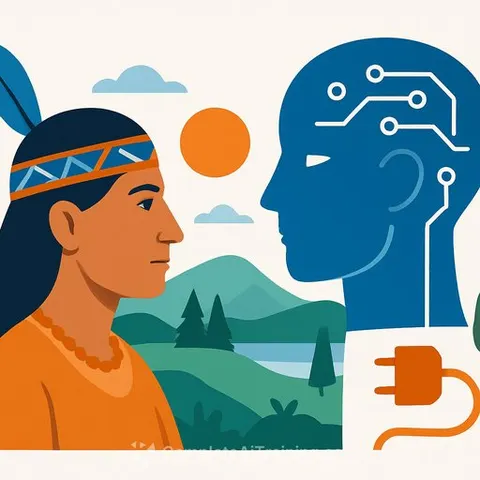
Indigenous Leaders Grapple With AI's Promise and Peril
Indigenous communities are using artificial intelligence to detect illegal logging, track wildfires, and monitor their traditional lands. But the data centers powering AI require vast amounts of water, energy, and critical minerals-resources often extracted from Indigenous territories. Indigenous leaders at the United Nations Permanent Forum on Indigenous Issues are now confronting a fundamental tension: how to use AI's protective capabilities without fueling the extraction they have resisted for generations.
Hindou Oumarou Ibrahim, a Mbororo leader and former chair of the forum, published a study examining both the potential and the risks AI presents for Indigenous environmental protection. Her research found that while AI offers real benefits, its infrastructure demands threaten Indigenous lands through land-grabbing, water depletion, and degradation.
"For generations, Indigenous Peoples have protected the world's most intact ecosystems without satellites, without algorithms or technologies," Ibrahim said. "AI can become a powerful ally to that stewardship, if it is used on our terms in a culturally appropriate way."
Real-World Applications
In Brazil's Acre state, Indigenous agroforestry agents in the Katukina/Kaxinawá reserve use AI to combat deforestation in an area ranked among the top five for deforestation risk. "It is very important to monitor the land because we Indigenous people are safer when we can detect if someone is invading, if someone is taking wood from our land," said Siã Shanenawa, one of 21 agents using the technology.
In Nunavut, Inuit communities combine traditional knowledge with predictive AI models to locate new fishing areas as climate change affects fish availability. In Chad, Indigenous pastoralists use satellite data with AI tools to anticipate severe droughts and secure migration corridors. These examples show AI working within existing Indigenous governance structures rather than replacing them.
The Sámi AI Lab in Norway investigates how AI can support Indigenous communities. According to Lars Ailo Bongo, a professor leading the research, AI is not yet inclusive enough-but it does offer opportunities. "AI can democratize access to the analytical capabilities needed to conduct data driven modelling aligned to Sámi views and norms," he said.
The Infrastructure Problem
Data centers powering AI consume enormous quantities of water for cooling and electricity to operate. Communities in Thailand, Pennsylvania, and Mexico have raised concerns about water shortages, pollution, and rising energy costs linked to data center expansion.
"AI is often perceived as immaterial, but it carries a very real environmental footprint," Ibrahim said. "It depends on vast amounts of energy, water, and critical minerals, many of which are extracted from or located near Indigenous Peoples' territories, leading to land degradation, biodiversity loss and, in some cases, the displacement of communities."
Beyond Environmental Costs
Ibrahim's research identified additional threats to Indigenous peoples. AI systems often lack adequate legal protections for digital rights, and they can exclude Indigenous peoples or enable extraction of sensitive data. The use of drones, satellites, or mapping tools without prior consultation can expose the locations of sacred sites or ecologically important areas.
Kate Finn, a citizen of the Osage Nation and executive director of the Tallgrass Institute, identifies what she calls "opportunity space" within AI for preserving Indigenous languages and strengthening governance. But she emphasizes a core requirement: "The consistent ask from Indigenous peoples around the world is that they want their free, prior, and informed consent respected before data centers go into their land."
Funding and Capacity
The Sámi face a specific constraint: a lack of funding to hire AI developers who can create models aligned with Sámi priorities. "This is especially sad, since we have Sámi AI developers that are interested in doing the work," Bongo said. "It is not a lack of competency, but capacity."
For projects relying on outside funding, Bongo warns that Indigenous peoples must not become junior partners. Decision-making power and resource allocation matter as much as technical capability.
What Governments Must Do
Cameron Ellis, field science director at Rainforest Foundation US, offers a clear principle: "Technology on its own doesn't protect forests-people do. These tools are only effective when grounded in community governance and leadership, and when the data they generate is used to trigger action on the ground."
Ibrahim calls on governments to prevent land-grabbing, water exploitation, and mining activities tied to data centers and energy infrastructure. She emphasizes that AI becomes harmful when imposed without consent. "In that context, it risks repeating old patterns of extraction of the resource, data and appropriation of knowledge and the credit to these knowledge," she said.