
AI news ·
Industrial AI moves into real-time machine control, says L&T Technology Services CTO
AI is now controlling physical machinery in real time - stopping a saw blade in under 31 milliseconds when a hand enters the danger zone. That's a different category than the software tools most companies call "AI."
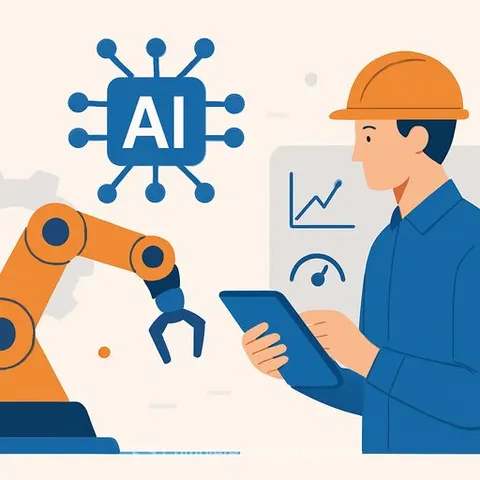
Industrial AI Moves Into Real-Time Machine Control, Beyond Software Tasks
Engineering companies are deploying AI systems that control physical machinery in real time, a shift that differs fundamentally from the software-focused AI tools dominating enterprise adoption discussions, according to Ashish Khushu, Chief Technology Officer at L&T Technology Services.
The distinction matters for product development teams: engineering-focused AI operates at the hardware level, making split-second decisions that prevent accidents or optimize manufacturing processes. Software-centric AI typically assists workers with analysis, documentation, or code generation.
Real-Time Safety Systems Show the Gap
Khushu described a wood-cutting machine safety system deployed in the US market. A camera mounted above the blade monitors hand movement. When an operator's hand enters the danger zone, the system detects the motion, processes the image, and commands the blade to stop and retract-all within 18 to 31 milliseconds.
That speed requires AI to work simultaneously with imaging systems, embedded chips, electrical instrumentation, and mechanical components. Software-only systems cannot operate at this scale.
Compressing Product Development Cycles
Engineering firms are using AI to shorten product development timelines by focusing on the earliest design phase. Capturing product functionality and engineering requirements with precision reduces downstream rework and iteration.
Companies report reducing design cycles from three years to 18 months, or five years to two years, through AI for Product Development interventions across multiple stages. The gains come from automating specification work that traditionally consumed months of manual effort.
Khushu said this area of AI application receives less attention in industry discussions than it deserves. "If you can capture the functionality and definition of products you're designing in minute details with high accuracy, you're solving a huge problem of development," he said.
Early-Stage Deployment Across Engineering
Large-scale deployment of agentic AI in engineering remains early. Most projects operate in specific domains-safety systems, design optimization, requirement gathering-rather than across entire product development workflows.
The distinction between AI Agents & Automation in manufacturing versus software environments will shape how product teams adopt these tools over the next 18 to 24 months.
Student Innovation Pipeline Shows Demand
L&T Technology's TECHgium platform, an engineering innovation competition for students, received 62,000 registrations from over 540 engineering institutes in 2026-a 60% increase from the previous year. Projects included robotic systems for medical diagnostics, AI-based video translation, and robotic arms for industrial safety.
Thirty-four teams presented working prototypes. Winners received prizes totaling more than 18 lakh rupees. The competition suggests engineering schools are training students to build systems that integrate AI with hardware and mechanical design.