
AI news ·
Innovaccer and AWS ink strategic collaboration as Mount Sinai adopts Signal 1 for AI oversight
Healthcare AI deployments moved from pilot to production this week, including a tool recovering 25 appointments in a night and a screening reaching 100% of inpatients.
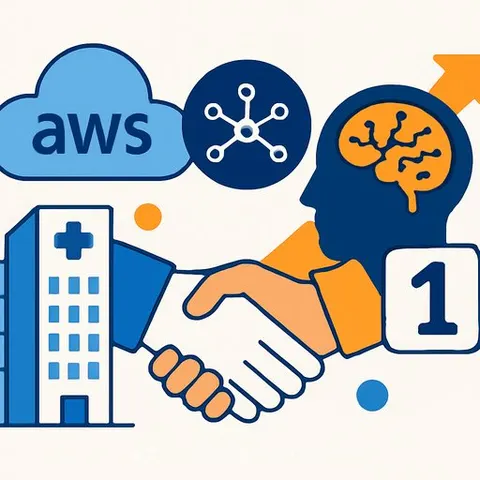
Five major developments in healthcare artificial intelligence landed this week-from a multi-year cloud deal between Innovaccer and AWS to OpenAI's release of GPT-5.5 Instant with improved health guidance. The announcements span clinical operations, patient engagement, AI governance, and foundational model performance, signaling continued investment in production-ready AI across health systems and payers.
Innovaccer and AWS target the gap between pilots and production
Innovaccer and Amazon Web Services signed a multi-year strategic collaboration agreement to help health systems and payers deploy agentic AI solutions at scale. The deal focuses on what Innovaccer CEO and co-founder Abhinav Shashank described as AI's "production problem, not an innovation problem."
"The organizations we work with are not short on ambition," Shashank said. "What they need is the infrastructure to run AI agents reliably, securely, and at the scale their operations demand. AWS gives us exactly that, and what we bring is a decade of healthcare-native context that makes those agents actually work in the environments health systems and payers operate in every day. This agreement is about closing the gap between what AI can do for healthcare and what healthcare is currently getting from it."
Under the terms, Innovaccer will scale agentic AI workloads using AWS services and expand its go-to-market reach through the AWS marketplace. The companies also plan to co-invest in customer success programs. The collaboration arrives as AI for Healthcare deployments face mounting pressure to demonstrate real-world reliability under compliance and security constraints.
Houston Methodist screens every inpatient with AI nutrition tool
Houston Methodist launched HealthLeap's AI-driven clinical screening platform on Thursday, designed to identify patients at risk of inadequate nutrition. The system screens 100% of inpatients daily across the entire care journey, enabling earlier interventions that may reduce complications, prevent avoidable care delays, and support shorter stays.
"At Houston Methodist, we are focused on strengthening how we identify patients who may benefit from additional nutrition support," said Michelle Stansbury, the system's associate chief innovation officer and VP of IT applications. "By incorporating advanced screening tools into the clinical workflow, we can help care teams recognize risk earlier, intervene sooner, and support more timely recovery for patients."
Invoca's AI agent turns patient inquiries into booked appointments
AI revenue execution platform Invoca launched Nico, an AI agent that engages, qualifies, and converts leads through personalized conversations drawn from first-party data. The tool handles inquiries from website forms, inbound phone calls, and digital advertising leads. Invoca CMO Peter Isaacson said consumers want "responsive, personalized communication in the channel of their choice."
Cleveland-based University Hospitals implemented the tool, and Matt Eaves, vice president of digital marketing, reported that it "recovered 25 appointments" during its first night. In one exchange, a patient texting from within the hospital received correct guidance to find a staff member for assistance-a response outside the AI's scripted parameters that it handled appropriately. The launch reflects growing demand for AI Agents & Automation in patient-facing revenue operations.
Mount Sinai centralizes AI oversight with Signal 1
Mount Sinai Health System partnered with AI management platform Signal 1 to bring centralized oversight and performance monitoring to its expanding AI portfolio. The platform provides streamlined intake and approval workflows, automated monitoring and reporting for deployed AI, and return on investment and impact tracking.
"As we expand across a diverse set of AI applications-from imaging to generative AI to emerging agent-based systems-our priority is ensuring we can monitor performance, safety, and impact at scale without slowing innovation," said Robbie Freeman, Mount Sinai's chief digital transformation officer. "Signal 1 gives us the structure and visibility to manage a diverse and growing AI portfolio-allowing our researchers and data science teams to focus on delivering innovation, differentiated solutions, and research."
OpenAI's GPT-5.5 Instant improves health guidance quality
OpenAI released GPT-5.5 Instant with improvements to ChatGPT's health capabilities, including better recognition of when urgent care may be necessary, stronger context-seeking, clearer explanations of uncertainty, and more accessible presentation of complex medical information. The free model now performs at a level comparable to the company's frontier thinking model, executives said.
The company works with more than 260 physicians across 60 countries, who have reviewed more than 700,000 example model responses to date. "As our models continue to improve, our goal is to make ChatGPT more accurate, more useful, and more impactful in those moments-and to keep bringing that progress to more people," the company said in its announcement.
Why this matters for healthcare professionals
This week's announcements share a common thread: healthcare organizations are moving past proofs of concept and into production infrastructure, centralized governance, and measurable outcomes. For clinicians and operational leaders, AI screening tools like HealthLeap's mean earlier intervention touchpoints. For IT and digital teams, the Innovaccer-AWS deal and Mount Sinai-Signal 1 partnership signal that scalable infrastructure and oversight systems are becoming prerequisites, not afterthoughts. And for anyone fielding patient inquiries, tools like Nico demonstrate that AI agents are already handling real patient interactions-with revenue and care coordination implications that will likely expand as these deployments mature.