
AI news ·
Insurers risk repeating legacy system mistakes as fragmented AI pilots pile up without a unified strategy
Insurers running disconnected AI pilots across departments are building new technical debt, not transformation. Without a unified strategy, costs rise faster than efficiency gains and hard-won lessons never spread.
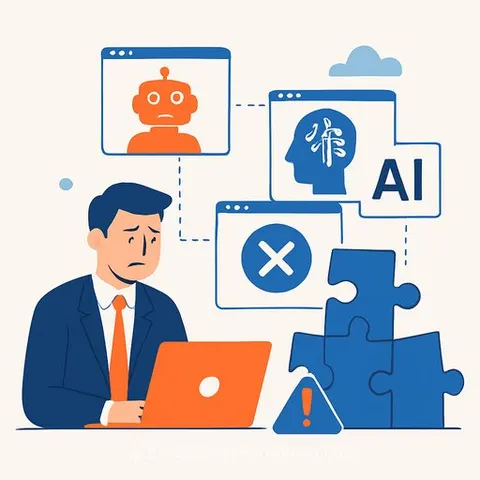
Insurance carriers face a choice: Build a unified AI strategy or accumulate new technical debt
Insurance organizations are experimenting with AI across every division. Underwriting teams test document summarization. Claims departments pilot automation. IT evaluates enterprise licenses. Business intelligence deploys new models. The problem: without a single organization-wide strategy, these experiments create what teams call "pilot purgatory" - multiple licenses for the same tools, isolated wins that don't compound, and costs that climb faster than efficiency gains.
Generative AI alone could unlock $50 billion to $70 billion in insurance industry revenue, with the highest impact on marketing, sales, customer operations, and software engineering. The goal is straightforward: improve efficiency, reduce manual work, enhance customer experience. But ROI gets diluted when each department optimizes for itself rather than the enterprise.
How fragmented pilots become legacy debt
This pattern mirrors what happened with policy administration systems and claims platforms. Sporadic acquisitions and disconnected strategy left many carriers with multiple systems performing overlapping functions. AI experimentation is following the same fragmented path.
Without a unifying architecture, what looks like innovation becomes a new form of legacy debt. Underwriting, claims, and new business pilots continue in separate lanes. The enterprise barely changes. Even when individual use cases show decent returns, total costs rise as integration work expands, governance grows, and vendor management increases.
Meanwhile, competitors adopting integrated AI operating models begin to move ahead. Pilot purgatory also distracts organizations from larger strategic priorities. AI becomes another layer of technical debt instead of a driver of change.
Why simply speeding up old processes fails
Many insurers apply AI superficially to existing workflows rather than reimagining them entirely. An underwriter's job has always meant reading volumes of material and extracting relevant details. AI can now do the information extraction in minutes. That frees time for analysis, judgment, and advising brokers through increasingly complex underwriting decisions.
The missed opportunity: treating AI as a faster way to do the same work. History offers a lesson. During the Industrial Revolution, manufacturers didn't just introduce machines to perform tasks more quickly. They reorganized production around new capabilities. Roles changed. Workflows were rebuilt. Assembly lines were redesigned.
Insurance faces a similar inflection point. If a process remains anchored in the old model and the goal is simply to run it faster, the opportunity is limited. Real value comes from reinventing the process around the new capability.
Take claims processing. Extracting key information from a 200-page medical report is no longer a constraint. Monitoring decision accuracy, managing exceptions, and maintaining empathy with beneficiaries can become central. AI isn't a layer on top of legacy workflows. Its true benefit comes from fundamentally rethinking how work is structured across the organization.
Three steps to build an AI-first operating model
Step 1: Audit roles, tasks, and departments. Before selecting technologies, audit how each role functions today and build a vision for how it could work with AI support. Where is time currently spent? Where does friction exist? Which activities directly influence departmental KPIs?
Ask: Where can efficiencies be created? Which activities could be done more efficiently? Which activities could become more valuable? Where must a human stay in the loop?
Manual data entry and repetitive document review often decrease significantly as AI handles large volumes of structured and unstructured information. But other responsibilities become more important: monitoring outputs, managing edge cases, escalating risk, applying professional judgment. This exercise also clarifies work that remains fundamentally human. Empathy, communication, and contextual judgment cannot be delegated to machines - particularly in claims where policyholders navigate sensitive life events.
Step 2: Reverse-engineer workflows. Once the future state of each role is defined, workflows can be rebuilt. Examine microprocesses across intake, underwriting, fraud review, claims adjudication, and customer communication.
Not every task requires advanced generative AI. Existing fraud models still matter. Robotic Process Automation continues to play an important role in structured tasks like data transfer and rule-based processing. Machine learning supports scoring and detection. Agentic AI orchestrates interactions across systems. Large Language Models summarize unstructured content. The goal is to connect capabilities, not use one tool to replace everything else.
Medical intake for a claim might combine document extraction using LLMs, cross-validation through agentic AI, and existing fraud scoring models, while a human remains in the loop for final decision making. AI is part of a coordinated toolset, not the solution at every step.
Step 3: Align on an organizational strategy. The final step is orchestrating the entire organization's AI pilots, tools, and frameworks. One approach is a unified platform that provides the foundation for reusable agents, multiple LLMs, shared governance, and opportunities to capitalize on lessons learned across teams. As use cases mature within individual departments, an orchestration platform can provide cross-pollination opportunities across underwriting, claims, new business, and billing.
The cost of standing still
Separate teams continue licensing the same tools. Cybersecurity exposure expands as more systems interact with sensitive data. IT capacity is absorbed maintaining multiple pilots. Hard-earned lessons benefit only those who experienced them. Technology costs soar. Vendor management needs grow. Most importantly, ROI from new AI initiatives falls far short of projections - neither for dollar savings nor efficiency gains. The enterprise barely changes.
Meanwhile, AI investment is becoming table stakes. Competitors are rolling out AI-first operating models and realizing measurable P&L impact. Clients and distribution partners increasingly assume you're using AI to improve responsiveness, accuracy, and decision making. Organizations that lag behind risk falling out of step with rising expectations across the value chain.
Insurers tied to manual processes and disconnected AI pilots may achieve lower operating costs in the short term. But they sacrifice the larger opportunity that accompanies organization-wide technological progress: the ability to shift time to higher-value work. When AI handles routine document analysis, teams focus on product innovation and new policy structures that meet emerging customer needs. Instead of reviewing documentation for hours, teams apply expertise to research, portfolio strategies, and designing new offerings.
Building an operating infrastructure, not just experiments
Investment in AI alone doesn't create organizational transformation. Without an enterprise thesis and a clear AI-first operating model, experimentation generates AI debt. Building and sustaining advanced AI capabilities in-house is also becoming increasingly difficult. AI technologies, tools, and architectures evolve rapidly. Maintaining expertise across LLMs, agentic systems, machine learning, governance frameworks, and enterprise integration requires continuous investment and exposure to real-world implementations.
Strategic partnerships provide flexibility that internal teams often struggle to achieve. Partners with deep specialist benches can scale expertise up or down as needed, bringing the right capabilities to each stage of transformation while helping firms avoid costly missteps. Across the industry, AI implementation is already underway. The question is which insurers will lead that shift.
For insurance professionals, understanding the difference between fragmented pilots and integrated AI operations is critical. AI for Insurance covers how claims processing, underwriting, and risk assessment are being transformed. AI Agents & Automation explores the workflow automation and orchestration systems that connect these capabilities into a cohesive operating model.