
AI news ·
Intuit cuts 17% of workforce and signs AI deals with Anthropic and OpenAI on the same day
Intuit is cutting 3,000 jobs - 17% of its global workforce - while signing new AI deals with Anthropic and OpenAI and raising its full-year financial guidance.
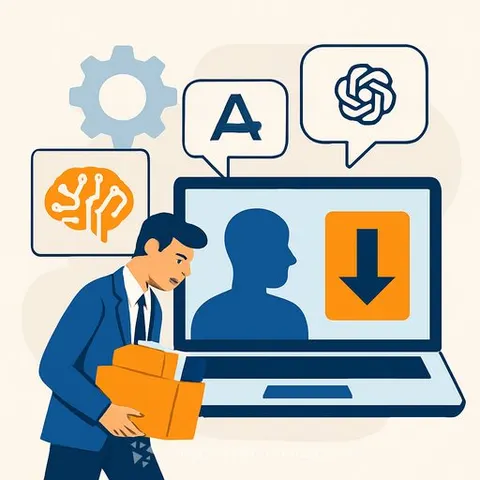
Intuit cuts 17% of workforce as it expands AI partnerships
Intuit announced Wednesday that it is eliminating approximately 3,000 jobs - 17 per cent of its global workforce across seven countries - while simultaneously raising its full-year financial guidance and signing multi-year deals with Anthropic and OpenAI.
CEO Sasan Goodarzi framed the restructuring in an internal memo as a way to reduce complexity and sharpen focus on artificial intelligence. The announcement came on earnings day, a timing choice standard in Silicon Valley designed to bury difficult news within financial data.
The redundancies will cost the company $300 million to $340 million in restructuring charges. Affected US employees have a final employment date of 31 July 2026 and will receive 16 weeks of base pay plus two additional weeks for every year of service. The company is closing offices in Reno, Nevada, and Woodland Hills, California.
The cuts span TurboTax, QuickBooks, Credit Karma, and Mailchimp across engineering, customer support, marketing, and administrative functions.
Intuit shares fell 5 per cent in morning trading after the memo was reported, then dropped a further 11 per cent in after-hours trading once the earnings release confirmed details.
The AI investment that complicates the narrative
Intuit is embedding its tax, finance, accounting, and marketing capabilities into Claude and ChatGPT while reducing headcount. Goodarzi did not directly address how these two moves connect.
The company raised adjusted earnings-per-share guidance to $23.80 to $23.85 and revenue guidance to $21.34 to $21.37 billion - both above analyst consensus. A company making 17 per cent of its workforce redundant while raising financial forecasts is not in distress. It is betting that fewer people augmented by AI will generate more revenue than more people without it.
This is Intuit's second significant restructuring in two years. In July 2024, the company cut approximately 1,800 employees - roughly 10 per cent of the workforce - also framed around AI investment. At that time, Goodarzi wrote that the company did not "do layoffs to cut costs." That framing has not survived the 2026 cycle intact.
Goodarzi's total compensation in fiscal 2025 was $36.8 million, including cash incentives and stock awards. Intuit did not respond to questions about whether the CEO or board would take a pay reduction alongside the cuts.
What this means for Singapore HR leaders
Intuit's direct footprint in Singapore is limited, but the pattern it represents is unfolding across technology companies that employ tens of thousands of professionals in the city-state. The fintech and financial software sector - where Singapore has positioned itself as a global centre - is now executing the same playbook.
Singapore's own data underscores the urgency. Fixed asset investment commitments rose 5.2 per cent to S$14.2 billion in 2025, yet job creation fell roughly 16 per cent in the same period, to 15,700 from 18,700 in 2024. The Economic Development Board chairman explicitly attributed the shortfall to companies being "able to do more with fewer employees" through technology.
A survey by NTUC found that more than half of professionals, managers, and executives in Singapore feel the need to upskill amid AI disruption. The Intuit announcement is the clearest evidence yet that the disruption they are anxious about is not theoretical.
The legal framework is tightening
Singapore's Workplace Fairness Act, due to come into force by 2026 or 2027, will require employers to explain and justify employment decisions - including redundancies - in a way that is transparent, documentable, and free from discriminatory impact.
Zhao Yang Ng, principal in the employment practice group at Baker McKenzie Wong & Leow, said: "If you can't explain how the tool made its decision, or if it was trained on flawed data, you're exposed to discrimination claims."
When a company announces AI partnerships and mass redundancies in the same CEO memo, the inferential question employees and regulators will ask is whether the selection process was genuinely performance-based or algorithmically influenced. Goodarzi's memo described a structural rationale - too many management layers, the need for speed - but offered no explanation of how individuals were identified. That is the disclosure gap Singapore's legal framework is designed to close.
The adoption-depth problem
The Intuit story arrives in Singapore at a moment of particular tension. Analysis of AI adoption in Singapore found that 97 per cent of the workforce are using AI poorly or not at all by the standard of genuine value creation. Only 2.7 per cent qualify as genuine AI practitioners.
This creates a specific risk for Singapore organisations contemplating similar restructuring. The Intuit model assumes that AI can replicate the work of 3,000 employees at sufficient quality and volume. That assumption is being made in an environment where AI tools are scaling faster than workforce readiness.
A Singapore HR leader considering similar restructuring should ask: do we have the 2.7 per cent of genuine AI practitioners in sufficient number to absorb the work of the roles we are eliminating? If the answer is no, the Intuit model - cut now, build capability later - carries significant operational risk.
Three actions for Singapore HR leaders
First, audit AI tools now. Any AI tools used in workforce selection, performance management, or role elimination criteria should be audited against the Workplace Fairness Act's forthcoming transparency and justification requirements before enforcement begins.
Second, be explicit about AI's role. Tell employees directly how AI is and is not influencing employment decisions. The gap between what companies say and what employees believe is widening, and that gap is where legal exposure and talent attrition originate.
Third, resist the timing pattern. Do not announce difficult workforce news bundled with positive financial guidance. Singapore's tripartite framework, built on genuine consultation between employers, employees, and government, expects more from employers than a simultaneous earnings call.
Singapore's government has invested more than S$1 billion in AI research and launched an initiative to upskill 40,000 tech workers. That signals clearly that Singapore's approach to AI-driven workforce change is capability-led, not headcount-reduction-led.
HR leaders who align internal programmes with that national direction are building something more durable than a cost-saving announcement. Those who follow the US technology playbook - cutting first and explaining later - may find regulatory and reputational consequences arrive sooner than anticipated.
For HR leaders navigating this transition, consider exploring AI for CHROs (Chief Human Resources Officers) or AI for HR Managers to build the governance frameworks and transparency practices this moment demands.