Japan to Join U.S. AI Project Aimed at Accelerating Scientific Discovery
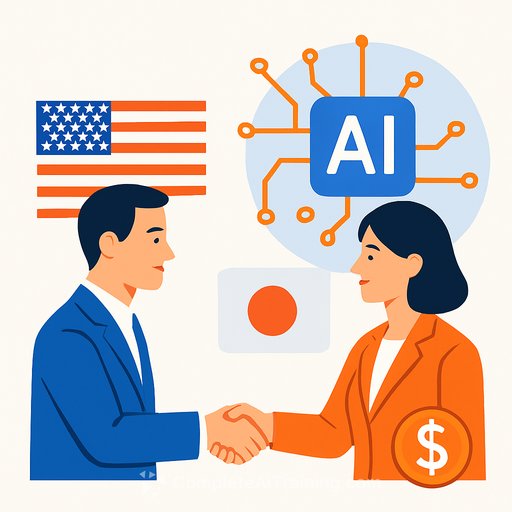
Japan will participate in the Genesis Mission, a U.S. government initiative to use artificial intelligence for scientific research and technological development, according to the Yomiuri Shimbun. The Japanese government has committed to the partnership as Washington and Tokyo deepen cooperation amid competition with China.
The two countries plan to invest $1 billion combined over five years, with Japan contributing $500 million. Senior officials from Japan's Ministry of Education, Culture, Sports, Science and Technology and Ministry of Economy, Trade and Industry will visit the United States in early June to finalize cooperation plans with the U.S. Energy Department.
What the Genesis Mission Does
The Energy Department has positioned the Genesis Mission as a national-scale effort comparable to the Manhattan Project and the Apollo program. It connects 17 national laboratories, the National Nuclear Security Administration, private companies and academic institutions on a single AI-driven platform.
The mission combines advanced supercomputers, experimental facilities, AI systems and scientific data to reduce research timelines. The Energy Department aims to double the productivity and impact of U.S. science and engineering within a decade.
The project targets 26 national science and technology challenges, including semiconductors, critical minerals, advanced manufacturing, biotechnology, nuclear energy, quantum information science and national security technologies. In March, the department announced $293 million in funding to support related research.
Why Japan Fits
Japan brings strengths in semiconductor materials and equipment, precision machinery, quantum technology and nuclear fusion research. The United States offers advantages in AI models, cloud computing, supercomputers and national laboratory data.
For Japan, participation provides access to top-tier U.S. research infrastructure and helps the country avoid falling behind in advanced industries. The partnership also reflects broader U.S.-Japan cooperation in defense and industrial policy as both countries respond to China's technological advances.
Twenty-four major technology organizations have already signed collaboration agreements with the Energy Department, including leading AI, semiconductor and cloud computing companies.
Strategic Implications
AI competition no longer centers on consumer applications. It now determines national competitiveness in semiconductor design, new materials, nuclear fusion, biotechnology, drug development, critical mineral exploration and military technology.
Japan's entry as a major international partner signals how roles within the U.S.-led technology order are being defined. The arrangement shows that global AI competition is shifting from corporate development to state-level races for scientific and industrial power.
The move carries implications for other countries, particularly South Korea, which competes in many of the same fields. If Japan gains early access to U.S. research infrastructure through the Genesis Mission, the competitive dynamics in advanced technology could shift significantly.
For professionals in research and science, the Genesis Mission represents a new model where government, industry and academia operate on a shared computational and data platform. AI for Science & Research offers training on how these tools are applied in practice.
Your membership also unlocks: