
AI news ·
Judge rules AI chatbot conversations are not protected by attorney-client privilege in Heppner fraud case
A federal judge ruled that AI chatbot conversations don't qualify for attorney-client privilege, after a convicted fraudster tried to shield his Claude chats from prosecutors. The decision is the first of its kind nationwide.
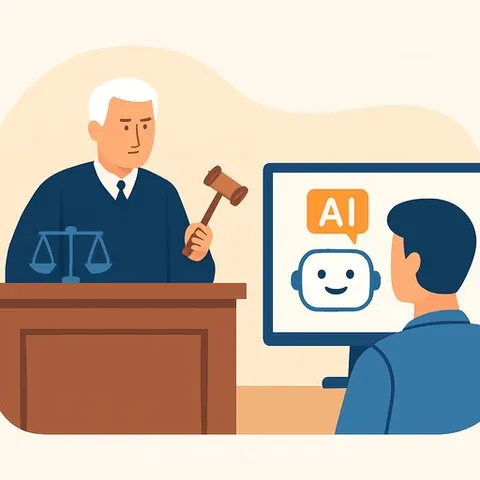
Federal Judge Rules AI Chatbot Conversations Aren't Protected Legal Privilege
Brad Heppner is guilty. A New York City jury convicted him in May 2026 on securities fraud, wire fraud, conspiracy, and making false statements to auditors. But the lasting impact of his case may not be the conviction itself - it's a federal judge's ruling that communications with an AI chatbot cannot claim attorney-client privilege.
Heppner, 60, was CEO of Beneficient, a Kansas-chartered investment company he marketed as a "pawn shop" for the wealthy. Federal prosecutors say he looted $150 million from a now-defunct holding company and funneled the money into his own accounts, causing $1 billion in damages to investors, predominantly retirees. He faces up to 20 years in prison on each charge and is scheduled for sentencing October 7.
Before his arrest, Heppner used Claude, Anthropic's AI chatbot, to seek legal advice on potential defenses. The FBI seized his computers and found 31 conversations with Claude. Heppner's defense team argued these conversations should be shielded from prosecutors under attorney-client privilege. The government disagreed.
The Ruling
Federal District Judge Jed S. Rakoff issued his decision February 17, 2026, a week after oral arguments. He answered what he called a "question of first impression nationwide": whether communications with a publicly available AI platform qualify for legal privilege.
The answer was no.
Rakoff identified three critical factors. First, Claude is not a lawyer and cannot provide formal legal advice - the platform itself tells users to contact an attorney. Second, legal privilege requires a "trusting human relationship," which doesn't exist between a user and an AI system. Third, Heppner had no reasonable expectation of privacy because Anthropic's user agreement explicitly allows the company to share information with third parties, including government authorities.
Rakoff also rejected the argument that conversations became privileged once shared with Heppner's actual attorneys. "Communications could not be 'alchemically changed' to privileged simply because they were later shared with counsel," he wrote. The conversations did not represent attorney work product because they predated any attorney strategy.
"The novelty of AI doesn't mean that it isn't subject to long-standing legal principles," Rakoff said in his opinion.
Legal Community Response
The ruling generated mixed reactions among legal professionals. The Harvard Law Review published an essay arguing that future courts should "resist the opinion's categorical tilt" and consider how privilege might operate differently in AI contexts. The New York State Bar Association framed the case as a cautionary tale about loose AI prompts.
Most commentary suggested Rakoff reached the right conclusion but possibly for incomplete reasons. Some characterized his approach as overly rigid.
For legal professionals, the practical implication is clear: communications with public AI platforms leave no room for privilege claims. If you seek legal advice using Claude, ChatGPT, or similar tools, expect that advice to be discoverable in litigation.
The Heppner Case Background
Heppner grew up in Hesston, Kansas, population 3,700. In 2021, he pitched the Kansas Legislature on creating the first trust company under the newly minted TEFFI Act, claiming it would fund rural economic development and help his mother avoid traveling for groceries. The Legislature, along with Governor Laura Kelly, backed the idea.
The only skeptic was Kansas bank commissioner David Herndon, who raised concerns about regulatory oversight. The Legislature responded by threatening to cut his office's budget to zero.
Beneficient opened offices in Hesston and Kansas. But clouds trailed Heppner from Texas. A federal class action lawsuit alleged he had defrauded investors to generate cash for Beneficient. The Securities and Exchange Commission opened an investigation. Heppner resigned as CEO in June 2025.
Federal prosecutors alleged Heppner spent $40 million of the stolen funds redecorating his eight-bedroom Dallas mansion, millions more on a ranch in east Texas, credit cards, private air travel, and $500,000 on jewelry.
His trial began April 21, 2026. The jury returned guilty verdicts on May 7.
What This Means for Your Practice
The ruling establishes that AI platforms are not substitutes for attorney consultation in privileged matters. If a client uses Claude or similar tools to discuss legal strategy, those conversations are not protected. This has several implications:
- Advise clients not to use public AI platforms for legal questions related to pending matters
- Understand that opposing counsel can request discovery of any AI conversations your client may have had
- Be aware that even if a client later shares AI conversations with you, those conversations don't retroactively gain privilege
- Consider whether your firm's own use of AI tools in legal work creates similar exposure
Rakoff acknowledged that generative AI represents "a new frontier in the ongoing dialogue between technology and the law." His opinion suggests courts will apply existing privilege doctrine rather than creating new exceptions for AI. Legal professionals should operate under that assumption until courts rule otherwise.
The Heppner case also serves as a reminder that AI cannot replace attorney judgment. When Heppner asked Claude for legal advice, the platform declined and suggested he contact a lawyer. He didn't. His conviction followed.
Learn more about AI for Legal professionals and understand how Claude AI functions in legal contexts.