
AI news ·
Kaiser nurses protest AI strategy as CEO details value-based care expansion
Kaiser Permanente cited a 15% drop in hospital stays from its value-based model. Outside, nurses protested that the system uses AI to automate staffing and clinical decisions.
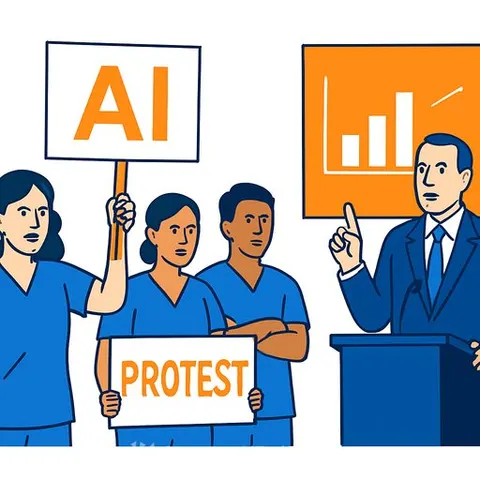
Kaiser Permanente CEO Greg Adams told hospital leaders Monday that the organization is making value-based care work at scale - citing shorter hospital stays and fewer emergency visits at recently acquired systems - while a group of the system's own nurses protested outside, arguing Kaiser is using AI to automate staffing and clinical decisions without their input.
The scene unfolded at the American Hospital Association's Leadership Summit in Denver. Adams briefly acknowledged the demonstration before outlining early results from Risant Health, the nonprofit vehicle Kaiser created in 2023 to acquire and operate health systems under its value-based care model.
Risant Health shows early operational shifts
Adams said more than 70% of Geisinger's physicians are now using Kaiser's value-based primary care guidelines. That change, he said, has freed up hundreds of specialty appointments, cut Geisinger's length of stay by nearly 15% on a case-mix-adjusted basis, and halved emergency department boarding. He credited an "intelligent triage" system that diverts patients who would have otherwise gone to the emergency department toward urgent care, primary care, or virtual visits.
Rather than reducing revenue, Adams argued the lower utilization created capacity for more patients. He tied the Risant strategy to a broader point: health systems can no longer treat daily operations and long-term transformation as separate choices. "We don't always get to choose the moment we lead," he said.
Nurses say AI is encroaching on their judgment
Outside in 97-degree heat, about a dozen nurses represented by the California Nurses Association gathered to protest Adams' appearance and Kaiser's AI strategy. They said the health system is using AI to decide nurse staffing levels and assess patient needs - tasks they said belong to frontline clinicians.
Terah Deason, a nurse at a Kaiser hospital in Santa Rosa, California, put it bluntly: "Kaiser is making billions and billions of dollars in profit, and they are investing a lot of that money into AI. The issue with that is that they're using AI to determine all kinds of things that nurses would normally determine, such as how many nurses we need in a day on the floor. They're using AI to assess how patients are actually feeling and what kind of treatment they're going to get. Basically, the concern is that they're going to use AI to start to replace us."
The protest highlights a broader tension over the use of AI for Healthcare and who controls its terms. The union isn't rejecting AI outright. Deason said nurses recognize the technology can be useful, but they want to decide when and how it's applied. "We should be the one to determine how it's used, and we should be the one to determine when it's appropriate," he said.
Bargaining over AI and worker voice
As a member of the Northern California bargaining team currently negotiating a new contract, Deason said nurses are pushing for contract language that guarantees them a say in AI deployment. He suggested that AI adoption could become a labor suppression strategy, making nurses more "disposable" if the technology is positioned as capable of doing their jobs.
Kaiser, in a statement, said it values its nurses and is committed to ensuring clinicians have a voice in the use of AI and other evolving technologies. "We look forward to continuing those discussions directly through the collective bargaining process," the statement read. Adams, during his session, said the organization is "fully committed to their being present to the work that we're doing around AI."
The gap between the stage and the sidewalk is less about whether AI belongs in healthcare and more about who sets the rules for its use. The nurses' concerns about automating staffing decisions point to a larger question for AI for Human Resources professionals: how to balance efficiency gains with worker participation. That tension is surfacing elsewhere, too. This month, a former Mayo Clinic research operations director sued the health system, alleging she was demoted and fired after raising concerns that AI projects were cutting corners on patient privacy and safety.
Why this matters for healthcare and HR professionals
For healthcare leaders, the Kaiser story shows that even when AI delivers operational results - shorter stays, fewer ED visits - it can create friction if frontline staff don't have a seat at the table. For HR and workforce managers, the protest is a concrete example of how AI adoption triggers demands for new contract language and shared governance. The question isn't whether AI will be used, but whether the people closest to patient care will have real power to shape how it's deployed.