Kazakhstan's AI push and SMR cooperation: What HR leaders need to act on in 2026
Kazakhstan is shifting from a raw materials model to a manufacturing and digital-first economy. For HR, this means new skill maps, new hiring patterns, and faster upskilling cycles.
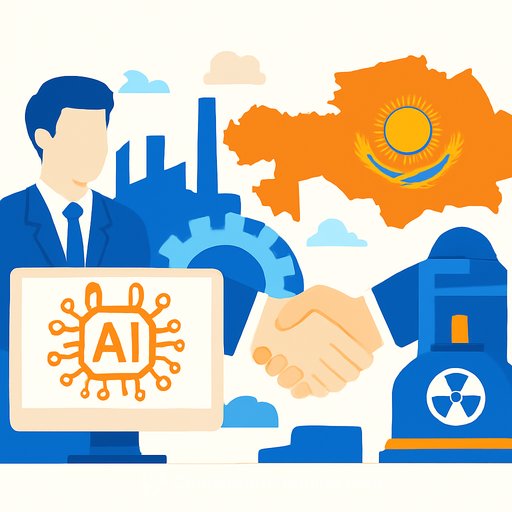
Here are the moves that matter: training one million people in AI skills by 2030, a growing manufacturing base anchored by foreign localization, and a U.S.-Kazakhstan initiative to build SMR (small modular reactor) talent. The window to build pipelines and internal training programs is open right now.
Manufacturing is scaling up - expect tighter competition for technical talent
Manufacturing output is projected to grow by ~6% in 2025, with faster gains in mechanical engineering and chemicals. Global firms are localizing: a Mars pet food plant in the Almaty region, a biopharma complex in the Alatau SEZ, and a full-cycle KIA plant in Kostanay anchoring supplier networks.
Heavy industry is deepening local procurement and adding rolling and casting capacity for higher value products. Most new facilities are built with exports to Central Asia and the EAEU in mind, which pulls in logistics, quality, and compliance roles.
- Build talent pipelines for production engineers, maintenance, quality, and HSE. Prioritize dual-skill profiles (e.g., mechatronics + data).
- Create supplier-aligned training academies in SEZs and mono-industrial towns to stabilize retention.
- Adjust comp bands for shift work and export-linked roles; add skill-based pay for PLC, CAD/CAM, and MES.
- Launch apprenticeship tracks with local colleges; tie completion to guaranteed wage steps.
- Stand up internal mobility between plants to reduce agency dependency and vacancy lag.
AI at national scale - one million trained by 2030
Kazakhstan crossed $1B in IT exports in 2025, targeting $5B next. The country opened ALEM AI, a regional AI center in Astana, and rolled out a supercomputing cluster (Alem.Cloud) that entered the TOP500. Today, 92% of public services are available online.
Government-backed programs plan to train students, civil servants, and entrepreneurs in AI tools. This is a direct signal for HR to codify AI competencies into job architecture, training, and performance.
- Run a role-by-role audit: list tasks that can be augmented by AI (analysis, drafting, reporting). Update job descriptions and KPIs accordingly.
- Set a baseline AI curriculum for all employees (prompting, data hygiene, review skills). Add advanced tracks for data, ops, and product.
- Introduce AI skill tiers with pay differentials; link to internal badges or external micro-credentials.
- Establish governance: acceptable use, privacy, vendor approvals, and human-in-the-loop review.
- Partner with universities and centers like ALEM AI to co-develop capstones and internships.
If you need ready-made pathways, consider the AI Learning Path for Business Unit Managers.
Productivity gains without mass layoffs
A joint study indicates ~70% of Kazakhstan's workforce has medium or high potential for productivity gains with AI, with jobs changing more than disappearing. 95 universities already teach AI disciplines, and an AI-focused university under the Alem.ai ecosystem is planned.
The signal for HR: focus on reskilling pathways over broad cuts. Make the move from headcount thinking to skills inventory thinking - and prioritize measurable improvements in Productivity as the outcome metric.
- Publish a company-wide skills taxonomy; map employees to skills, not just roles.
- Convert "at-risk" tasks into training modules; redeploy instead of replace where feasible.
- Add assessments that measure AI fluency (scenario-based prompts, data checks, critical review).
- Revise performance reviews to reward AI-assisted throughput and quality, not just volume.
SMR cooperation with the U.S. - new requirements for a nuclear-ready workforce
Under the U.S. Department of State's FIRST program, the Kazakhstan Institute of Nuclear Physics will receive an SMR classroom simulator in Almaty. U.S. firms Holtec International and WSC Inc. will develop it, with Sargent & Lundy supporting a national SMR feasibility study.
The site is expected to serve as a training hub for Kazakhstan and Central Asia. This supports energy security for economic growth and data infrastructure, while setting higher bars for safety, compliance, and specialized certifications.
- Define clearance, vetting, and safety culture criteria early; align job families with nuclear standards.
- Create certification ladders (operator, technician, safety, cybersecurity) with recognized providers.
- Draft partnerships with technical universities and the Almaty training hub for internship-to-offer pipelines.
- Coordinate with facilities, legal, and ESG teams on compliant shift patterns and fatigue risk management.
Program details: U.S. FIRST program.
Tourism spotlight: demand spikes in Mangystau
International coverage is lifting interest in the "lunar" scenery of Bozzhyra, Torysh, and Zhygylgan. Expect more seasonal hiring for guides, transport, hospitality, and safety roles.
- Prioritize local hiring and language training; add first-aid and remote safety modules.
- Set dynamic staffing models for peak seasons; secure housing and transport stipends early.
- Offer micro-credentials for eco-guiding and geosite preservation; tie to pay steps.
90-day HR action plan
- Days 1-30: Build a skills inventory; identify AI-augmentable tasks in top 20 roles; open MOUs with two universities or centers (e.g., ALEM AI).
- Days 31-60: Launch baseline AI training for all staff; stand up two apprenticeship tracks (manufacturing + data); update job descriptions and KPIs.
- Days 61-90: Implement skill-based pay tiers; roll out governance for AI use; finalize certification ladders for SMR-adjacent or HSE-critical roles.
Key signals to watch
- Manufacturing vacancy rates in Almaty region, Kostanay, and SEZ sites.
- AI course enrollments and completion rates vs. internal demand for data and automation skills.
- Progress on the SMR simulator hub in Almaty and feasibility outcomes for site selection.
- Tourism season bookings in Mangystau and related staffing lead times.
The macro trend is clear: Kazakhstan is investing in skills, production, and energy capacity. HR's advantage comes from moving early-codify the skills, build the ladders, and lock in the partnerships now.
Your membership also unlocks: