
AI news ·
Large language models reshape customer service with faster, scalable support
Large language models are taking over routine customer support tasks across e-commerce, banking, healthcare, and SaaS. They handle volume and speed well, but still fall short on emotionally complex situations that need human judgment.
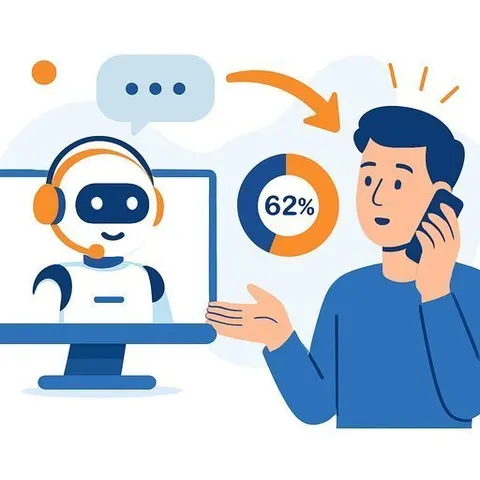
How LLMs Are Reshaping Customer Support Operations
Large language models are handling customer service work that once required human agents. Companies across e-commerce, banking, healthcare, and SaaS are deploying these systems to answer questions, process requests, and resolve issues faster than traditional support teams.
Unlike rule-based chatbots, LLMs understand context, detect sentiment, and generate responses that sound natural. They work 24/7, handle thousands of simultaneous inquiries, and reduce the repetitive work that slows down support operations.
What LLMs Actually Do in Support
AI for Customer Support systems perform specific tasks that free up your team's time. They track orders and process returns in e-commerce. They answer account questions and flag fraud in banking. They guide users through onboarding in software products. They schedule appointments and explain medical information in healthcare.
The key difference from older chatbots: these systems adapt to what customers actually say rather than forcing them into predefined paths.
The Measurable Benefits
Businesses report faster ticket resolution, lower operational costs, and higher customer satisfaction scores. Support teams spend less time on routine questions and more time on issues that need judgment or specialized knowledge.
- Instant responses reduce wait times and frustration
- Round-the-clock availability covers multiple time zones
- High-volume handling prevents bottlenecks during peak periods
- Consistent tone and accuracy across thousands of interactions
- Data from customer conversations reveals trends and pain points
Where These Systems Fall Short
LLMs struggle with emotionally complex situations. A customer angry about a billing error needs empathy and judgment-things AI can simulate but not truly deliver. A confused patient needs a human to listen carefully and think through options.
These systems also make mistakes. Training data gaps or ambiguous information can lead to incorrect responses. Sensitive customer data requires careful handling to prevent breaches.
The most reliable approach treats LLMs as tools that handle volume and routine work, with human agents ready to take over when complexity or judgment matters.
What's Changing Next
Future systems will detect emotions more accurately and personalize responses based on individual customer history. They'll hand off to humans smoothly when needed. They'll work across voice, chat, and visual channels instead of text-only.
The goal isn't to eliminate support jobs. It's to shift work toward problems that actually need human attention.
The Practical Reality
For support teams, this means learning to work alongside AI. You'll spend less time on repetitive tickets and more time on situations where your judgment makes a difference. You'll review AI responses for accuracy. You'll handle escalations that the system can't solve.
Understanding Generative AI and LLM fundamentals helps you use these tools effectively rather than resist them. The teams adapting fastest are the ones treating AI as a co-worker, not a threat.
For companies, the question isn't whether to adopt LLM-powered support-it's how to implement it without losing the human elements that build customer loyalty.