
AI news ·
Legal AI tools that answer too quickly erode junior lawyers' judgment, classroom pilot finds
AI training tools are making junior lawyers less confident, not more, according to classroom pilots run through Product Law Hub. When AI delivers answers before lawyers articulate their own reasoning, they stop thinking and defer to the output.
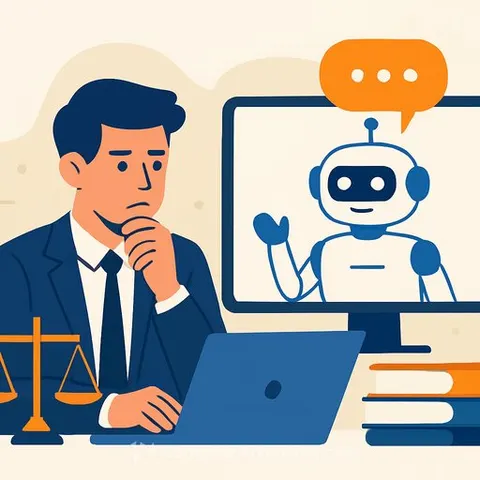
Legal AI Training Tools Are Making Junior Lawyers Worse, Not Better
Law firms are investing heavily in AI to accelerate junior lawyer development. The theory is straightforward: faster answers, cleaner summaries, and better issue spotting should help young lawyers ramp up quickly. Classroom research suggests the opposite is happening.
A series of empirical pilots conducted through Product Law Hub using an AI product law coach revealed that many legal AI tools are eroding the core skills junior lawyers need most. The problem is not accuracy. The tools generally provide sound legal guidance. The problem is timing.
When AI delivers answers before junior lawyers have articulated their own reasoning, they stop thinking. They defer to the system's output without fully understanding why it works. Over time, they become less confident, not more.
The Confidence Problem
Junior lawyers typically struggle with confidence and framing, even when they are technically capable. They hunt for the "right" answer instead of learning how to frame problems, assess tradeoffs, and explain risk in context. Confidence builds through repeated exposure to uncertainty and the experience of reasoning through it.
AI that jumps straight to answers short-circuits that process. It removes the productive discomfort that forces a junior lawyer to ask, "What am I missing?" or "Why does this matter to the business?"
In the classroom pilots, this showed up quickly. When the AI behaved like an answer engine, students disengaged. Quantitative usage data showed shorter sessions and fewer follow-up interactions. Students moved on faster, but they did not go deeper.
More concerning: several students reported feeling less confident after using answer-forward systems, even when they agreed with the output. They second-guessed themselves more. They felt less ownership over their own reasoning.
Why Practice Hides What Training Reveals
Classrooms surface these dynamics because learners have fewer incentives to hide confusion. They disengage visibly. In law firm practice, junior lawyers adapt instead. They comply, even if the tool is making them worse.
That matters because what happens in low-stakes learning environments will repeat under billable pressure. A tool that discourages reasoning in a classroom will do the same when a junior lawyer is trying to bill hours and please a partner.
The Design Question
The pilot data showed a clear difference: when AI forced students to slow down by asking clarifying questions or prompting them to articulate tradeoffs before responding, engagement increased. Students stayed longer, revised their thinking, and were more willing to defend their conclusions.
The difference was not intelligence. It was design.
AI can support junior lawyers when it behaves like a mentor instead of an oracle. The most effective interactions occurred when the system asked questions before giving answers, explained why an issue mattered in context, and made tradeoffs explicit instead of hiding them. Those choices kept the human in the loop cognitively, not just procedurally.
What Firms Should Optimize For
If firms want AI to help junior lawyers improve, they need to be honest about what they are optimizing for. Speed is easy to buy. Judgment is not.
Tools that prioritize instant answers may look efficient in demos, but they risk producing lawyers who are faster and less capable at the same time. That is not a trade most firms would accept if they saw it clearly.
The classroom data suggests a simple but uncomfortable truth: AI does not automatically make junior lawyers better. In many cases, it makes them worse, unless it is deliberately designed to slow them down, challenge them, and force them to think.
That may feel counterintuitive in a profession obsessed with efficiency. But judgment has never been built quickly. AI should not pretend otherwise.
For more on AI for Legal professionals and how to approach AI deployment thoughtfully, explore relevant resources on how AI can support rather than undermine skill development across the legal profession.