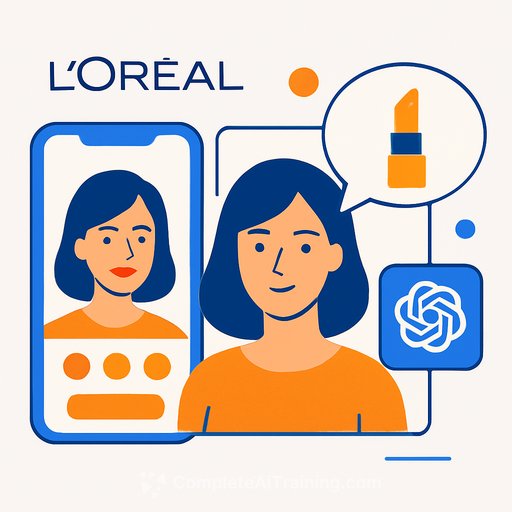
L'Oréal and OpenAI announced a strategic partnership at VivaTech 2026 in Paris that will embed OpenAI's models across the beauty giant's consumer experiences, scientific research, and internal operations. For marketing teams, the deal signals a direct path to AI-powered virtual try-ons, conversational product discovery, and scaled brand content - all inside platforms already used by millions.
The collaboration will let consumers virtually apply Maybelline New York makeup through a ChatGPT interface, using L'Oréal's ModiFace augmented reality technology. The feature turns a text conversation into a visual, interactive shopping moment. L'Oréal also plans to improve product discovery for its full brand portfolio - Lancôme, Kérastase, and others - inside ChatGPT in the U.S., with AI-driven recommendations guiding purchases.
Advertising pilots and the new purchase journey
Three L'Oréal brands - SkinCeuticals, CeraVe, and Garnier - are joining OpenAI's ChatGPT advertising pilot. The experiment explores how brands can reach consumers at the exact moment of product discovery and purchase intent, rather than interrupting their experience elsewhere. For marketers accustomed to search and social ads, this represents a shift toward conversational commerce surfaces where recommendation and transaction merge.
The partnership extends beyond consumer touchpoints. L'Oréal will use GPT-Rosalind, OpenAI's life sciences reasoning model, to study the skin microbiome at scale. The company expects the model to help identify beneficial microorganisms and speed up skincare development, starting with La Roche-Posay. This connects R&D directly to future product claims and positioning - raw material for marketing narratives built on proprietary science.
Scaling creative production without losing brand identity
OpenAI's models are being integrated into CreAItech, L'Oréal's internal generative AI content platform. The system produces images and videos while preserving each brand's distinct identity. Creative teams can scale content output without the usual trade-off between volume and consistency - a persistent tension for global brand organizations managing dozens of sub-brands across markets.
L'Oréal reports that more than 73,000 employees have already been trained in generative AI and use internal tools including L'OréalGPT and AI-powered digital assistants. The CreAItech integration layers OpenAI's latest capabilities on top of an existing foundation, suggesting the company is moving from experimentation toward operational dependence. For marketing leaders, the internal adoption numbers matter: they indicate an organization where AI literacy is becoming a baseline expectation, not a specialist skill. Those looking to build similar fluency can explore structured AI for Marketing Courses that focus on practical application rather than theory.
Leadership perspectives on the collaboration
Asmita Dubey, Chief Digital and Marketing Officer at L'Oréal, said the collaboration reflects the company's ambition to use AI to improve consumer experiences while also empowering employees and transforming core business functions such as marketing and research. Emmanuel Marill, OpenAI's Managing Director for Europe, the Middle East and Africa, said the partnership builds on L'Oréal's combination of science, creativity and technology, with AI expected to play an increasingly important role in innovation and customer engagement.
Why this matters for marketing professionals
This partnership makes AI-powered beauty commerce a live channel, not a concept. Marketing teams should watch how virtual try-on inside ChatGPT affects conversion paths and whether conversational advertising pilots produce measurable intent signals that rival search or social formats. The deeper lesson is organizational: L'Oréal trained 73,000 employees before layering advanced models into production. Marketing leaders who want to deploy similar tools - whether from OpenAI or other providers - need teams that already understand prompt engineering, output review, and brand governance. Building that capability often starts with targeted upskilling through resources like OpenAI Courses tailored to marketing workflows. The technology is ready; the bottleneck is team readiness.
Your membership also unlocks: