
AI news ·
L'Oréal strikes deal with OpenAI to power marketing content and virtual try-on
L'Oréal partners with OpenAI to add its image model to CreAItech. The system cut production costs by 40% last year and created 50,000 assets.
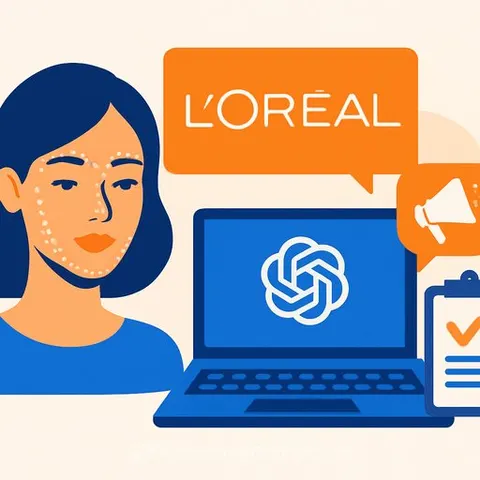
L'Oréal has struck a partnership with OpenAI that will give the beauty company access to the latest generative AI models for its in-house content production engine, CreAItech, and see subsidiary brand Maybelline build a virtual try-on feature directly into ChatGPT. The deal, announced June 19 at the VivaTech conference in Paris, adds OpenAI's image model to a system that already helped L'Oréal cut production costs by 40% last year.
Asmita Dubey, L'Oréal's chief digital and marketing officer, said the company is "both eager to do a foundational partnership. We believe we can be more demanding of AI." The agreement also includes access to GPT-Rosalind, a reasoning model built for the life sciences sector, for the company's R&D division.
CreAItech's expanding model toolkit
CreAItech, which L'Oréal began developing in 2024 and rolled out last year, now incorporates models and tools from Seedance, Google (Gemini, Veo3 and Imagen), Adobe and Stable Diffusion. The addition of OpenAI's image model is driven by the quality of its text-to-image rendering, Dubey said. "They come with different strengths. We want to add OpenAI's image model because the text-to-image rendering is so good."
The system is used by the company's 10,000-strong marketing staff globally to produce stills and video for social media, e-commerce and other channels that demand a high volume of visual assets. During the 2025 full-year earnings call, CEO Nicolas Hieronimus told analysts that CreAItech had halved production costs and that staff had created 50,000 marketing assets with the suite. An earlier deal with Nvidia in 2025 focused on more efficient GPU usage as the operation scaled.
For marketers looking to build similar capabilities, structured AI Learning Path for Marketing Managers resources can help teams evaluate which models and workflows fit their production needs.
Product discovery and advertising on ChatGPT
The partnership also changes how L'Oréal products appear in AI-generated responses. The company will now supply up-to-date product information directly to OpenAI for inclusion in the models that power ChatGPT, so that when users ask about its products, the tool pulls from L'Oréal's own data rather than relying solely on the open web.
L'Oréal has been running paid ads on ChatGPT since April, testing the platform with its CeraVe, pharmaceutical and Garnier brands in the U.S. "It's early days," Dubey said, noting the company is "testing the advertising product to see what consumers are [looking at], whether they click to buy." The move reflects a broader shift in personal care, where Gartner analyst Greg Carlucci noted that "nearly one in five consumers now use generative AI tools to find information," and brand websites are seeing traffic declines as consumers shift to AI-led search.
Measuring AI's impact on marketing
L'Oréal tracks the performance of its AI systems through a proprietary tool called BETiQ. Dubey said the company aims to build a flywheel where automated creative effectiveness data feeds into media decisions, but that the vision is still taking shape. The metrics in play range from hours saved and content volume to ROAS and click-through rates. "Whenever we think about measurement, we are thinking about reduce, increase, improve," she said.
The hours reclaimed by CreAItech are already being reinvested. Worldwide advertising and promotions spend - which accounts for 32% of sales - rose 10% year over year to $15.48 billion. Roughly 60% of that goes to paid social, and the company works with 500,000 influencers and creators annually. AI systems also help craft briefs and manage creator relationships at scale. "When you have hundreds and thousands of [creators], you can't just WhatsApp them," Dubey said.
Why this matters for marketing professionals
L'Oréal's rapid expansion of its generative AI content engine shows that enterprise marketing teams are moving beyond experimentation and into production at scale. The 40% cost reduction on 50,000 assets signals that in-house AI tools are no longer theoretical - they are reshaping budget allocation, creative workflows, and the role of external agencies. For marketing leaders, the challenge is not just adopting models but measuring their impact across both efficiency and media performance metrics. As brands like L'Oréal redirect saved hours into higher ad spend and creator partnerships, the competitive advantage will go to teams that can connect AI production speed with smarter media planning. The broader trend, AI for Marketing adoption, is accelerating across industries, and the lesson from Dubey's team is that the technology "augments creativity" even as it changes who does what - and how fast.