
AI news ·
Managers are the main barrier to AI adoption in organisations, Gallup finds
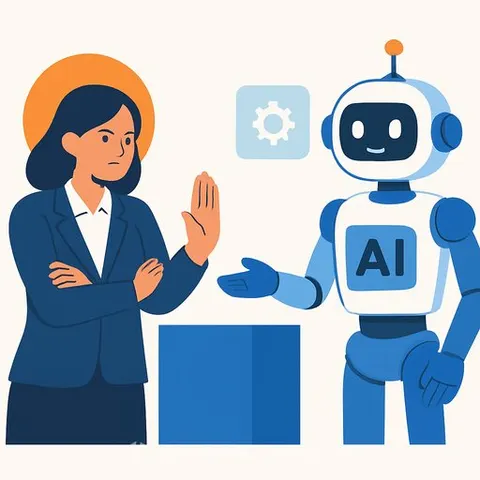
AI productivity gains aren't reaching company profits, Gallup found after surveying 264,000 workers. The main barrier: fewer than a third of employees say their manager actively supports AI use.
AI productivity gains aren't translating to company profits, Gallup finds
Employees in organizations using AI report improved personal productivity, but the technology is failing to boost organizational performance or the bottom line. A Gallup study of nearly 264,000 workers across 160 countries identified a critical bottleneck: managers who don't actively support AI adoption.
Among US workers in AI-implementing organizations, 65% said the technology had a positive impact on their individual productivity. Yet only 12% strongly agreed that AI had transformed how their organization works. The disconnect between personal gains and company-wide benefits mirrors what executives are seeing.
A National Bureau of Economic Research survey of thousands of leaders in the US, UK, Germany, and Australia found that 89% reported zero impact on labor productivity over the past three years, despite widespread AI use. Those same executives expect AI to boost productivity by 1.4% in the next three years.
Manager support drives adoption
The strongest predictor of whether employees use AI-aside from technical integration-is whether their direct manager actively champions it. In US organizations implementing AI, employees whose managers strongly supported AI use were highly likely to see the technology as transforming their work.
The problem: less than a third of US employees in AI-implementing organizations strongly agreed their manager actively supported their team's use of the technology. In Germany, only 21% of employees in organizations using AI said their manager provided active support.
Gallup CEO Jon Clifton said the issue isn't the technology itself. "Large language models can draft legal contracts, write code and synthesise research at speeds no human team can match. But those gains are not showing up in the bottom line."
A recent MIT study found that despite roughly $40 billion in enterprise investment, 95% of organizations saw zero measurable impact on profits.
Management practices account for significant productivity variation
Research from Stanford, Harvard Business School, and MIT found that differences in management practices account for roughly 30% of variation in total factor productivity-the standard measure of how technology affects output. Poor management can erase the benefits of sophisticated tools.
Gallup researchers concluded that AI tools could provide managers with real-time, personalized coaching grounded in management science. Few managers have received formal training in effective people management, despite its outsized impact on organizational results.
Job loss concerns rise in AI-adopting organizations
In the first quarter of 2026, 18% of US employees said their job was very or somewhat likely to be eliminated in the next five years due to automation or AI. In organizations that had implemented AI, that figure jumped to 23%.
Concerns were highest in finance (32%), insurance (32%), and technology (31%) sectors. A separate Gallup survey in Germany found 19% of employees in AI-using organizations worried their job would be eliminated within five years.
Workforce changes appear mixed. Among US employees in large organizations (10,000-plus staff) where AI had been implemented, 33% said their employer was reducing headcount compared to 30% expanding. Smaller organizations (5,000-10,000 employees) showed the opposite: 38% expanding versus 23% reducing.
Organizations adopting AI are more likely to change workforce size-either direction-than those without AI. While some sectors face job losses, the overall employment effect has not been uniformly negative.
Employee engagement matters
Organizations with engaged employees navigate major disruptions more successfully. Employee disengagement erodes productivity gains from AI tools, while active disengagement creates security risks.
For HR professionals, the data points to a straightforward priority: ensuring managers actively support and coach their teams through AI adoption. Without that foundation, even the most powerful technology will sit underutilized.
Learn more: Explore AI for HR Managers Courses or browse AI for Human Resources resources.