
AI news ·
Marketers argue taste becomes the scarce resource as AI floods culture with content
Generative AI made content infinite, which flipped marketing's core problem: attention is no longer scarce, but taste is. Most brands are still optimizing for reach while missing what audiences actually want.
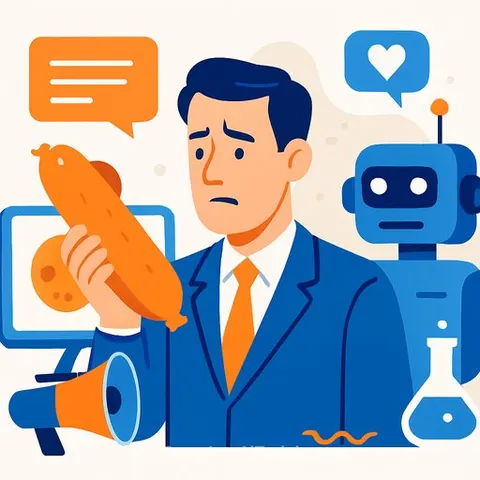
Taste Is Now Marketing's Rarest Asset
Generative AI has made content production cheap and infinite. That changed what's actually scarce in culture, and most brands haven't caught up.
For the past decade, marketing operated on a single principle: reach more people, feed the algorithm, produce more content. Then AI arrived and pushed that logic to its end point. Now anyone can generate anything for almost nothing. The feed never empties.
But somewhere in that abundance, the market inverted. Attention stopped being the bottleneck. Taste became it-the judgment to recognize what's good, and the authority to say so publicly.
The problem is that most brands have no idea what people actually want because they're reading the wrong signals. Popularity and quality have decoupled. The metrics layer is making it worse.
Sarah Story, a DJ and label boss whose BBC Radio show made her one of the UK's most trusted taste-makers, sees this constantly. "A lot of labels are getting influencers to push tracks and it's blown up and it's not necessarily great," she said. Her solution is deliberate: she ignores the numbers entirely. When music arrives-from SoundCloud, TikTok, or a USB handed to her mid-set-she applies one filter. "Is this a good record? Will I play this in a club? If I will, I'll go with it."
That instinct matters more than algorithms now. Veo, a sports tech startup, runs its TikTok operation with 17-year-olds and gets 26 million organic views. But a sharper example is the People's Puskás Award, a competition celebrating the best grassroots football goals captured on camera worldwide. Last year's winner was a player in Cork, Ireland. The year before, a 16-year-old in the French fifth tier whose overhead kick landed him on national television. Veo went looking for quality where no one else was. The audience followed.
"The best goal is happening every week all over the world," said Rob Scotland, head of brand at Veo.
Taste Requires Institutional Cover
For marketers, trusting instinct over metrics is risky. Their discipline sits as close to art as any science gets, yet it has been systematized so thoroughly that the alchemy that built the world's biggest brands got coded away. Going against that industrial logic is daunting. When it goes wrong, it's on you.
But that reputational skin in the game is exactly what gives taste its value. Media executives understand this better than most. Nick Sargent, who held multiple positions at Condé Nast including chief business officer for CULTURE, said: "I wanted to make sure that journalists were in a protected position where they didn't have to worry about money or funds or costs."
Taste requires institutional cover. Without it, the reputational risk lands on the individual. Most organizations aren't built to absorb that.
The smarter ones are starting to figure it out. Unilever pushed into the creator economy. Gap hired its first chief entertainment officer. Netflix bakes viral hooks into shows from the ground up. JD Sports is rethinking stores not as retail space but as places where kids can show up, compare products, and feel part of something. None are trying to buy their way into culture. They're trying to already be there.
Depth Beats the Algorithm
Conor McNicholas, former NME editor, learned this the hard way. "The brand function of NME was to connect culture-hungry young music fans with inspiring music," he said. "That's what you do."
When digital arrived and magazines became ineffective vehicles for that mission, NME moved into TV, radio, and social. The format changed. The mission didn't. Most brands chasing the next algorithmic shift get exactly that backwards.
Charlotte Mair, founder of cultural communications agency The Fitting Room, put it plainly: "I think brands today are being built to sell. Previously they were built to add value, to give a service, to play a part in society. That depth has been completely lost."
And yet that depth is exactly what people are hunting for. Vinyl sales are surging. Physical magazine sales are up 20 percent. Running clubs have replaced superclubs. Gen Z shoots on point-and-click cameras-drawn to what James Kirkham called "the friction and the difficulty." Substack is booming. People buy paper tickets not to get in, but to remember they were there.
Even 12-year-olds show the same instinct. Music producer Tunde Babalola said of his son's peer group: "When I was a kid everyone wanted to be a DJ, then the generation after wanted to be a producer using Fruity Loop on the PlayStation Two, but now everyone's got their own streetwear label. It's like 200 kids hanging around every Saturday, talking, sharing ideas."
The medium is new. The impulse is ancient-to seek out culture, find connection through it before anyone tells you what to like.
Availability Isn't Experience
Sarah Borman, Universal Music Group's head of Gen Alpha, worries the industry is sleepwalking into destroying that impulse. Her distinction is simple: with 700,000 tracks uploaded to Spotify every week, the industry convinced itself the problem is scarcity. For the generation coming up, it's barely begun.
"We all have this illusion that music is everywhere. But if you're a child, your access is limited by so many things," she said.
Availability is not the same as experience. Real, felt, and remembered experience is the only thing that builds the kind of relationship between people and culture that brands spent a decade trying to replicate with targeting tools and optimization budgets.
Charlie Copsey, founder of experience company Underground Fan Club, built a business on creating exactly those conditions. Her measure of success isn't reach. It's whether someone leaves feeling something unexpected. After a recent dinner for 20 women runners, one attendee messaged her: "I've never walked into a room and felt so included in my life."
Brands consistently squander that by treating talent like a commodity. The instinct to build differently exists. The case is obvious. Getting it signed off is another matter entirely.
"When you work with the right person, they love what you're doing as much as the fans," Copsey said.
The plainest summary of where things stand: "We spent a decade learning how to go viral. But the cleverest ones are now trying to see how they can look quiet. It's how they look legit."
Because legit can't be manufactured at scale. It has to be earned-one good call at a time in front of people who'll notice if you get it wrong.
For marketers navigating an age of infinite content, that distinction matters more than any algorithm ever will. Learn more about AI for Marketing to understand how to apply these principles in practice.