
AI news ·
Microsoft and Mayo Clinic partner to build a frontier AI model trained on clinical data
Microsoft and Mayo Clinic announced a partnership June 2, 2026, to build a medical AI model trained on clinical data rather than general internet text. Mayo Clinic will own the finished model.
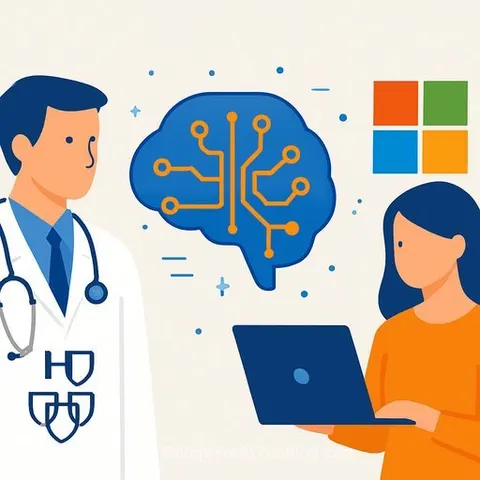
Microsoft and Mayo Clinic Build AI Model Designed for Medicine, Not General Knowledge
Microsoft and Mayo Clinic announced a partnership on June 2, 2026, to develop a frontier AI model trained exclusively for healthcare. The collaboration combines Mayo Clinic's anonymized clinical data and medical expertise with Microsoft's AI engineering and cloud infrastructure.
The distinction matters. General AI tools trained on internet data can produce plausible-sounding health information while missing the clinical precision that real diagnosis requires. That gap becomes dangerous when patients face complex conditions, ambiguous symptoms, or treatment decisions that depend on subtle patterns in their medical history.
This model aims to close that gap by training on data from actual clinical practice rather than the broader digital world.
How the model will work
The system will support clinical reasoning across a wide range of medical situations. It will help care teams analyze complex patient information, synthesize data from multiple sources, and identify patterns that might point toward earlier diagnosis or more personalized treatment.
Earlier diagnosis matters enormously in medicine. Many serious conditions respond far better to treatment when caught before they advance. A system that spots subtle signals across a patient's history and test results could compress the time between first concern and confirmed understanding in ways that directly affect outcomes.
Beyond supporting doctors, the model aims to serve patients directly by expanding access to trusted medical knowledge. A person in a rural area or a country with fewer specialist resources could access the same depth of information available to patients at Mayo Clinic's main campus.
Ownership and distribution
Mayo Clinic will own the finished model. That ownership structure keeps clinical accuracy and patient data responsibilities anchored in the organization whose reputation depends on getting medicine right, rather than distributing those responsibilities across competing commercial interests.
Microsoft will make the model available through its Azure cloud platform using application programming interfaces. Hospitals and health systems worldwide can eventually integrate it into their workflows without building the underlying AI from scratch.
Before broader rollout begins, the model will deploy within Mayo Clinic's own clinical environment. Real-world healthcare applications will test its outputs against actual patient care decisions and allow developers to identify and correct weaknesses under controlled conditions.
Earlier projects built the foundation
This announcement does not arrive without history. Microsoft and Mayo Clinic have been building toward this collaboration through earlier AI projects that explored specific clinical applications.
In early 2025, the two organizations announced AI work in radiology-developing systems that automatically generate reports from chest X-rays, evaluate tube and medical line placement, and detect changes between current and prior images. These tasks currently consume significant radiologist time and AI can perform them in seconds with the accuracy needed to support clinical judgment.
Mayo Clinic also worked with Cerebras Systems on a genomic foundation model, combining reference genome data with Mayo's patient exome records to explore AI's potential in personalized medicine at the molecular level.
Those earlier projects established both the technical groundwork and the trust required to attempt something more ambitious. They also demonstrated a consistent philosophy: healthcare AI should serve clinical judgment rather than override it, operate with rigorous standards for accuracy and safety, and keep the institution treating patients in control of how the technology develops.
The frontier model announced this month carries those principles forward into a system designed for the full scope of clinical medicine. The question it now sets out to answer is whether AI trained deeply enough on the right data can genuinely help the healthcare system deliver better outcomes for more people, more of the time.
Learn more about AI for Healthcare and Generative AI and LLM applications in clinical settings.