
AI news ·
Microsoft CEO Satya Nadella says companies must build proprietary AI systems to retain economic value
Microsoft CEO Satya Nadella warned against a few AI models capturing all economic returns in a post with 28 million views. He urged companies to build proprietary token capital.
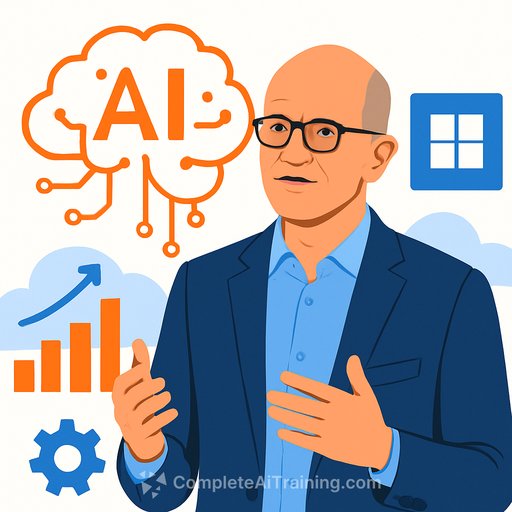
Microsoft CEO Satya Nadella warned last night on X against a future where a handful of AI models capture all economic returns, in a post that has surpassed 28 million views. He argued that enterprises must build their own "token capital" to prevent proprietary expertise from being commoditized by general-purpose AI systems. This shift directly impacts how organizations protect institutional knowledge and workforce value.
The threat of commoditized expertise
In the past, companies bought digital tools to make employees more efficient. Today, AI models can absorb human expertise and turn proprietary capabilities into standardized services. Nadella said, "every company in every industry is ceding value to a handful of all-consuming models." He added, "We must not allow a few AI systems to capture all the economic returns."
As organizations face this transition, leaders in HR must understand how to protect and value employee expertise through AI for Human Resources strategies. Protecting this value requires shifting focus from mere tool adoption to building internal data moats.
Human capital versus token capital
Nadella introduced two core concepts for the AI-driven economy. Human capital includes employees' knowledge, judgment, relationships, creativity, and pattern recognition. Token capital represents the AI capabilities built and owned directly by the enterprise. He argued that human capital does not lose value as token capital grows. Instead, human agency drives the growth of token capital by setting goals and connecting information across domains.
Building a private learning loop
The real opportunity lies in building a learning loop on top of existing models, rather than just selecting the best one. Companies must transform workflows and accumulated judgment into AI systems that improve with every use. This requires a private evaluation system to track progress on business-critical outcomes, rather than relying on external benchmarks. A private reinforcement learning environment allows the model to grow stronger by learning from internal execution trajectories.
Nadella described this cycle as a stair climber with a compounding effect. Companies that build this system early will gain a distinct advantage, regardless of new capabilities emerging in individual models.
Industry reactions and strategic stakes
The post drew a tongue-in-cheek response from Elon Musk, who called the article "interesting." This interaction highlights underlying tensions regarding Microsoft's reliance on external AI models. Musk previously suggested that OpenAI would eventually replace Microsoft's software moat. Nadella's latest comments suggest a strategic pivot toward ensuring enterprises retain control over their data and intellectual property.
Why this matters for Human Resources
HR professionals must prepare for a shift in how employee value is measured and protected. As companies build proprietary AI systems, workers will need to focus on high-level judgment, relationship building, and pattern recognition. These are skills that cannot be easily outsourced or automated. To manage this strategic shift, executives can explore an AI Learning Path for CHROs to align talent development with enterprise AI sovereignty.