
AI news ·
Microsoft's Dynamics 365 Contact Center puts pressure on Genesys, NICE, and AWS to consolidate fragmented AI tools
Microsoft launched Dynamics 365 Contact Center, combining customer service, quality monitoring, and agent coaching into one AI-driven system. The move puts direct pressure on Genesys, NICE, and AWS Connect to rethink their fragmented approaches.
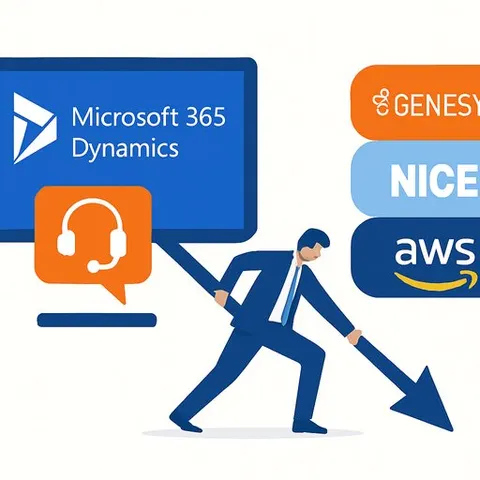
Microsoft's Unified Contact Center Platform Forces Rivals to Rethink Strategy
Microsoft has launched Dynamics 365 Contact Center, an AI-driven platform that combines customer service, quality management, and agent assistance in a single system. The move directly challenges competitors like Genesys, NICE, and AWS Connect, which have traditionally offered fragmented tools that work in isolation.
The platform integrates three AI agents: Customer Assist Agent handles customer interactions, Quality Assurance Agent monitors calls, and Agent Assist Agent coaches representatives in real time. This orchestrated approach differs from traditional contact center software that bolts AI features onto existing systems as separate modules.
For contact center leaders, the shift raises a fundamental question: Is unified automation worth the risk of deeper dependence on a single vendor?
The Case Against Fragmentation
Traditional contact center platforms have long relied on separate tools for self-service bots, agent coaching, and quality monitoring. These disconnected systems create operational friction-data doesn't flow smoothly between tools, and managers lack visibility across the entire customer journey.
Microsoft's integrated approach threatens to make modular solutions obsolete. Organizations are increasingly treating AI for Customer Support as a top priority for generative AI investment, and they want platforms that deliver end-to-end orchestration, not patchwork solutions.
The pressure on incumbents is real. If Genesys, NICE, and AWS Connect cannot replatform around unified agentic systems, they risk losing relevance as enterprises consolidate spending around fewer, more capable vendors.
Reliability Is the Unspoken Problem
Unified AI agents promise efficiency, but they also concentrate risk. A single AI error-a hallucination, a misrouted call, a compliance violation-can damage customer trust and invite regulatory scrutiny.
AI hallucinations and reliability failures have become top-tier concerns for organizations running generative AI in production. In customer service, the stakes are higher than in most business functions. A misstep during a claims call or financial dispute can permanently erode customer loyalty.
The vendors that win this market will deliver not just automation, but verifiable, auditable trust. That means transparent decision-making, clear escalation paths, and systems that fail gracefully when they encounter situations outside their competence.
Voice Is Becoming Strategic Again
As chat, email, and self-service portals become standard, voice is re-emerging as a competitive advantage. For B2C companies, voice remains the channel customers use when emotions run high-insurance claims, healthcare disputes, financial problems, loyalty issues.
AI-augmented voice, where agents receive real-time coaching and calls are automatically monitored for quality, transforms voice from a cost center into a brand-protection asset. Microsoft's platform is well-positioned to capitalize on this shift because it treats voice as a core capability, not an afterthought.
B2B companies face similar pressures. Complex sales cycles, multi-stakeholder account management, and technical escalations all depend on voice quality. A unified platform that captures voice intelligence, feeds it into CRM and ERP systems, and applies automated quality assurance at scale gives B2B organizations an operational edge that fragmented tools cannot match.
Vendors that treat voice as a commodity channel will lose ground to platforms that embed voice intelligence into the broader enterprise system.
This Is Now a Board-Level Decision
Platform consolidation in customer experience has moved beyond IT procurement. Boards are demanding measurable ROI from AI investments, and unified platforms promise faster time-to-value and simpler governance.
Microsoft's move is a direct play for this consolidation, but it also raises uncomfortable questions. Will enterprises accept deep lock-in with a single vendor? Will they demand open orchestration standards? Can they maintain flexibility if they consolidate around one platform?
The AI Agents & Automation conversation is no longer confined to technology teams. C-suite executives are asking whether agentic AI in customer service justifies the operational and strategic risks.
What Comes Next
- Competitor Response: Genesys, NICE, and AWS Connect must decide whether to rearchitect their platforms for agentic integration or accept market share losses.
- Reliability Proof: Microsoft's agents must deliver the consistency and transparency that regulators and enterprise boards require. One high-profile failure could slow adoption significantly.
- Lock-In Backlash: Enterprises may demand open standards and multi-vendor orchestration capabilities to avoid vendor dependence.
- Budget Reality: Increased AI spending doesn't automatically mean platform consolidation. Many organizations will hedge with hybrid, multi-vendor strategies through 2027.
For contact center professionals, the message is clear: the tools and platforms you use are changing. The question is whether your organization will lead the shift to unified agentic systems or follow competitors who move faster.