
AI news ·
Moody's warns banks' rush to adopt AI creates new risks from Silicon Valley dependence
Banks' reliance on a few AI providers risks systemic outages and price gouging, Moody's warns. Over 75% of London financial firms now use AI, with a 20% chance it will replace mid-level employees by 2030.
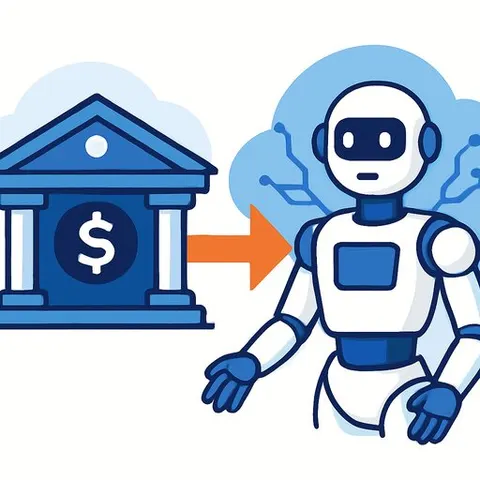
The race to adopt AI is creating a new vulnerability for the world's largest banks: dependence on a small group of Silicon Valley firms, leaving lenders exposed to widespread outages and price increases, according to a new report from Moody's.
The financial sector's push to integrate AI into daily operations will eventually cut costs and increase revenues across the City of London and Wall Street, the rating agency said. But that will require "substantial investments," and with so many rivals chasing the same goal, many of those benefits will end up being "competed away."
Systemic dependency on a few tech providers
"The reliance of most financial firms on a relatively small set of foundation AI model and cloud computing providers risks creating a systemic dependency," the Moody's report said. "This is because a model outage at one major provider could potentially spread quickly across customers and sectors. As AI adoption deepens, regulators may increase their focus on operational resilience and third-party concentration in the AI model stack."
More than 75% of City companies now use AI, according to a UK Treasury select committee report published in January, with insurers and international banks among the biggest adopters. They are mostly using it to automate administrative tasks or help with core operations, including processing insurance claims and assessing customers' creditworthiness.
Vendor dependency and price gouging risks
The AI race also risks creating "vendor dependence risk," Moody's said, meaning that "a set of dominant AI model and infrastructure providers could, over time, exert control over the price of AI services." That issue is likely to emerge as the bosses of loss-making generative AI companies, including OpenAI and Anthropic, come under pressure to deliver profits for investors.
"While this could pose credit risks to financial firms, they would nevertheless retain control over key assets, including proprietary data," Moody's said. Many big banks and insurers also have longstanding experience negotiating down tech contracts, and may be using open-source AI models and striking key partnerships to try to offset "dependency risks." If you're a finance professional looking to understand these dynamics and the strategic side of AI adoption, the AI Learning Path for CFOs covers vendor risk analysis, cost management, and financial automation - all themes at the center of this Moody's report.
Job displacement and deposit flight
Moody's acknowledged the potential blow to some staff, who could be deemed replaceable as a result of new tech. Its report said there was a 20% chance that, by 2030, AI will be able to do the work of a "solid mid-level employee."
Lloyds Banking Group's chief executive, Charlie Nunn, recently doubled down on AI investment plans with a £13bn strategy that would involve using the technology to lure new business and increase payouts for shareholders. That will involve £2bn of cost cuts, which Nunn said would affect staff. "That is going to impact work. It is going to require us to continue to reskill people and hire new people, but that's been my history for 30-odd years in financial services."
For banks, AI might also make it easier for customers to switch to accounts offering higher interest rates, creating the possibility that large chunks of cash could be moved at short notice. "In this context, depositors' trust in the institution and the resilience and stability of deposit funding are critical," Moody's said. For finance professionals across the sector, AI for Finance resources can help make sense of how these risks - from vendor dependency to deposit flight - play out in day-to-day operations and long-term strategy.
Why this matters for finance professionals
If you work in a bank, insurer, or any financial firm using AI, the Moody's report makes clear that your employer's biggest risk isn't just missing out on AI's potential - it's building too much trust in a single provider. The next operational resilience crisis for a major lender may not be a trading floor error or regulatory fine, but a sudden model outage at one of the handful of companies that now powers your AI systems. For finance professionals, the takeaway is simple: in-house knowledge of AI model evaluation, third-party risk management, and vendor negotiation is no longer optional - it's a core part of banking stability.