Nafis 2026: Five AI-enabled priorities to raise the quality of Emiratisation in the private sector
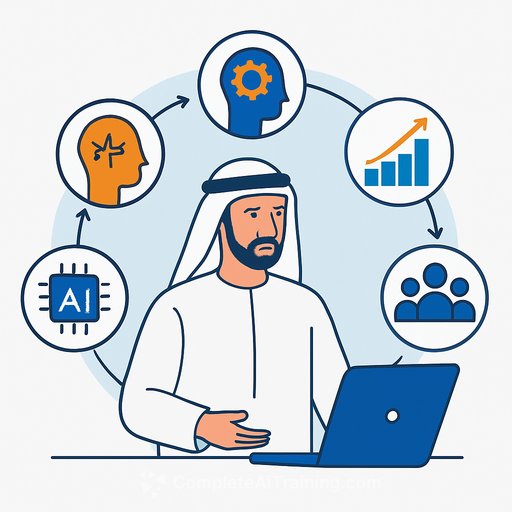
The Emirati Talent Competitiveness Council (Nafis) has shifted its focus from headcount to impact. Under the Nafis 2026 vision, the programme will use AI-enabled priorities to measure, improve, and sustain the quality of Emiratisation across the private sector.
The aim is clear: place Emiratis in future-focused roles, build skills pipelines early, and make employers active partners in talent creation. For HR leaders, this is a move from filling roles to building capability that sticks - see the AI Learning Path for Training & Development Managers for practical examples and role-specific learning design.
Why this matters for HR
Headcount targets are giving way to measurable outcomes: skill depth, role quality, and career continuity. HR teams will be expected to prove role relevance, skills progression, and retention in future-critical jobs. This is where AI-supported training, better job architecture, and data-led workforce planning come together.
The five AI-enabled priorities under Nafis 2026
- Future roles first: Shift hiring and development toward jobs aligned with economic transformation and market needs, with clear role maps and career ladders.
- AI-supported learning pathways: Use AI to align education, training, and certification with employer demand so graduates and mid-career talent land in high-value roles faster.
- Quality metrics, not just counts: Track outcomes like time-to-productivity, career progression, skills attainment, and job stability using data and analytics.
- Employer-as-creator model: Move from passive hiring to co-developing talent through apprenticeships, work-based learning, and structured on-the-job training.
- Mindset and life skills: Reshape perceptions of private-sector work among youth and build foundational skills that support long-term performance.
What the numbers say
- 176,000 Emiratis now work in the private sector, including ~157,000 who joined since Nafis launched in September 2021.
- Emiratis are employed across 32,000+ private establishments.
- 137,000 citizens benefited from support packages that strengthened job stability and continuity.
- 7,500 citizens trained through Kafa'at and healthcare tracks, yielding 370+ qualified national professionals.
- Graduate preference for private-sector careers jumped from 15% to 58%.
Women are driving key sectors
Emirati women represent 94% of educational roles in the private sector and more than 91% in healthcare professions. They hold 54.9% of leadership roles (including legislators and executives) and exceed 71% participation in technical and specialised jobs.
For HR, this is a signal to double down on leadership pathways, returnships, and technical upskilling that preserve this momentum and convert it into long-term leadership depth.
Structural challenges addressed
Nafis has confronted long-running issues-qualification alignment, job security, and career continuity-through a stack of practical solutions: a digital platform, salary support, child allowances, pension contribution support, and unemployment insurance. These tools remove friction so HR can focus on role quality and performance outcomes.
What HR leaders should do next
- Map future roles: Identify the top roles your business will need 12-36 months out. Define skills, levels, and success metrics for each.
- Build AI-enabled learning tracks: Pair job families with structured learning, assessments, and on-the-job projects. Short cycles, clear checkpoints - training coordinators can use role-specific frameworks such as the AI Learning Path for Training Coordinators to operationalise internships and apprenticeships.
- Co-create talent with Nafis: Offer internships, apprenticeships, and residency-style training that convert into full roles. Treat managers as coaches.
- Measure quality: Track time-to-productivity, certification achievement, promotion velocity, and retention in critical roles - not just hiring volume.
- Embed life skills: Communication, problem solving, and ownership matter. Bake these into onboarding and performance reviews.
- Strengthen inclusion: Maintain the strong pipeline of Emirati women into leadership and technical roles with sponsorship, flexible policies, and visible role models.
- Use data to steer decisions: Build dashboards that combine skills, learning progress, and business impact. Review monthly with line leaders.
From initiative to integrated system
After four years, Nafis has matured from a support programme into a national system for human capital development in the private sector. The philosophy is simple: investment in people is the most durable form of competitiveness.
With Nafis 2026, the emphasis moves to sustainable, high-quality employment that serves Emiratis and the knowledge-based economy. Companies are expected to be partners in creation, not just recipients of talent.
Useful resources
- Nafis official portal
- Ministry of Human Resources and Emiratisation (MOHRE)
- AI Learning Path for Teachers
Bottom line
Quality is now the metric that counts. If you build AI-supported learning pathways, co-create talent with Nafis, and measure outcomes that matter, you'll meet targets-and build a workforce that stays relevant as the market changes.
Your membership also unlocks: