
AI news ·
New York appeals court sanctions attorney and law firm for fake citations generated by artificial intelligence
A New York court fined an attorney and his firm $10,500 for submitting a brief with fake AI-generated case citations. The ruling stresses the duty to verify all legal research.
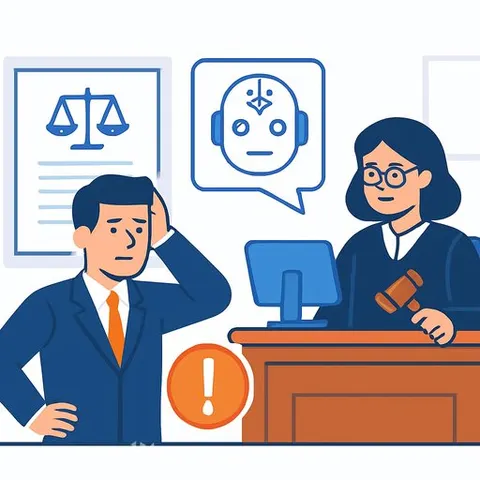
A New York appeals court has ordered monetary sanctions totaling $10,500 against attorney Michael Sanders and his law firm after Sanders filed a brief in a personal injury appeal that cited multiple nonexistent cases generated by an artificial intelligence tool. The decision underscores the professional risks of relying on AI-generated legal research without verification.
The Appellate Division, Second Department, ordered Sanders to pay $8,000 and his law firm, Law Offices of Michael S. Lamonsoff PLLC, to pay $2,500 to the Lawyers' Fund for Client Protection of the State of New York. Presiding Justice Hector D. LaSalle wrote that the brief contained "citations to nonexistent cases, fictitious purported Court of Appeals quotations wholly contrary to actual law, and misrepresentations about what certain real cases actually held or decided."
Sanders represented a plaintiff who sued a private property owner and the city of New York after a trip-and-fall accident. In December 2024, a trial court granted summary judgment dismissing the complaint. Sanders appealed, but in early June the Second Department affirmed the dismissal and uncovered the fabricated citations.
Fictitious citations surface during oral argument
At a May 20 oral argument before a Second Department panel, judges raised concerns about fictitious and erroneous citations in the plaintiff's brief. When asked about the cases, Sanders told the court he was not prepared to discuss them and declined an offer for a 15-minute recess to review the material. The panel then instructed all parties to submit arguments on potential sanctions.
Attorney takes responsibility but leaves gaps
In his response, Sanders submitted an affirmation taking "full responsibility for the deficiencies identified by the Court." But he did not identify or acknowledge the brief's misstatements of law or misrepresentations about real cases. He said he used both traditional legal research resources and AI-assisted tools, though he could not recall which specific AI tool produced the fake citations.
Sanders told the court he believed the non-existent citations originated during the AI-assisted portion of his research, which he "negligently failed to verify." He acknowledged violating his law firm's policy requiring personal review and confirmation of all AI-generated output. He also admitted that during oral argument he should have told the panel the fabricated cases were "hallucinated by artificial intelligence."
Law firm warns of immediate discipline
The law firm submitted an affirmation from general counsel Stacey Haskel, who noted Sanders had an unblemished record since joining the firm in 2024. Haskel said the firm "has made it unequivocally clear that any future deviation from these standards will be met with immediate disciplinary action." The court declined to award costs to the defendants, as neither party requested them.
Why this matters for legal professionals
This case serves as a direct warning to lawyers using AI tools for legal research. The sanctions are not for the AI errors themselves, but for the attorney's failure to verify the output before filing. Professional competence standards require lawyers to confirm the accuracy of every citation and legal proposition they present to a court. Failure to do so can lead to monetary sanctions, reputational damage, and possible referral to attorney disciplinary authorities. Legal professionals who incorporate AI into their workflow should establish mandatory verification checkpoints and ensure they receive proper training on both the capabilities and limitations of these tools.
To avoid similar mistakes, legal professionals can seek out targeted AI for Legal training on using AI tools responsibly in legal research and document drafting.