
AI news ·
Nvidia and Hoppr build AI foundry to simplify deployment of medical imaging models
Getting AI into hospitals, not building better models, is the real barrier holding back healthcare AI. Hoppr and Nvidia have partnered on an AI foundry that lets providers fine-tune imaging models on hundreds of records instead of 100,000.
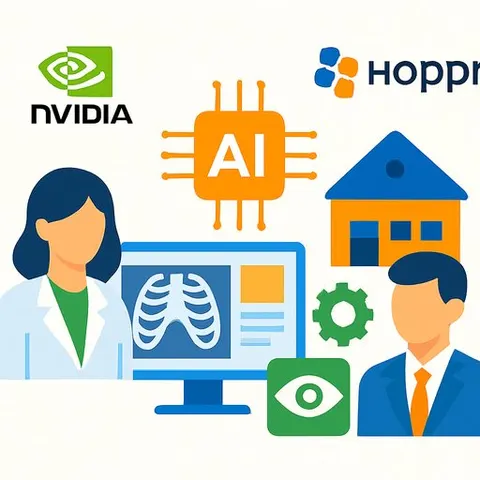
Deployment, Not Models, Is the Real Bottleneck for Healthcare AI
Healthcare AI leaders at Nvidia and Hoppr say the industry has been focused on the wrong problem. Building better models matters less than solving how to actually use them in hospitals.
The two companies are shifting strategy accordingly. Hoppr has built an AI foundry that combines Nvidia's computing power and foundation models to help healthcare providers develop and deploy custom imaging AI without starting from scratch.
Hospitals have historically needed massive datasets-around 100,000 patient records-to train AI models. Pre-trained foundation models change that equation. Providers can now fine-tune models using datasets containing just hundreds of records, said Hoppr CEO Khan Siddiqui.
"We're providing the platform where health systems, radiology practices and med device companies can now build their fine-tuned models very quickly and deploy them very quickly in their practice or in their product," Siddiqui said.
The foundry lets providers embed specialized tools directly into radiology workflows instead of relying on generic, one-size-fits-all solutions. That localized approach makes custom AI development feasible for organizations that lack the resources to build models independently.
From Point Solutions to Software Ecosystems
David Niewolny, global head of business development at Nvidia, described the foundry as solving healthcare AI's "last mile" problem-the gap between having powerful tools and actually running them in clinical settings.
"Nvidia is providing the tools and the raw performance. Hoppr is taking that, and through the use of open models and the fine-tuning that they're doing, turns it into a much more turnkey clinical-grade AI that is designed to be run inside of hospitals," Niewolny said.
The partnership reflects a broader shift in how healthcare organizations approach AI. Instead of buying finished applications, providers are increasingly building and iterating on models internally-more like a software development operation than a collection of isolated tools.
Whether this approach actually increases clinical adoption or simply adds complexity remains unclear. The answer will likely determine how quickly imaging AI moves from pilot projects to routine practice.
For more on AI for Healthcare and how foundation models enable deployment at scale, see our coverage of AI infrastructure and clinical applications.