
AI news ·
Nvidia CEO Jensen Huang says AI creates jobs, not mass unemployment
Nvidia CEO Jensen Huang told the Milken Institute conference that AI will create jobs, not kill them, pointing to factory and engineering roles in AI hardware production. Critics counter that up to 15% of U.S. jobs could still vanish.
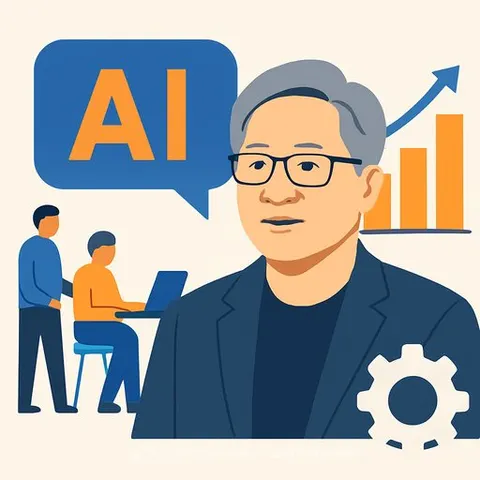
Nvidia CEO Dismisses Mass Unemployment Concerns, Points to Factory Jobs Instead
Jensen Huang, Nvidia's CEO, said AI will create jobs rather than eliminate them, contradicting widespread concerns about workforce displacement. Speaking at the Milken Institute's Global Conference on May 4, 2026, Huang argued that the technology drives job growth and opens opportunities for large-scale re-industrialization.
Huang's main argument centers on AI infrastructure. He said building what he called "new generation factories" for AI hardware will require substantial human resources-engineers, technicians, and factory workers-across the supply chain.
On the displacement question, Huang said the concern misses a key point: automation typically replaces specific tasks within a job, not entire positions. He argued that most roles involve multiple functions, and AI handles only some of them.
He also cautioned against exaggerating negative scenarios. "The most worrying thing is that we are making people afraid of AI to the point of not daring to use it," Huang said.
The Counterargument
Not all forecasters agree. Some financial and academic organizations warn that AI could disrupt labor markets significantly. One projection estimates roughly 15% of U.S. jobs may disappear in the coming years due to automation and AI.
The reality is more complex. Both trends-job creation and job replacement-appear to be happening simultaneously. AI is generating new roles in data, software, and systems operations while making existing positions obsolete in other sectors.
What HR Professionals Should Watch
For human resources leaders, the outcome depends on organizational strategy and workforce planning. How companies retrain workers and adapt to changing skill requirements will determine whether AI becomes an opportunity or a liability.
Experts say the long-term economic impact remains uncertain. The decisive factors will be how countries and businesses deploy the technology and whether they invest in labor force development.
HR professionals navigating this transition should consider exploring AI for Human Resources resources to understand how the technology affects recruitment, talent management, and workforce planning. Leadership-level perspectives are available through the AI Learning Path for CHROs, which addresses strategic workforce analytics and organizational transformation.