
AI news ·
Nvidia releases open AI models to improve quantum computer calibration and error correction
NVIDIA released Ising, a family of open source AI models for quantum processor calibration and error correction. The models are up to 2.5x faster and 3x more accurate than current standards, with over a dozen institutions already testing them.
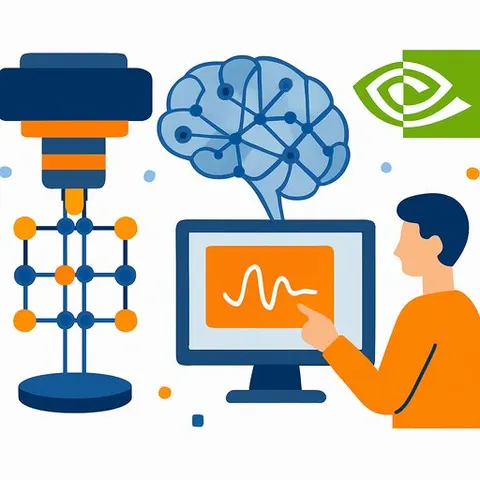
NVIDIA Releases Open AI Models for Quantum Computing Calibration and Error Correction
NVIDIA announced Ising, a family of open source AI models designed to address two critical obstacles in quantum computing: processor calibration and error correction. The models deliver up to 2.5 times faster performance and 3 times higher accuracy than existing industry standards, according to the company.
Quantum computers remain fragile and difficult to control at scale. Error correction and calibration consume significant time and resources, slowing the path toward practical applications. NVIDIA positions AI as the solution-what CEO Jensen Huang called "the control plane" or operating system of quantum machines.
Two Models Address Different Needs
Ising Calibration uses a vision language model to interpret measurements from quantum processors and automate continuous tuning. The model reduces calibration time from days to hours, according to NVIDIA.
Ising Decoding offers two variants of a 3D convolutional neural network-one optimized for speed, one for accuracy-to decode quantum error correction in real time. Both outperform pyMatching, the current open source industry standard.
Adoption Across Research Institutions
More than a dozen organizations are already deploying Ising, including Harvard's School of Engineering and Applied Sciences, Fermi National Accelerator Laboratory, Lawrence Berkeley National Laboratory, and the U.K. National Physical Laboratory.
Atom Computing, Infleqtion, IQM Quantum Computers, and Cornell University are among the adopters. Academic labs at UC San Diego, UC Santa Barbara, University of Chicago, and the University of Southern California are testing the models.
Integration With Existing Tools
NVIDIA packages Ising with training data, workflow templates, and NIM microservices that let developers fine-tune models for specific hardware without extensive setup. The models run locally on researchers' systems, protecting proprietary data from external servers.
Ising integrates with NVIDIA's CUDA-Q software platform for hybrid quantum-classical computing and the NVQLink hardware interconnect for real-time control.
Market Context
The quantum computing market is projected to exceed $11 billion by 2030, according to analyst firm Resonance. Progress depends on solving engineering challenges that have stalled the field for years. Open models allow researchers to maintain control over their data while accessing state-of-the-art AI capabilities.
The models are available on GitHub, Hugging Face, and NVIDIA's build portal. Learn more about Generative AI and LLM applications, or explore AI Research for quantum and physics-focused development.