
AI news ·
Oak Ridge experts debate AI regulation, education and energy use at ORAU panel
Oak Ridge experts said teachers must stay ahead of AI tools or risk students outsourcing their thinking entirely. The Feb. 10 panel urged teacher training and having students cross-check AI outputs against multiple sources.
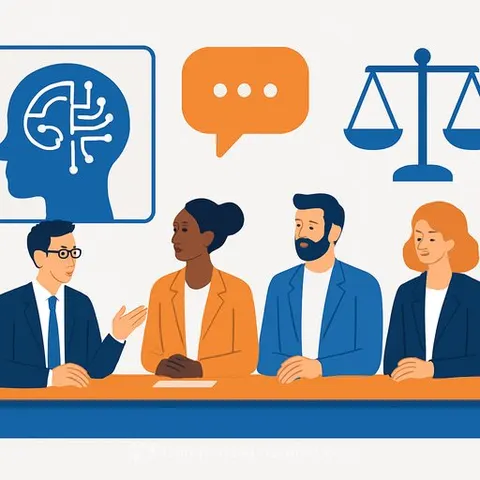
Oak Ridge Panel Examines How Teachers Should Handle AI in Classrooms
Four experts at Oak Ridge National Laboratory tackled a practical question for educators this month: how do you teach students to think critically when AI can write essays, code, and reports in seconds?
The panel, held Feb. 10 at Oak Ridge Associated Universities, included Stephen Streiffer, director of Oak Ridge National Laboratory; Lynne Parker, former principal deputy director of the White House Office of Science and Technology Policy; William Lyons, professor emeritus at the University of Tennessee; and Ashley Stowe, chief research officer at Oak Ridge Associated Universities.
The Education Problem
Lyons framed the core tension. Businesses want employees to work faster and more efficiently - ChatGPT helps with that. But schools have a different mission: teaching students how to think and communicate.
"The challenge is to teach students how to use AI tools to aid them in critical thinking," Lyons said. When a student uses AI to draft an essay to meet a deadline, the learning stops.
Stowe proposed a classroom strategy. Teachers can use AI to identify which students have learning gaps and what those gaps are, then close them quickly so students don't fall behind.
Validating AI With AI
Stowe offered a practical approach to accuracy. Ask students to compare outputs from multiple AI models - ChatGPT and Google Gemini, for example - to test whether the information holds up across systems.
"Use AI to validate AI," he said.
He also recommended having students "reach out to humans to test the information you're getting." This combines AI tools with human judgment, the opposite of outsourcing thinking entirely.
Teacher Training Matters
Parker emphasized that teachers themselves need preparation. "We need to be proactive and intentional and create programs and resources that can train teachers to be AI literate," she said.
Teachers need examples of how AI works in actual classrooms - not just theory. This prepares them to guide students toward productive use rather than shortcuts.
Parker added: "Our children's futures depend on being able to use AI well."
The Humanities Question
Lyons raised a concern specific to humanities education. Many universities question the value of history, literature, and philosophy majors. Some instructors have responded by banning technology from classrooms entirely.
That's the wrong direction, Lyons argued. The humanities will be "reconfigured to teach students to understand how humans operate, how they deal with others and how to react to them in a sensitive way."
AI won't replace that work - it will amplify it. Students need soft skills, creativity, and judgment. Those remain fundamentally human.
What Teachers Should Know
Stowe described a classroom model using AI as a tutor. But tutors require trust. Students must verify what they're learning, compare sources, and think about whether the information makes sense.
This mirrors the AI Learning Path for Teachers, which emphasizes using AI as a tool within established teaching methods rather than a replacement for them.
The Socratic method - conversation between teacher and student - remains effective. AI can handle routine questions and free up class time for deeper discussion.
For more on practical applications, see our guide to AI for Education.