
AI news ·
Ohio schools adopt AI policies as educators weigh risks to student learning
Ohio public schools must adopt AI policies by July, as districts weigh how the technology affects student thinking. A 2025 MIT study found students who used ChatGPT to write essays showed lower cognitive activity than those working independently.
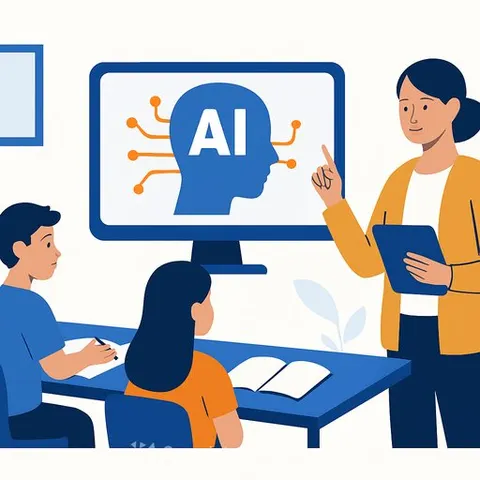
Ohio Schools Required to Set AI Policies as Districts Weigh Risks to Student Learning
All Ohio public school districts must adopt formal policies on classroom artificial intelligence use by July. The requirement comes as educators grapple with a fundamental tension: how to introduce AI tools without eroding the critical thinking skills that define actual learning.
The concern is concrete. A February Pew Research poll found that 57% of teenagers have used chatbots to search for information, and 54% used them for schoolwork. More troubling: 59% of teens believe cheating with AI happens regularly at their school.
An MIT study released in 2025 showed that students who used large language models like ChatGPT to write essays demonstrated lower cognitive activity than those using search engines or their own thinking. The LLM users "consistently underperformed at neural, linguistic, and behavioral levels," the study found, raising questions about long-term educational effects.
How Districts Are Responding
Columbus City Schools, South Western City Schools, and Olentangy Local Schools have all passed AI policies in recent months, largely following Ohio's state model policy. Their approaches reveal different strategies for managing the technology.
Olentangy Schools uses NotebookLM, a closed-loop system built on Google Gemini that pulls only from curriculum materials like class presentations and readings. Brent Rohrer, the district's instructional technology supervisor, called it a "walled garden" that prevents AI from generating false information and gives teachers granular control over how the tool functions.
The district has blocked access to ChatGPT and similar open services. "We've been slow and intentional about what we're choosing to even promote to our teachers," said Mindy Shultz, Olentangy's director of curriculum and innovative learning.
Allison Volz, a librarian at Briggs High School who helped craft Columbus City Schools' AI policy, said students often don't recognize the harm in outsourcing their thinking. "They don't see the connection that it's harmful to not do your own thinking," she said.
Where Teachers See Value
Not all classroom AI use carries the same risk. Jay DiMasso, an instructor at the South Western Career Academy, uses AI in his interactive media and design class to automate routine tasks-editing photo batches, adding captions to videos-that once consumed hours or days.
DiMasso also generates paper-and-pencil assignments using AI. But he maintains a clear boundary: students must still demonstrate they've learned the fundamentals. "If we're using AI to shortcut everything, it's maybe just not the most effective way to learn," he said.
Detra Price, an OSU professor of teaching and learning, said English and language arts teachers face the steepest challenge in assessing student work without AI doing the heavy lifting. Her advice to districts: ask students directly how they're using AI. "Get some clarity about what's actually happening in your school and in your classroom," Price said.
Volz emphasized that students need to understand AI's limits and learn to evaluate information critically. "They need to have the information literacy to be a productive member of society, because you have to be able to question and know whether things are factually true," she said.
For educators implementing these policies, the question isn't whether to use AI-it's how to use it without replacing the cognitive work that defines learning. AI for Education resources and AI Learning Path for Teachers can help educators navigate these decisions.