
AI news ·
Elementary teacher uses therapy dogs to teach artificial intelligence to young students
Samantha Westerlind taught 1,300 K-5 students AI fundamentals using a therapy dog project where fourth graders built a model to distinguish gentle from rough petting with 92% accuracy.
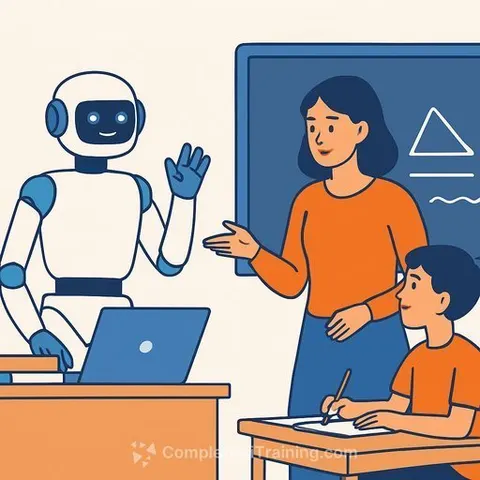
Samantha Westerlind, an elementary technology teacher in Cherokee County, Georgia, taught 1,300 K-5 students the fundamentals of artificial intelligence this year using a curriculum built around hands-on projects and ethical thinking. Her work, which earned a Discovery Education Award, shows that children as young as five can understand how AI learns when lessons connect to real-world experiences like training a therapy dog.
How a therapy dog taught AI literacy
The idea came from Westerlind's own dog, Zelda. While teaching the mutt to sit, she realized that repeating a command until the dog learns mirrors how an AI model processes consistent data. "We just kept giving her the same command, over and over again-sit, sit, sit," Westerlind said. "And suddenly I realized that training a dog is exactly the same as training an AI."
She applied this insight at school, where therapy dogs visited but kindergarteners often handled them too roughly. Westerlind had fourth graders use micro:bit circuit boards with accelerometers to build an AI model that could distinguish gentle petting from rough handling. Students collected movement data and trained the model themselves, aiming for a 92% accuracy rate. The devices displayed a happy or unhappy face based on the petting detected.
When kindergarteners wore the micro:bits on their wrists and interacted with the dogs, the real-time feedback prompted immediate behavior changes. "The kindergarteners self-regulated because the AI gave them real-time, objective feedback," Westerlind said. "This session allowed both grade levels to master complex concepts. The 4th graders learned about data sets and model accuracy, while the kindergarteners learned that AI 'knows' things because we provide it with information over and over again."
Why early AI education matters
Westerlind argues that elementary students are far more capable of understanding AI than most adults assume. "It's so important for the younger grade levels, kindergarten through 5th grade, to have that foundation and understanding," she said. Yet most district policies and curriculum frameworks delay AI instruction until 6th grade, a gatekeeping she calls a mistake. Educators seeking to close this gap can turn to programs like AI for Primary School Teachers, which offer strategies for introducing AI concepts to young learners.
Part of the urgency comes from the fact that children are already interacting with AI chatbots, often without recognizing the risks. "Because AI is so cool, they let their guard down and started giving these AI bots their private information," Westerlind said. Existing digital citizenship lessons haven't caught up to the conversational nature of AI, leaving young students vulnerable.
Building empathy into AI literacy
The therapy dog project succeeded because students cared about the outcome. Westerlind believes AI education should start with empathy and ethics, not just functionality. "It moved the technology out of the abstract and into a hands-on experience that improved both digital literacy and student empathy," she said. The growing emphasis on ethical AI use is reflected in resources like AI for Education, which provides training for educators on responsible AI integration.
She also points to a contradiction in many schools: teachers use AI tools while telling students not to. Students notice the double standard, and it can breed resentment or workarounds. Instead of leading with a chatbot prompt, Westerlind insists that curiosity should come first. "It shouldn't be 'I inputted a prompt and look, I got something from it.' It should be, especially for the younger grades, the foundation and understanding knowledge that AI can be so much more."
Why this matters for educators
Westerlind's experience shows that starting AI education early, with physical projects and ethical framing, produces students who are both informed and cautious. For teachers, the takeaway is to move beyond tool-first lessons and build a foundation of how AI learns, using real-world analogies that resonate with young children. Schools can also host parent information sessions to address fears and build a shared understanding of AI's role in the classroom.