
AI news ·
Police use of artificial intelligence outpaces regulation
Police use AI to write reports and analyze evidence, raising concerns over surveillance and bias. At least 30 U.S. cities have canceled AI camera contracts since early 2025.
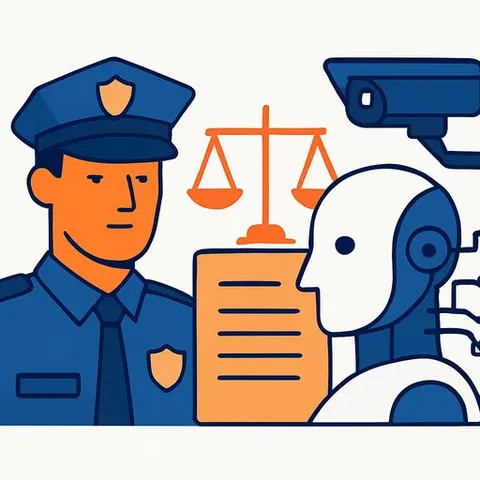
Police departments across the United States are deploying artificial intelligence to write reports, analyze evidence, and manage growing troves of digital data from body cameras, surveillance footage, and case files. As AI use expands rapidly, civil liberties advocates and legal scholars warn that the technology may deepen surveillance, introduce hidden bias into investigations, and complicate the defense's ability to challenge evidence in court.
AI expands from passive search to active investigation
Law enforcement agencies have used data-driven tools such as facial recognition and automated license plate readers for decades. Today's AI platforms, however, do more than flag objects in video. They can scan hours of protest footage in minutes, identify faces across networks of traffic cameras, and generate investigative leads by cross-referencing disparate databases. "AI is going to basically be able to sort through otherwise overwhelming amounts of data in ways that we just haven't seen yet, and give police and prosecutors and the government a lot more power over us," said Andrew Guthrie Ferguson, a law professor at George Washington University and author of "Your Data Will Be Used Against You."
Companies including Axon, Motorola Solutions, Mark43, and Clearview AI offer tools that search body-worn camera footage, summarize case files, and draft reports using audio transcriptions. Mark43's AI-powered ReportAI, for instance, creates narrative reports from dispatch records and camera video, while BriefAI condenses information for investigators. "Our core mission is to help responders spend less time on administrative work, so that they can spend more time serving in their communities," said Wendy Gilbert, Mark43's senior vice president of product. Yet critics note that such efficiency can blur the line between assistance and decision-making.
Regulatory frameworks are still catching up
No national standard governs AI use in policing. California and Utah recently passed laws requiring disclosure when generative AI contributes to police reports and mandating accuracy reviews. More than a dozen other states have enacted rules on facial recognition, drone surveillance, and automated license plate readers, according to the National Conference of State Legislatures. But many agencies operate without clear requirements. Cris Moore, a computer scientist at the Santa Fe Institute, said the pace of technological change is outstripping the legal system's ability to absorb it: "It's fair to say that the speed at which technologically created evidence has been adopted, and the aggression with which it's being pushed makes it hard for the legal community to keep up."
As lawmakers work to define boundaries, the AI for Government landscape underscores the unevenness of current policy. Some police departments adopt internal guidelines, while others rely on vendor assertions. The absence of uniform procurement standards and independent auditing leaves room for error and abuse.
Misuse, bias, and the risk of "agentic policing"
Reports of officers misusing AI-powered license plate readers have surfaced in multiple states. In April, a former Costa Mesa, California, police officer pleaded guilty to using Flock Safety cameras and law enforcement databases to track his wife, a mistress, and romantic rivals. At least 30 U.S. cities have ended or canceled contracts for such systems since early 2025, according to NPR. Flock Safety said in a blog post that permanent audit logs help detect improper access and that misuse is rare.
Beyond intentional misuse, scholars worry about a future in which AI takes on an agentic policing role-automatically linking data sources to propose suspects or connections between cases. Ferguson described a scenario where "all that data is going to be dumped into an AI model, and they're going to query it to say who's the most likely suspect." He added, "We've never started with an answer and made people work backwards. There are very real constitutional, statutory and practical risks with this new model of agentic policing." Such a process could make it difficult for defense counsel to reconstruct how a suspect was identified, undermining the right to confront the evidence.
Rachel Levinson-Waldman, director of the liberty and national security program at the Brennan Center for Justice, said the surveillance potential is especially troubling: "It's especially concerning sort of the ways that these tools could supercharge that kind of surveillance and enforcement."
Safeguards and calls for oversight
Industry and policy experts generally recommend that police agencies require clear disclosure when AI generates report content, mandate human verification of all AI-produced text, and conduct regular independent audits. Those practices align with a framework released by the Council on Criminal Justice, which calls for enforceable procurement standards and ongoing performance monitoring. "The pace of change is really pretty dramatic, and there's a lot of energy and churn and attention to these issues," said Jesse Rothman, director of the council's task force on artificial intelligence. "The opportunities and the risks are really serious."
Why this matters for legal professionals
For defense attorneys, prosecutors, and judges, the surge of AI-generated police work creates immediate pressure to understand how these tools operate and where they can fail. Machine-written narratives and algorithmic suspect leads must be scrutinized under the same rules of evidence that govern traditional methods-yet the underlying models often remain opaque. Legal practitioners will need to craft discovery requests that surface AI logs, training data, and validation studies. They must also stay abreast of evolving state laws and judicial rulings that set admissibility thresholds. As agencies adopt more autonomous tools, the ability to challenge AI-sourced evidence may become a defining skill in criminal litigation. Resources that track the intersection of technology and law, such as AI for Legal, can help professionals stay informed about these rapid changes.